


Impacts of training service quality on student satisfaction and Word-of-mouth in online English training
- Ho Chi Minh City University of economics & Finance
- Vietnam Aviation Academy
Abstract
This article aims at investigate components that comprise training services quality and the impacts of training service quality on student satisfaction and word-of-mouth in online English training. The combined quantitative and qualitative research methods were applied. Data were surveyed from 502 students studying online English programs, mainly at Universities in Ho Chi Minh city. Analytical methods such as cronbach's alpha, exploratory factor analysis (EFA), Confirmatory Factor Analysis (CFA), and Structural Equation Modeling (SEM) were used to test the quality relationship of online English training services to student satisfaction and student word of mouth. The SPSS and AMOS programs are also used for data analysis. The findings show that the quality of service provided by online English training has a direct influence on student satisfaction. The service quality of online English teaching has an immediate and indirect influence on student word-of-mouth. Student satisfaction has a direct influence on student word of mouth. Moreover, the research points out that service quality of online English training consists of six components: (1) responsiveness; (2) reliability; (3) empathy; (4) assurance; (5) privacy and (6) website design. Based on these findings, some administrative implications for educational administrators are proposed in order to improve the quality of training services toward learner satisfaction, so that they will have positive oral communication from learners, which is the most effective and reliable channel for communication and promotion.
Introduction
With the increased demand for learning English, people's lives are becoming increasing hectic, necessitating a more acceptable and convenient type of English instruction. As a result, the form of online English training was formed and continues to grow. This type of online learning fits the criterion of saving time and money while also allowing students to access knowledge at any time and from any location.
English training institutions provide numerous modes of learning ideal for students in order to address the increasingly demanding demands of individuals to learn English. At the same time, rivalry amongst training institutions appears to interest students. Training institutes are always launching marketing campaigns to retain current students and recruit new students. Website datareporta.com shows that the number of Vietnamese internet users is 68,7 millions at August 2020, and internet-linked smartphones is 145,8 millions, equals to 150% Vietnamese population, so that the development of the online English training is crucial. Learning English via online in general is a learning that is done electronically by using electronic-based media, computers and a network. Online learning is also known as electronic learning, e-learning, online learning, internet enabled learning, virtual learning, or web-based learning. So does develop the concern to online training service quality, the relationship of online training service quality and students satisfaction. When the students are satisfied to online training service quality, positive word-of-mouth is happened, then English training institutions needs to know how use it.
In terms of marketing, word-of-mouth (WOM) is a low-cost and high-efficient method1. Once students are happy with the service quality, they will spread positive word-of-mouth about it. As a result, recognizing the link between the quality of online training services and word-of-mouth is critical in assisting training institutions in attracting more students through proper growth strategies.
The purpose of this research is to (1) identify the components that contribute to the quality of online English training services; (2) consider the potential impact of online training service quality on student satisfaction and word-of-mouth; and (3) suggest implications to improve the quality of online English training in order to enhance student satisfaction and promote word-of-mouth.
Theoretical structure and Research model
Basic concepts
Word-of-mouth
Word-of-mouth (WOM) is defined as the oral, direct, person-to-person communication, on the one hand, between the recipient of information, on the other hand, a non-commercial information provider related to personal evaluation of goods, services and brands2.
Kirby & Marsden3 defined “word-of-mouth is person-to-person communication, between recipients and transmitters of information related to a service, brand or other information in the market” or “conversation between two or more people regarding products and services independent of any business”.
The most important thing about word-of-mouth is that it allows consumers to exert communicative influence and is the standard in evaluating service quality. Previous studies have shown that word-of-mouth has a significant influence on customers regarding purchasing decisions Özdemir et al. 1, word-of-mouth has an influence behavior rather than other sources of control. When people talk to each other about a product, service or information in the market, they can also share their own experiences with the community and that influence the buying process of other people. The customer experiences are understood as unique and memorable and these messages are often spread through word-of-mouth.
Student satisfaction
Student satisfaction can be understood in many different ways. Browne et al.4 showed that in university, student satisfaction depends on the quality of the course, teaching activities and other factors related to the school activities. Teachers need to be sympathetic, treat students gently and be ready to help when students need or they simply listen to students wishes. Grossman5 argues that students should be treated like customers in the school and that schools should prioritize meeting the expectations and needs of students.
According to DeShield et al.6, most education centers consider higher education to be a service industry, so they pay more attention to meeting the expectations and needs of customers and customers are also their students.
Student satisfaction can be defined as the perception of students regarding the university experience and the educational value received while studying at a training institution7. Student satisfaction according to Chute et al.8 is an important psychological factor contributing to students’ academic success. Satisfaction is also a reliable predictor of students’ ability to retain knowledge. It can be said that student satisfaction can be expressed in many ways, the perception of the quality of the online information system, the quality of the teaching staff and the quality of training management services. The final chemistry survey conducted on each student is the basis for providing managers with valuable information on the level of student satisfaction, thereby suggesting measures to improve the quality of the students’ course or program of study8.
Online training
Online training is a type of remote education in which learning programs are delivered using computers and the internet. According to Ding & Wang9, online training is the process of leveraging information technology and networks to deliver educational and training services. Students may access e-learning materials, receive remote professional help from the instructor, and take advantage of training services throughout the learning process by using the media.
Ngai et al.10 discussed that an online education system is "a learning technology system that employs a web browser as a major method of engaging with students, as well as the Internet and an intranet as primary means of communication inside one's own system and with other systems." These systems serve as the principal platform for teaching and learning."
According to modern point of view of Atkins11, online training is the delivery of learning content using modern electronic tools such as computers, satellite networks, Internet, Intranet, in which learning content can be can be obtained from websites, CDs, video tapes, audio through a computer or television; Teachers and students can communicate with each other via the network in the form of: electronic mail (e-mail), online discussion (chat), forum (forum), conference, video, ...
Learning English online is the use of information technology to teach English in order to achieve the convenience and efficiency mentioned above, and online English learning websites are websites that provide English language learning programs, teaching English language students according to their available level and goals.
Service quality in training
According to Kotler12, in marketing, service quality is viewed as an intangible metric or advantage that one party may deliver to another. According to Parasuraman et al.13, 14, service quality is defined as the difference between consumers' expectations of the service and their assessment of the results when utilizing the service.
Five factors of training service quality were suggested by Harvey & Green15, Giao16: Quality is excellent (or excellence); perfection (full, faultless output); suitability for purpose (matching student needs); appreciation for money (worth the investment); transition (moving from one state to another). Many quality assurance agencies in nations such as the United States, the United Kingdom, and Southeast Asia employ the phrase "training service quality is conformance with training objectives" as stated above.
Cheng & Tam17 argued that training service quality includes the inputs, processes and outputs of the education system to provide services that completely satisfy internal and external customers in order to meet the current and potential expectations of students.
According to Santos18, the quality of online services is defined by consumers' evaluations of the service delivery process in the online environment. Customers may compare service quality amongst suppliers more easily in the internet context than in the traditional service quality assessment. Customers who use internet services have greater service quality expectations than those who use traditional services.
Two major factors are used to evaluate the quality of online training services: service quality connected to educational knowledge and service quality related to electronic technologies19. Online training services differ from traditional training services. For conventional services, the process involves direct interaction between service providers and clients via a variety of human behaviors (attitudes, actions, smiles, glances, etc.). There is no such thing as direct touch with online service; everything is done through an electronic system. Online services are widely utilized in a variety of industries, most notably commodities trading, business, and banking, and it is now rapidly expanding in the field of online education.
Research model and hypothesis
Parasunaman et al.13 said that five gap theory of service quality, service quality is determined by the difference between customer expectations and actual experience with service providers. Yang & Jun20 introduced in their study the traditional service quality assessment factors in the online service environment and proposed a service measurement tool consisting of 7 components (reliability, accessibility, ease of use, privacy, security, reputation and responsiveness).
Udo et al.21, Samir & EL-Ansary22 showed that the quality of online training services is measured by the following factors: Assurance, empathy, responsiveness, reliability and website content and these factors have a positive impact on student satisfaction.
Previous research has also found that service quality has a favorable influence on customer satisfaction and word-of-mouth. According to Bitner & Zeithaml23, customer satisfaction is a broad notion that expresses a person's contentment with a service, whereas service quality focuses on particular aspects of the service. Cronin & Taylor24 proposed that service quality is the source of satisfaction, and that satisfaction is determined by the difference between customers' expectations of service quality before to purchase and their perceptions after using products and services. Aljumaa25 ardued that service quality has a beneficial impact on word-of-mouth. According to Leonnard & Thung 26, in their research, it was said that consumers using a service receive a service that matches their expectations, which creates word-of-mouth leading to service reuse. Rita et al.27 also shows that the overall quality of online services is clearly related to customer behavior including word-of-mouth.
In addition, some studies also show that satisfaction has a positive impact on word-of-mouth. Yoga & Gde28 uses SERVQUAL tool to measure service quality. Research has also shown that service quality has a positive impact on customer satisfaction and word-of-mouth; Customer satisfaction has a positive effect on word-of-mouth and also shows the mediating role of satisfaction in the relationship between service quality and customer word-of-mouth.
Most studies have shown that the main factor leading to students’ word-of-mouth is their satisfaction29, 30, 31, 32. For online English training, there will also be a positive relationship between student satisfaction and their word-of-mouth.
With the above analysis, the hypotheses are proposed and the research model is proposed as shown in Figure 1.
Hypothesis
Hypothesis H1: The quality of online English training services is a multi-directional concept that is positively measured by 6 components including: Responsiveness, reliability, empathy, assurance, privacy and website design.
Hypothesis H2: Online training service quality has a positive impact on student satisfaction in the online English learning environment.
Hypothesis H3: Online training service quality has a positive impact on studentsword-of-mouth in the online English learning environment.
Hypothesis H4: Student satisfaction has a positive impact on their word-of-mouth in the online English learning environment.

Suggested esearch model
Research Methods
Based on the scale of previous studies such as Trung33 Giao 29; Udo et al. 21; Dewi & Suprapti34; Uppal et al.35; Rita et al.27; Yoga & Gde28; Jun & Cai36; Han & Beak37; Keong30 and adjusted after qualitative research, the concepts in the research model are measured as follows: (1) Responsiveness (RES) - 4 observed variables; (2) Reliability (REL) - 3 observed variables; (3) Empathy (EMP) - 4 observed variables; (4) assurance (ASS) - 4 observed variables; (5) privacy (PRI) - 4 observable variables; (6) Website design (WEBD) - 4 observed variables; (7) satisfaction (SAT) - 4 observed variables; (8) word-of-mouth (WOM) - 5 observed variables.
The survey subjects of this study are students who have been and are studying online English programs, mainly in Ho Chi Minh City. Ho Chi Minh City is a good place for many colleges and universities, the online English training environment here is the most vibrant in the country, so the research here can be a representative study for the situation of online training in Vietnam. The convenience sampling method is used. The survey was conducted by sending online questionnaires to students. Observed variables are measured on a 5 Likert scale (from 1 - strongly disagree to 5 - strongly agree). There were 661 questionnaires sent and 502 valid responses were collected. The reliability of the research concepts is checked by Cronbach’s alpha coefficient, the scales value is tested by exploratory factor analysis (EFA) and confirmatory factor analysis (CFA). Then test the research hypotheses by structural equation modeling (SEM).
Research results
Research sample
Convenient sampling method is used in this study. The survey was conducted by sending online questionnaires to the students who have been and are studying online English programs, concentrated mainly in Ho Chi Minh City. There were 661 questionnaires sent and 502 valid responses were collected to serve this study (Table 1).
Sample Description
|
Frequency |
Percentage (%) | ||
|
Gender |
Male |
223 |
44.4% |
|
Female |
279 |
55.6 | |
|
Age |
Under 25 |
450 |
89.6 |
|
25-35 |
52 |
10.4 | |
|
Year of study |
The first year |
106 |
21.1 |
|
The second year |
189 |
37.6 | |
|
The third year |
143 |
28.5 | |
|
The fourth year |
64 |
12.8 | |
|
Major |
Technology/Technique |
48 |
9.6 |
|
Educations |
108 |
21.5 | |
|
Social Studies |
63 |
12.5 | |
|
Economy |
189 |
37.6 | |
|
Other |
94 |
18.7 | |
|
Fees Payer |
You pay yourself |
152 |
30.3 |
|
You pay part of it yourself (< 50%) |
70 |
13.9 | |
|
Family/others pay |
280 |
55.8 | |
|
Online learning hours/week |
Less than 5 hours/week |
156 |
31.1 |
|
5-10 hours/week |
276 |
55.0 | |
|
11-20 hours/week |
70 |
13.9 |
Check the scale
The test of the scale on the principle that variables with variable correlation coefficients - sum less than 0.3 will be rejected, the scale must have Croncbach’s Alpha reliability of 0.6 or higher38. Table 2 shows all the scales that can be used in EFA exploratory factor analysis.
Result of Cronbach’s Alpha coefficient
|
No. |
Variable code |
Factor |
Correted Item -Total Correlation |
Cronbach’s Alpha if Item deleted |
Crobach’s Alpha |
|
1 |
RES1 |
Responsiveness |
.695 |
.778 |
.835 |
|
2 |
RES2 |
.627 |
.809 | ||
|
3 |
RES3 |
.675 |
.786 | ||
|
4 |
RES4 |
.669 |
.791 | ||
|
5 |
REL1 |
Reliability |
.737 |
.801 |
.860 |
|
6 |
REL2 |
.746 |
.792 | ||
|
7 |
REL3 |
.721 |
.816 | ||
|
8 |
EMP1 |
Empathy |
.695 |
.763 |
.828 |
|
9 |
EMP2 |
.665 |
.778 | ||
|
10 |
EMP3 |
.654 |
.783 | ||
|
11 |
EMP4 |
.604 |
.805 | ||
|
12 |
ASS1 |
Assurance |
.578 |
.822 |
.832 |
|
13 |
ASS2 |
.650 |
.791 | ||
|
14 |
ASS3 |
.696 |
.771 | ||
|
15 |
ASS4 |
.718 |
.761 | ||
|
16 |
PRI1 |
Privacy |
.620 |
.758 |
.806 |
|
17 |
PRI2 |
.643 |
.747 | ||
|
18 |
PRI3 |
.627 |
.755 | ||
|
19 |
PRI4 |
.597 |
.769 | ||
|
20 |
WBD1 |
Website design |
.659 |
.766 |
.820 |
|
21 |
WBD2 |
.609 |
.789 | ||
|
22 |
WBD3 |
.662 |
.764 | ||
|
23 |
WBD4 |
.640 |
.775 | ||
|
24 |
SAT1 |
Satisfaction |
.629 |
.780 |
.821 |
|
25 |
SAT2 |
.662 |
.765 | ||
|
26 |
SAT3 |
.629 |
.781 | ||
|
27 |
SAT4 |
.651 |
.770 | ||
|
28 |
WOM1 |
Word-of-mouth |
.649 |
.816 |
.846 |
|
29 |
WOM2 |
.704 |
.802 | ||
|
30 |
WOM3 |
.704 |
.802 | ||
|
31 |
WOM4 |
.569 |
.838 | ||
|
32 |
WOM5 |
.652 |
.816 |
Exploratory factor analysis EFA
EFA results for online training service quality scale
The results of the EFA exploratory factor analysis were obtained as follows: KMO coefficient = .883 satisfying the condition in the range [0.5, 1.0], Barlett test with Sig. = .000 < .05. At the 6th factor, the Eigenvalue = 1,104 > 1.0 helps to ensure that 6 factors are extracted and the total variance extracted for 6 factors reaches 57.886 > 50%. Six significant factors include: Responsiveness formed from 4 observed variables, reliability formed from 3 observed variables, empathy formed from 4 observed variables, assurance formed from 4 observed variables, privacy formed from 4 observed variables, website design formed from 4 observed variables.
EFA results for satisfaction scale
The results of exploratory factor analysis EFA are obtained as follows: KMO coefficient = .706 satisfying the condition in the range [.5, 1.0], Barlett test has Sig. = .000 < .05. Eigenvalue = 2.602 > 1.0 and the total variance extracted of the factor reached 53.422 > 50%. A statistically significant factor is Satisfaction formed by 4 observed variables.
EFA results for word-of-mouth scale
The results of exploratory factor analysis of EFA are obtained as follows: KMO coefficient = .839, satisfying the condition in the range [.5, 1.0], Barlett test has Sig. = .000 < .05. Eigenvalue = 3.115 > 1.0 and the total variance extracted of the factor reached 53.186 > 50%. A statistically significant factor is the word-of-mouth formed by 5 observed variables.
Confirmatory factor analysis (CFA) results.

CFA (normalized) results of the scales online English training service quality
As mentioned above, three concepts (training service quality; satisfaction and word-of-mouth) are included in the research model (Figure 2). The scales of these concepts were initially refined by Cronbach’s alpha and exploratory factor analysis (EFA) by data collected during the research program (with n = 502). These scales continue Confirmatory factor analysis CFA.
The CFA testing process is carried out in two steps: first testing the CFA with the components of the online training service quality, then performing the CFA test for the critical model of the research model.
The results of the CFA test for the concept of online training service quality show that: CFA gives 212 degrees of freedom. The model has Chi-square = 559.571 (P = .000); Chi-square/df = 2.639 < 3; GFI = 0.912; TLI = .931; CFI = .943; RMSEA = .057 < .08. Therefore, confirming the scale model for online training service quality responds well to surveyed data.
Similarly, the results of CFA analysis for the critical model of the research model give 452 degrees of freedom. The model has Chi – square = 1105.679 (P = .000); Chi-square/df = 2.446 < 3; GFI = .875; TLI = .914; CFI = .921; RMSEA = .054 < .08. Therefore, the measurement model assertion responds well to surveyed data (Figure 3).

CFA (normalized) critical measurement model results
The results of testing the discriminant value between the variables in the online training service quality scale model and the critical model show that all the estimated correlation coefficients are associated with the standard error (SE) for p < .05, so the correlation coefficient of each pair of concepts is different from 1 at 95% confidence. Thus, the concepts gain distinctive value. The results of the combined reliability assessment and the total variance extracted based on the normalized regression weights of the observed variables in the measurement model are summarized in Table 3. This result shows that the combined reliability of the measurement scales for the concepts in the research model, varying from .801 to .861 and the total variance extracted of the scales varying from .508 to .672 are all greater than .5, this shows that the theoretical measurement model has the required reliability.
Summary of measurement model testing results
|
Number of observed variables |
Reliability |
Total Variance Explained |
Suitability | ||
|
Cronbach’s alpha |
Aggregate Reliability | ||||
|
Responsiveness |
4 |
.835 |
.816 |
.539 |
Suitable |
|
Reliability |
3 |
.860 |
.821 |
.672 |
Suitable |
|
Empathy |
4 |
.828 |
.860 |
.531 |
Suitable |
|
assurance |
4 |
.832 |
.818 |
.542 |
Suitable |
|
Privacy |
4 |
.806 |
.806 |
.510 |
Suitable |
|
Website design |
4 |
.820 |
.812 |
.535 |
Suitable |
|
Online training service quality |
- |
- |
.861 |
.510 |
Suitable |
|
Satisfaction |
4 |
.821 |
.849 |
.532 |
Suitable |
|
Word-of-mouth |
5 |
.846 |
.801 |
.508 |
Suitable |
Through the above CFA analysis results, it can be concluded that the measured concepts in the research model meet the requirements of reliability, convergence and discriminant.
The results of testing the theoretical model by Structural Equation Modeling (SEM)
Structural Equation Modeling (SEM) was used to test the theoretical model. The model can be said to fit the surveyed data with: Chi - square = 1105.679 (P = .000); degrees of freedom df = 452; Chi-square/df = 2.446 < 3; GFI = .875; TLI = .914; CFI = .921; RMSEA = .054 < .08 (Figure 4).
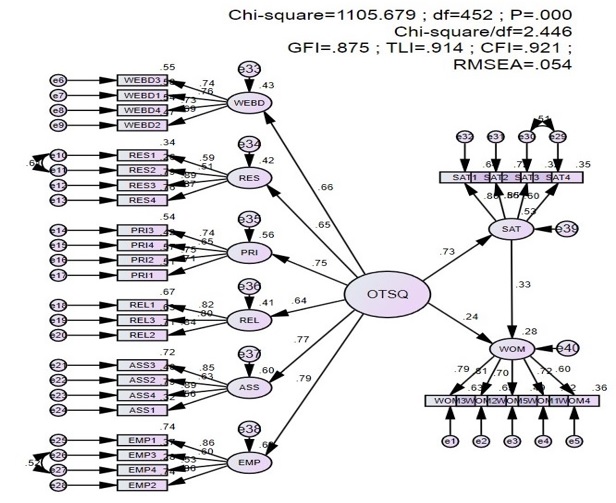
SEM results of theoretical (normalized) model
All the correlations hypothesized in the research model are proved by SEM model test. The estimated (unnormalized) results of the main parameters are presented in Table 4. This result shows that these cause-and-effect relationships are all statistically significant because all have p-values < 0.05. Through this result, it can be concluded that the measurement scales of the concepts in the model reach the theoretical relevance.
Unnormalized regression coefficient of the theoretical model
|
Correlations |
Estimated |
S.E |
C.R. |
P |
Hypothesis |
Conclusion | ||
|
SAT |
<--- |
OTSQ |
.844 |
.097 |
8.715 |
*** |
H2 |
Accepted |
|
WEBD |
<--- |
OTSQ |
1.000 |
H1 |
Accepted | |||
|
RES |
<--- |
OTSQ |
.801 |
.096 |
8.386 |
*** |
Accepted | |
|
PRI |
<--- |
OTSQ |
1.175 |
.121 |
9.688 |
*** |
Accepted | |
|
REL |
<--- |
OTSQ |
1.103 |
.117 |
9.401 |
*** |
Accepted | |
|
ASS |
<--- |
OTSQ |
1.480 |
.140 |
10.550 |
*** |
Accepted | |
|
EMP |
<--- |
OTSQ |
1.445 |
.135 |
10.676 |
*** |
Accepted | |
|
WOM |
<--- |
OTSQ |
.372 |
.131 |
2.841 |
.005 |
H3 |
Accepted |
|
WOM |
<--- |
SAT |
.447 |
.114 |
3.915 |
*** |
H4 |
Accepted |
The relationships in Table 4 show that the quality of online training services is assessed by 6 factors (WEBD, RES, PRI, REL, ASS, EMP); Online training service quality has a direct and positive impact on satisfaction; online training service quality has a direct and positive impact on word-of-mouth; satisfaction has a direct and positive effect on word-of-mouth. The above effects are consistent with the proposed research hypothesis and are statistically significant because all have p < .05.
Normalized Estimation Coefficients
|
Correlations |
Normalized regression coefficient | ||
|
SAT |
<--- |
OTSQ |
.728 |
|
WEBD |
<--- |
OTSQ |
.659 |
|
RES |
<--- |
OTSQ |
.651 |
|
PRI |
<--- |
OTSQ |
.749 |
|
REL |
<--- |
OTSQ |
.643 |
|
ASS |
<--- |
OTSQ |
.774 |
|
EMP |
<--- |
OTSQ |
.792 |
|
WOM |
<--- |
OTSQ |
.236 |
|
WOM |
<--- |
SAT |
.328 |
The estimated results of the regression coefficients in Table 5 show that: The quality of online training services is measured by 6 factors with the order of impact: EMP (β=.792) ; ASS (β=.774), PRI (β=.749), WEBD (β=.659), RES (β=.651), finally REL (β=.643). Online training service quality has a positive and direct impact on satisfaction (normalized coefficient is .728), which confirms to us the role of training service quality on customer satisfaction pupil. We also see that training service quality has a positive and direct impact on word-of-mouth (normalized coefficient is .236). This confirms the view that, when the quality of training services is good, it directly affects students’ word-of-mouth, word-of-mouth here is actively conveying good messages about the English training program online. Besides, satisfaction also has a positive and direct impact on word-of-mouth (normalized coefficient .328). This confirms the role of students’ satisfaction to word-of-mouth in the relationship between online English training service quality and satisfaction and word-of-mouth.
The test results also show that, in addition to the direct impact of online training service quality on word-of-mouth, there is also an indirect relationship through satisfaction (Table 6).
Direct and indirect effects of concepts in the research model
|
Mode of impact |
WOM |
SAT | |
|
OTSQ |
Direct |
.236 |
.728 |
|
Indirect |
.239 |
.000 | |
|
Total |
.475 |
.728 | |
|
SAT |
Direct |
.328 | |
|
Indirect |
.000 | ||
|
Total |
.328 |
With the analysis results in Table 6, we find that the quality of online English training services has an indirect impact on word-of-mouth through the medium of satisfaction (β=.239). With the above results, we see that the quality of online English training services plays a very important role in bringing satisfaction as well as word-of-mouth of students. Because of that, English training units that want to improve satisfaction and promote word-of-mouth among students need to take measures to further improve the quality of online English training services. With the above analysis results, we can see that the 4 initial hypotheses are accepted
Discussing research results
The quality of training services is generally identified as an important factor measuring the perceptions and expectations of students for each study program. The results of data analysis in this study have demonstrated that the quality of online English training services is a multi-directional concept that is measured by 6 components including: empathy (β=.792), assurance (β=.774), privacy (β=.749), website design (β=.659), responsiveness (β=.651), and finally reliability (β=.643).
This result supports the previous studies such as21, 27, 33, 34, 35, 28, 29, 30, 36, 37, 38. Both of these studies applied the E-SERVQUAL tool to assess the quality of online learning services and proved that the quality of online training services is measured by five factors: assurance, empathy, responsiveness, reliability and website content; Or as the study of Uppal et al. 35, with the e-learning service quality model made up of 3 measuring variables: service quality includes 5 independent variables: responsiveness, empathy, assurance, reliable and tangible; The information quality variable is the learning content and the system quality variable is the course website. These studies have also shown that the quality of the website is the factor that students care about the most. However, in this research, the factor most appreciated by students is empathy with the coefficient β=.792, this is considered a new finding on students’ assessment of the quality of online training services.
In this study, once again confirming the addition of privacy factors (β=.749) into measuring the quality of online training services is appropriate. A recent study by Rita et al. (27) with 4 factors of overall e-service quality included in the study: (1) Website design; (2) customer service; (3) security/privacy; (4) level of commitment. Research has proven that security is one of the factors that customers are very concerned about when participating in online shopping. In the study of Trung33, it has also been shown that the quality of the information technology system is one of the important factors in assessing the overall quality of training services, in which security is an important factor on issues that students care about and appreciate. In online training, students are also considered as real customers and have the same characteristics as customers in other internet-based businesses. Therefore, students are also affected by factors in the online environment. In particular, security is an issue that almost everyone is concerned about when participating in the online environment when the risk of leaking personal information and online payment information is increasingly happening.
In this study, the author has also proved that the quality of online training services has a positive and strong impact on student satisfaction with the coefficient β=.728. That means, in order to have student satisfaction with online learning, the quality of training services must be guaranteed and must meet the needs of students. This result is also consistent with the results of previous authors such as35, 21, 22.
Some previous studies on service quality in the traditional environment such as the study of Dewi & Suprati 34, Giao29, Yoga & Gde28, or service quality assessment in the online environment by Rita et al.27 has prove that There is a positive influence between satisfaction and word-of-mouth, not only that, satisfaction also plays an intermediary role in the relationship between service quality and word-of-mouth. Research results of the author once again confirmed that there is a positive relationship between satisfaction and word-of-mouth in the online learning environment with β=.328. Not only that, satisfaction also plays a mediating role in the relationship between online training service quality and word-of-mouth β=.239). It shows that when students are satisfied with the quality of online English training services, they will actively participate in the course and tend to spread positive information to more people. The results of this study also support the results of previous authors as mentioned above.
Conclusion and implications
Main results of the study
The research results show that the quality of online English training services is a multi-directional concept composed of 6 components: reliability, responsiveness, assurance, empathy, privacy and website design. In which, the factor rated the most by students is empathy (β=.792), the next most appreciated factor is assurance (β=.774) and security (β=.749), the remaining factors are evaluated in order from high to low, which is website design (β=.659), responsiveness (β=0.651), and finally the reliability (β=.643). This study also shows that the quality of online English training services has a direct and strong relationship with satisfaction (β=.728). Quality of online English training services has a direct impact on word-of-mouth (β=.236) as well as indirectly to word-of-mouth (β=.239) through the medium is satisfaction. Satisfaction has a positive effect on word-of-mouth with β=.328.
Contribution of research
Theoretically, the study adds theoretical values such as establishing the variables that comprise the quality of online English instruction services, in which the factor most appreciated by students is empathy, assurance and privacy. The study also shown that the quality of online English training services has a favorable impact on student satisfaction and word-of-mouth, as well as the function of satisfaction in mediating the relationship between service quality and students’ satisfaction Online English classes for word-of-mouth students.
In terms of practical application, the study's purpose is to assist organizations and administrators in determining which aspects of online training service quality are most important to students. and how the quality of online training services influences student happiness and word-of-mouth Because everything is limited, such as capacity, resources, financial resources, etc., the findings of this study will allow administrators to prioritize focusing on the factors that students are most interested in, have the greatest influence on students (empathy, assurance, confidentiality), and have appropriate plans, marketing strategies, and solutions to improve and enhance the quality of online English training services, thereby satisfying and improving students s needs. When students are happy, they tend to spread word-of-mouth, allowing positive information to reach more individuals.
From the standpoint of the readers: to assist readers in gaining new perspectives on the philosophy of online English training service quality, as well as student happiness and word-of-mouth, therefore supporting their learning, work, and study with greater quality.
Implications
Students are now seen as actual customers by educational institutions. The interaction between service providers at foreign language instruction units and student clients has caused this shift in perspective. Providing a high-quality service will lead to success for foreign language training firms, enhancing their worth at a time when competition in the foreign language training industry is strong. According to research, students' general satisfaction with the quality of online English instruction programs is now fairly good. The quality of online training services is a factor that influences student happiness. This demonstrates that modern online English training programs prioritize quality, target students, and create the most suitable and optimal settings for students. As a result, students who take online English classes are highly valued and happy. According to research, students' word-of-mouth in online English training is also quite active. It is clear that when students are pleased with the quality of online training services, they tend to communicate positive and helpful information to friends, family, and the student community.
The quality of online English training programs has also been demonstrated to have a direct and indirect impact on students' word-of-mouth, according to research. Given the wonderful effects of word-of-mouth, one meaningful implication is given here: instead of online English training schools/institutions spending large sums of money on advertising and marketing, they will get positive word-of-mouth from students by improving the quality of training, towards the satisfaction of students, and this is an effective and reliable communication and promotion channel.
The research results have also proved that the quality of online training services is assessed by 6 main factors which are reliability (REL), responsiveness (RES), assurance (AS), empathy (EMP), privacy (PRI) and website design (WEBD). The research results also suggest very meaningful management implications, specifically: According to the research results, the first factor highly appreciated by students is empathy (EMP). In the process of organizing customer service training, it must come from the customers love of service, so that the best service quality can be guaranteed. Teachers or service staff must be really sympathetic and dedicated to students, always caring for students throughout the learning process. Students who find empathy throughout their learning journey will be more motivated and determined to learn.
The second factor is assurance (ASS): In the process of studying, students always expect the training service provider to bring a team of lecturers who ensure their professional qualifications and teaching skills, and the curriculum is guaranteed the knowledge that students want. Because of that, English training organizations need to have the best teachers as well as the best learning programs to bring the best learning experiences to students.
The third factor is privacy (PRI), as we all know in today online environment, security is a top concern for customers participating in online services when the risk of leak personal information as well as payment information into the hands of some bad actors. Customer information leakage leads to disturbance and other risks. Because of that, in order to bring a peace of mind when experiencing online services, training organizations need to take measures to ensure the safety of users. The fact that users feel protected when participating online gives them peace of mind and increases their satisfaction.
The fourth factor is website design (WEBD), in an online learning environment, teachers and students interact with each other through the online information technology system, here it is through the website system of the training units. A website with an eye-catching interface, easy to use, and full of information will bring the best learning experience to students, bringing high efficiency as well as motivation in learning. Because of that, English training organizations should consider developing a user-friendly website system that can meet the needs from basic to advanced to provide the best learning experience for students.
The third aspect is reactivity (RES); learning requires maximal assistance from administrators, academic support personnel, and practice for students, particularly those who have worked. Students anticipate immediate and timely help from the academic support staff, accurate and timely notice of learning assignments for students, and an effective support system throughout the learning process; achieving those expectations will offer happiness as well as peace of mind while studying.
The last factor is reliability (REL) must be ensured, for foreign language training organizations, the brand is the first thing that creates the trust of students. However, with each learning program, it is also necessary to promptly adjust and fix problems quickly when there are problems, to avoid causing discomfort for students when participating in online learning. The program must commit to implementing what has been set out and committed to students, taking credit as the first. All of these contribute to student satisfaction.
This study also demonstrates that service quality has a direct link with satisfaction and has an indirect and direct influence on student word-of-mouth. According to research, when students are happy with the quality of online English training services, they are more likely to actively engage in the course and communicate good information to others. Students who are satisfied are willing to discuss and promote their experiences to friends and family. Students that receive effective training will have more positive comments about the program and will participate constructively to making it better and better. This will aid training units in developing better future orientations for their own units.
Limitations and directions for further research
The data collection procedure with a representative sample number is not high due to the restricted time to carry out the study and the convenient sampling technique, therefore slightly restricting the survey results. This study also exclusively includes students who primarily reside and study in Ho Chi Minh City, rather than surveying all online English students across the country.
If there is enough time, samples will be surveyed on a larger scale, such as the North, Central, and Western regions, or the entire country, to achieve accurate quantitative analysis results, bringing a more comprehensive and macro perspective to detect more new factors in measuring the quality of online training services affecting student satisfaction and word-of-mouth.
This survey also only includes students enrolled in Ho Chi Minh City colleges and universities who have participated in online English learning. The next research can concentrate on subjects participating in online learning in the corporate setting, business units offering online training for vocational certifications, and short-term certificates.
ABBREVIATIONS
AMOS: Analysis of Moment Structures
EFA: Exploratory Factor Analysis
KMO: Kaiser – Meyer - Olkin
CFA: Confirmatory Factor Analysis
SEM: Structural Equation Modeling
WOM: Word of Mouth
RES: Responsiveness
REL: Reliability
EMP: Empathy
ASS: Assurance
PRI: Privacy
WEBD: Website design
SAT: Satisfaction
OTSQ: Online training service quality
SE: Standard Error
CONFLICT OF INTEREST
The authors would like to reassure readers that there is no conflict of interest in the article's publication.
AUTHOR CONTRIBUTION
Author 1: Chi Huynh Vu, the author, is responsible for the following content: research design, theoretical synthesis, surveys and contacts with practitioners, data analysis and processing, and discussion of research findings.
Author 2: Giao Ha Nam Khanh is the author of the following content: Additional comments on the theoretical basis, discussion of research results, comments on the form of presentation.