


Multilevel multinomial logit model to study individual migration decision in Viet Nam
- National Economics University, Hanoi, Viet Nam
- University of Economics & Law, VNUHCM, Viet Nam
Abstract
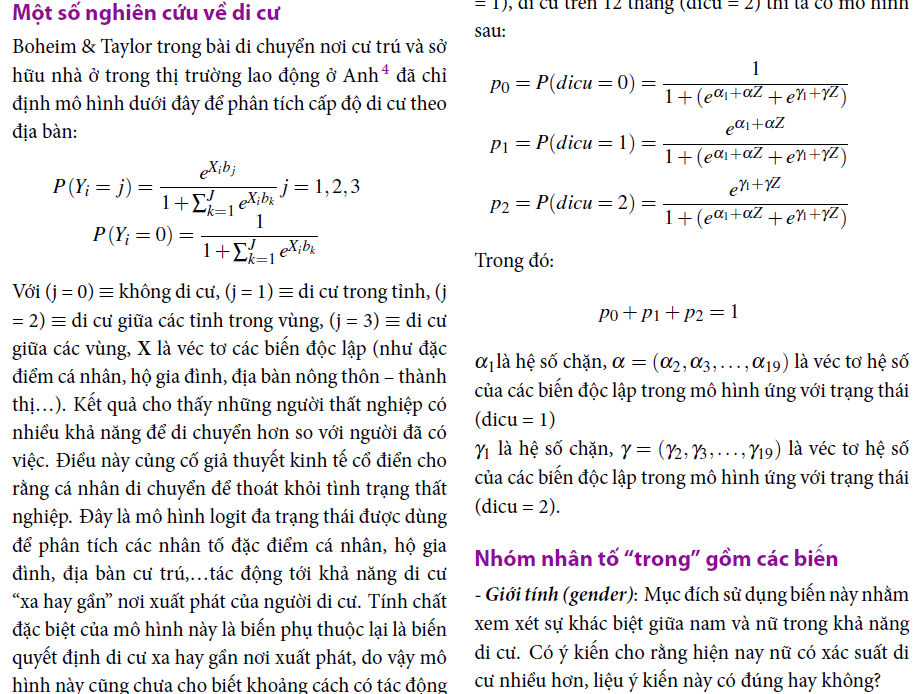
In this paper we study the impact of relevant factors, such as individual characteristics, wages, living areas, on individual migration decisions. We have been using data from Labor Force Survey 2014 from Genaral Statistics Office of Vietnam (LFS 2014). We are going to evaluate how these above factors affect the status of "short-term migration" and "long-term migration" compared to "nonmigration". The well-known model in this field is the multinomial logistic model. However, the multinomial logistic model does not control the latent factors that have different effects on migration decision. This would result that the estimated coefficients of the variables would no longer be reliable (biased estimates due to lack of important variables). Hence, we have selected a multilevel multinomial logistic model. The levels we choose to control latent factors are province and region levels. As the results, the potential factors of different provinces and regions show different impacts on migration decisions. To sum up, a multilevel multinomial logistic model gives more reliable estimates, so it is more suitable for migration analysis compared to conventional multinomial logistic model.