


The impact of green supply chain management practices on sustainable performance: the moderating role of traceability
- Faculty of International Economics, University of Economics and Law, Vietnam National University Ho Chi Minh City, Vietnam
Abstract
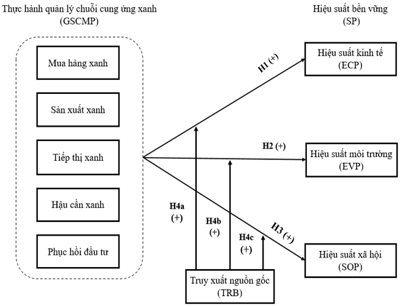
This study analyzes the impact of green supply chain management practices (GSCMP) on the sustainable performance (SP) of manufacturing and exporting enterprises in Vietnam (DNSXXK) across three dimensions: economic performance (ECP), environmental performance (EVP), and social performance (SOP), while simultaneously exploring the moderating role of traceability (TRB) in these relationships. Specifically, the research examines whether TRB amplifies or diminishes the strength of the effect of GSCMP on each type of performance, thereby providing a more comprehensive understanding of how manufacturing and exporting enterprises in Vietnam can leverage traceability as a supporting tool to optimize economic benefits, mitigate environmental impacts, and enhance social responsibility in the context where sustainable development is increasingly becoming a prevailing trend. The study employs survey data collected from 319 randomly selected manufacturing and exporting enterprises, with the partial least squares structural equation modeling (PLS-SEM) approach used for data analysis and hypothesis testing. The empirical results reveal that GSCMP significantly influence sustainable performance across all three dimensions. This finding underscores the critical role of green supply chain management practices in enhancing the overall operational effectiveness of enterprises, not only in terms of economic gains but also in relation to environmental and social responsibilities. However, the results also indicate that traceability does not play a positive moderating role between GSCMP and SP, primarily due to barriers associated with workforce capacity, technological infrastructure, and financial resources, which limit the effective implementation of traceability in enterprises. Based on these findings, the study proposes several important policy implications, emphasizing the promotion of GSCMP as a strategic tool to enhance sustainable performance, alongside investments in and the development of traceability capabilities to ensure supply chain transparency and sustainability. These measures are intended to minimize pollution and strengthen social obligations in the global trade environment, thereby improving competitiveness and integration capacity in the international marketplace.