


Does external debt reduce climate risk? Evidence from a global perspective
- University of Economics and Business, Vietnam National University, Hanoi, Vietnam
Abstract
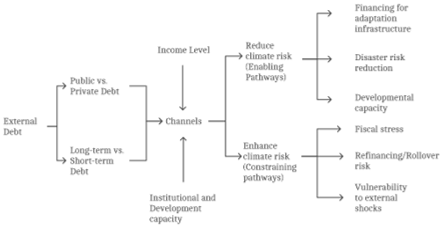
Climate change poses growing threats to economic stability, social welfare, and long-term development, particularly in countries with high exposure to climate-related risks and limited fiscal and institutional capacity. At the same time, climate adaptation remains underfinanced, especially in low- and middle-income economies that struggle to mobilize sufficient domestic resources. This study examines whether external debt can function as an effective instrument for reducing climate vulnerability by supporting climate adaptation and resilience-infrastructure investments. Using a panel dataset of 174 countries spanning the period from 2004 to 2022, the analysis investigates the relationship between external debt and climate risk, measured by the Climate Risk Index (CRI), which captures countries’ exposure and sensitivity to extreme weather events. The empirical strategy employs a fixed-effects panel regression framework based on the STIRPAT model to control for country-specific heterogeneity as well as key socioeconomic and environmental factors. The results indicate that higher levels of external debt are significantly associated with lower climate risk, suggesting that external borrowing, when appropriately managed, can enhance adaptive capacity and reduce vulnerability to climate shocks. Decomposition analyses further show that long-term external debt and public external debt are particularly effective in lowering climate risk, as these forms of borrowing are better aligned with the long-term nature of climate adaptation investments and public resilience infrastructure, while also reducing refinancing pressures. Additional heterogeneity analyses reveal that the beneficial effects of external debt are strongest in countries with low GDP levels and limited progress toward the Sustainable Development Goals, where domestic financing constraints and weaker institutional frameworks restrict adaptation efforts. Overall, the findings emphasize the importance of debt structure, maturity, and governance in shaping climate outcomes and contribute to the climate finance literature by providing empirical evidence that well-designed and targeted external debt can play a constructive role in advancing climate resilience and sustainable development.