


Social entrepreneurial intention among university students: the influence of artificial intelligence and entrepreneurship education on self-efficacy
- Ho Chi Minh City Open University
Abstract
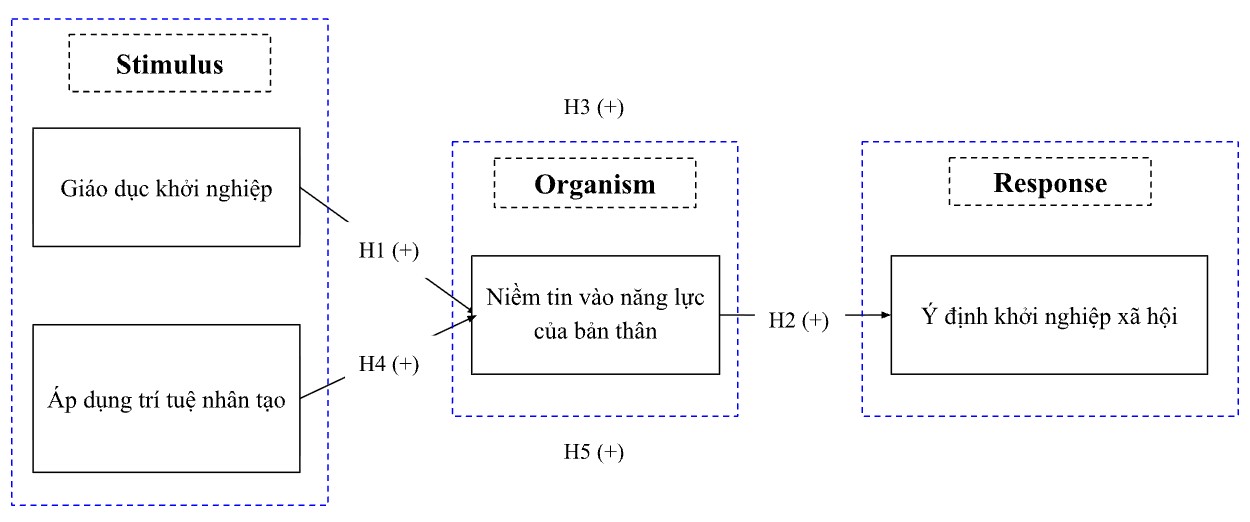
Social entrepreneurship intention has received increasing attention from the academic community as many social problems remain unsolved, requiring individuals to proactively contribute to meaningful solutions. The rapid development of technology, especially artificial intelligence, has opened up new avenues to address social challenges with greater creativity and efficiency. In this context, understanding the factors that drive social entrepreneurship intention becomes essential to foster a generation of young entrepreneurs who combine social responsibility with technological competence in solving practical problems. Based on the Stimulus - Organism - Response theory, this study explores how technological and educational stimuli influence individuals’ internal cognitive and affective states, enhancing their self-efficacy and thus their SEI. Data were collected from 281 undergraduate students studying at universities across Ho Chi Minh City through a convenience sampling method. The participants, who were mainly aged 18 to 24 and majoring in economics or engineering, represent the demographic group most exposed to both entrepreneurship education and the growing influence of AI in the learning environment. Empirical findings show that both entrepreneurship education and AI-related developments have a positive impact on students’ SEI through the mediating role of self-efficacy. Specifically, exposure to entrepreneurship-focused curriculum increases students’ confidence in pursuing socially-oriented projects, while the prevalence of AI technology provides them with new tools and mindsets to translate social awareness into innovative action. The study highlights that the interaction of digital stimuli and education can promote a stronger sense of empowerment and motivation for students to engage in social entrepreneurship as an important career option. Overall, this study enriches the emerging dialogue on the intersection of technology, education, and entrepreneurship, emphasizing the pivotal role of self-efficacy in transforming technological and educational experiences into socially oriented entrepreneurial behavior.