


Which causes knowledge-sharing and innovative work behavior? The case of Vietnamese university lecturers
- Ho Chi Minh City University of Foreign Languages – Information Technology, Vietnam
- Ho Chi Minh City University of Economics and Finance, Vietnam
Abstract
The purpose of this study is to investigate the elements that influence the process of knowledge sharing and the capacity for innovation among university teachers in Vietnam. The covariance-based structural equation model (CB-SEM) was utilized in the process of conducting data analysis, which was carried out with the assistance of SPSS and AMOS software. The research is based on survey data collected from 380 lecturers, all of whom hold at least a master's degree in subjects that are relevant to the courses that they teach their students. There were five primary characteristics that were identified, along with their respective correlation coefficients, regarding the sharing of knowledge and the consequent impact that it has on the innovative capabilities of lecturers. According to the data, there are substantial correlations between knowledge-sharing and a variety of elements, including as trust, the perceived utility of information and communication technology (ICT), pleasure in assisting other people, knowledge self-efficacy, organizational rewards, and the aforementioned. Furthermore, it was demonstrated that the act of knowledge-sharing itself had a significant influence on the innovative behaviors of individual lecturers. It is clear from these findings that it is essential to cultivate an atmosphere that encourages collaboration and trust, as well as to make use of information and communication technology tools in order to make the sharing of information easier. Considering the findings, the research provides recommendations that can be put into practice with the intention of improving the ways in which university instructors in Vietnam share their knowledge. These recommendations place an emphasis on the establishment of supportive corporate cultures, the promotion of trust-building efforts, and the provision of sufficient resources and incentives. Through the implementation of these tactics, lecturers have the ability to not only enhance their practices of knowledge-sharing but also continuously innovate in their teaching methods, thereby contributing to the general growth of higher education in Vietnam.
Introduction
Universities operate as the knowledge-intensive environments and play a central role in knowledge creation through research, knowledge dissemination through publication, and interpersonal interactions 1. They also play an essential role in knowledge transfer through collaboration between individuals, businesses, and other organizations to support innovation 2. Thus, how to effectively share knowledge of lecturers in universities in order to create core value as a critical competency. The issue is becoming a concern for many universities globally, particularly in Vietnam. In recent years, the Vietnamese government has continuously introduced policies to facilitate the development of the education sector to meet the human resource needs for the country's economic development. The Vietnamese government believes that education development is a priority among national policies, significantly higher education. In order to higher education, Vietnamese universities try to develop their research capacity and reduce the gaps with other universities worldwide. First, it is necessary to improve the quality of teaching and consolidate many skills for effective teaching, especially among the lecturers. Constantly improve expertise, enhance mutual knowledge-sharing, and contribute to knowledge innovation in line with development trends of countries worldwide.
The Industrial Revolution 4.0 has dramatically impacted the value of human life and production activities. In this context, knowledge is one of the crucial factors, which is the basis for developing all human productivity in depth. According to research by Wright et al. , human resources, including the skills, experience, and knowledge of employees, can form the competitive advantage for an organization or enterprise 3. Jafari et al. also asserted that knowledge is "the most important resource to implement the organization's strategy"4 The organization’ s focus on knowledge has many benefits, including reducing time in the workflow, reducing transaction costs, improving customer services, adapting to new changes, and creating a learning environment, thereby contributing to increased productivity and production efficiency5. These benefits demonstrate the importance of knowledge in gaining an advantage in a competitive environment. From the early 1990s onwards, researchers and business administrators worldwide have applied and approached the trend in business development as known as knowledge management. Among those activities, knowledge-sharing is considered a core knowledge management activity knowledge-sharing brings three benefits to organizations 6. First, knowledge-sharing among employees and departments in the organization is necessary to transfer individual and group knowledge into organizational knowledge, leading to the effectiveness of knowledge management. Second, some studies have found that knowledge-sharing is critical to the success of an organization 7; when individuals share knowledge, doing it significantly increases an organization's resources, reduces time wasted in trial and error, but reluctantly sharing knowledge will impact the survival of the organization8. Many factors affect the desire to share knowledge among employees in an organization9, 10. Some authors have also discussed the factors affecting knowledge-sharing in organizations in general and enterprises in particular, which can be attributed to three main areas such as, individual, organizational and technological capacities11. Third, when an individual actively shares knowledge, knowledge is absorbed, thereby creating this condition to promote innovative behavior. These three benefits are the basis for motivating and realizing new insights and knowledge of implementing tasks in the organization. Therefore, the increase of knowledge-sharing will promote employees' innovative behavior, help organizations survive and grow in depth, and improve competitiveness based on existing knowledge and new ideas of human resources.
Most studies on knowledge sharing are concentrated in European and American countries, where knowledge sharing theory was first developed. Research on knowledge-sharing in Asian countries has not been mentioned much, especially in university context12. Meanwhile, globalization makes the economy competitive on a large scale; knowledge-sharing has tremendous significance for universities in developing countries13.
In Vietnam, numerous studies have been conducted to evaluate the impact of knowledge sharing among employees at enterprises and university lecturers. Specifically, studies conducted by Tran Minh Thanh, Nhung and Loan, and Nguyen Tuan Anh, among others14, 15, 16. These studies have suggested that variables such as trust, school leadership culture, information systems, and reward systems are factors that affect knowledge sharing. The correlation between information sharing and innovation is a pivotal subject of investigation in organizational behavior and management, since it profoundly influences an organization's capacity to adapt and prosper in competitive landscapes. Knowledge sharing denotes the dissemination of information, skills, and experiences among individuals inside an organization, which can cultivate a culture of collaboration and innovation. Studies demonstrate that efficient information dissemination can augment innovation capacities by promoting the exchange of ideas and insights essential for creating new products and services. Diansari et al. discovered that information sharing has a positive correlation with innovation in small and medium companies (SMEs), highlighting that employees who engage in knowledge sharing foster a more inventive organizational culture17. Hu and Randel's study indicates that tacit knowledge sharing mediates the connection between explicit knowledge sharing and team creativity, implying that businesses should promote both types of information sharing to optimize inventive results18. Zhou and Li assert that internal knowledge sharing is crucial for radical innovation, enabling firms to utilize their pooled experience and market insights 19. The significance of leadership in cultivating an environment that promotes information sharing is paramount. Transformational leadership has demonstrated the ability to improve information-sharing practices, subsequently enhancing innovation capacities ("Transformational Leadership, Knowledge Sharing and Innovation Capability: An Empirical Study from Lao Firms", 2021). The relationship between information sharing and innovation is crucial for firms aiming to improve their competitive advantage. By fostering a culture of knowledge sharing and collaboration, organizations may harness the creative potential of their staff, resulting in enhanced innovation outcomes and enduring success in the marketplace.
However, there has been no research conducted in Vietnam to assess the impact of knowledge sharing and its effect on the innovation ability of university lecturers.
Their big question firms have to ask:
-
What factors affect the knowledge-sharing of Vietnamese university lecturers?
-
How does knowledge-sharing affect the innovative behavior of university lecturers in Vietnam?
-
What solutions need to be implemented to enhance knowledge-sharing and thereby promote the innovative behavior of Vietnamese university lecturers?
Stemming from the role of knowledge-sharing and the ability to innovate in-depth development of lecturers, universities, and its operations, this study conduct as follow , section 2 reviews the studies of knowledge-sharing in literature. Section 3 explains the research design and describes the data. Section 4 illustrates the CB_SEM model to demonstrate the analysis. Section 5 discusses the managerial implications and mentions the limitations and potential future research.
Theoretical Background for the Study
Knowledge Sharing
Knowledge-sharing is easily recognized as having many concepts. According to Cummings, knowledge-sharing is defined as information provided to people to work together and solve certain problems, develop new ideas, propose initiatives, or implement policies and processes 20. According to Nguyen et,al., knowledge-sharing is a collection of behaviors related to information exchange or support for others. It is different from sharing the information, where managers provide information about the organization to employees. While knowledge-sharing has the nature of reciprocal theory, information-sharing can be unidirectional and unsolicited 21.
Knowledge-sharing is also defined as the exchange of knowledge (skills, experience, and understanding) between individuals in an organization. Liu et al. argue that knowledge-sharing can help employees share knowledge and experiences, which aim to help projects and tasks complete quickly and cost-effectively22. In addition, knowledge-sharing involves individuals sharing the organization's information, ideas, suggestions, and expertise with others. The mechanisms of knowledge-sharing within an organization are also pointed out by the research team such as, the contribution of knowledge to enlarge the organization's database. knowledge-sharing in formal and informal interactions with team members and outside the working group; knowledge-sharing in community activities22. In addition, knowledge-sharing is also defined as a deliberate subjective act of making knowledge reused by others through knowledge transfer by Lee and Al-Hawamdeh 23; a process of giving and receiving knowledge, in which knowledge creativity and sharing depend on individual conscious efforts to enhance knowledge-sharing by Linh et,al. 24. As with knowledge, knowledge-sharing can be seen in verbal communication activities, while invisible knowledge sharing can occur in social activities, observations, or counseling activities.
Many organizations have built-in networking systems that allow employees to share, exchange, and access knowledge. However, without a culture of knowledge-sharing, the benefits gained by the organization and for individuals would not be high. Employees in the organization may feel that unfriendly colleagues lead to precautions in sharing imply too complex to find the knowledge they want. When a wary attitude exists, the organization needs to pay attention to the implementation approach of applying behavioral patterns among employees25.
Relationship between innovative work behavior and knowledge-sharing
Innovation is crucial for the long-term viability of companies since it enables the development of new business models, management practices, strategies, organizational structures, as well as new products or services26. An optimal approach to bolstering an organization's capacity for innovation is to cultivate employees' aptitude for generating novel ideas and fostering creative behavior. Human capital, the foundation for assessing employees' innovative capabilities and fostering innovation, is a crucial technique for administrators to effectively address global competitiveness and environmental uncertainty, and to attain high performance and objectives27.
Innovative work behavior (IWB) refers to employees' actions to generate, introduce, and apply novel ideas that positively impact the workplace, group, or organization, thereby enhancing overall performance28. This behavior is characterized by deliberate efforts to create and implement advantageous ideas for the benefit of individuals, groups, or organizations 29. IWB involves a systematic approach to developing new solutions, which includes identifying problems, generating responses, and executing those solutions within an organizational context. Åmo and Kolvereid describe IWB as actively seeking to develop new products, explore new markets, innovate processes, and form novel combinations30. As a multifaceted and multilevel process, IWB relates to interactions among individuals, groups, and organizations31. At the individual level, IWB encompasses the creation, introduction, and application of new ideas within one’s role to benefit both the individual and the broader organization 32. Kanter: further posits that IWB at both individual and group levels includes actions such as idea generation, collaboration, execution, and delivery 31. Additionally, at the group level, IWB involves generating, introducing, and implementing novel ideas within a team, to enhance performance and drive organizational success.
Stages of innovative work behavior
Innovative work behavior is divided by Dorenbosch et al. into two stages33: The process of inventing and executing ideas can be divided into three steps, as outlined by Scott and Bruce: developing ideas that are both beneficial and original, obtaining support for these ideas, and finally implementing the ideas that have already been pushed34. The initial phase involves idea generation, where employees identify challenges and opportunities and actively pursue novel ideas as potential solutions to these issues. The second stage, known as idea protection, involves promoting ideas within the organization to garner support for their future development. This entails forming groups and alliances of qualified persons who possess the necessary competencies to implement these ideas. The third phase involves implementing the developed idea as the main driving force in the day-to-day operations of a group or organization 28.
Cummings: also separates innovative work behavior into three phases: the initiation phase, which involves understanding problems and generating ideas or solutions, and the second phase which employees try to promote ideas and build relationships with colleagues to support them; the third stage, employees implement ideas by creating new metrics from previous experience20.
De Jong and Den Hartog also studied innovative work behavior and acknowledged that innovative work behavior consists of three stages34, 35. Therefore, this study applied the structure of innovative work behavior in three stages: idea creation, idea promotion, and idea realization.
Based on the analysis into stages, the innovative work behavior scale has been developed by some scholars such as Janssen, De Jong and Den Hartog, and Bysted28, 35, 36. All scales refer to the proposal, seeking support and implementation of innovative ideas of individual employees. However, in most research on innovative work behavior from 1980 to 2009, the effect of innovative work behavior has been studied extensively at the individual level 37. Therefore, the meaning and complexity of innovative work behavior in organizations at other levels are not well understood and studied. Employees and their colleagues can generate innovative ideas, although fundamental breakthroughs are typically achieved by individuals. However, accomplishing more intricate inventions often necessitates cooperation that draws upon a variety of knowledge, skills, and job responsibilities 28.
The relationship between innovative work behavior and knowledge-sharing
Knowledge-sharing is one of the important processes of knowledge management systems because it is a way of trans parenting hidden knowledge and an increasing basis for new intellectual creativity 38. Von Krogh et.al, pointed out that the stage of knowledge creation is the next step and is related to the need for innovation39.
The process of creating knowledge takes place through transformation, which is a process in which one person reveals and shares with others they know. People with limited knowledge of some difficulties from which history captures knowledge from others. King describes the socialization and externalization processes in the theory of knowledge creation as social processes that allow people to interact and share knowledge, resulting in the creation of new knowledge31.
Darroch and McNaughton assert that enhancing knowledge-sharing between companies fosters creativity and innovation, enabling the development of novel work methods, procedures, and the transformation of conventional approaches 40. Moreover, this facilitates organizational growth and improved functioning. Knowledge dissemination is a crucial determinant of organizational innovation. While explicit information has a direct impact on the pace of innovation, tacit knowledge influences the caliber of invention.
Information-sharing is a catalyst that motivates individuals to generate information and convert it into enhanced influence41. When employees engage in active information sharing, they learn knowledge and create situations that foster their inventive behavior. Holub highlighted that the process of sharing knowledge facilitates the rapid development of critical thinking and creativity42. The SECI model, consisting of the processes of socialization, externalization, combination, and acquisition, has been identified as beneficial for both knowledge creation and exchange 43.
Sharing knowledge has the ability to help create and put into action the ideas of those who receive the knowledge (Mura et al., 2013). Sharing knowledge with colleagues enables individuals to engage in communication, exchange ideas, highlight the advantages of concepts, and convert them into practical solutions 44. According to Wang and Noe, persons engaged in knowledge-sharing anticipate that their ideas will be endorsed by their colleagues in the future, leading to the advancement or execution of new ideas45. These individuals experience higher job satisfaction by placing trust in their supervisors and coworkers 46. Employee knowledge-sharing enhances response time and fosters creativity47.
Knowledge-sharing is fundamentally linked to the enhancement of creativity and the promotion of innovation within organizations. This relationship is underscored by the fact that when individuals exchange knowledge, they not only broaden their own expertise but also contribute to a collective pool of insights that can spark innovative ideas. Devi highlights that knowledge sharing significantly enhances employees' skill sets, thereby fostering creativity as individuals become more adept in their fields48. Furthermore, Jo and Joo assert that knowledge sharing is crucial for transforming individual knowledge into organizational knowledge, which is essential for continuous learning and adaptation49. Moreover, Islam and Asad emphasize that employees with strong knowledge ties are more receptive to innovative concepts, suggesting that knowledge sharing acts as a catalyst for creativity41. This is reinforced by Zhou and Li, who argue that effective internal knowledge sharing is vital for facilitating product innovation, as it allows for the integration of diverse perspectives and expertise19. Collectively, these studies illustrate that knowledge-sharing not only enhances individual innovative work behavior but also cultivates an organizational culture that prioritizes creativity and innovation.
Research Model
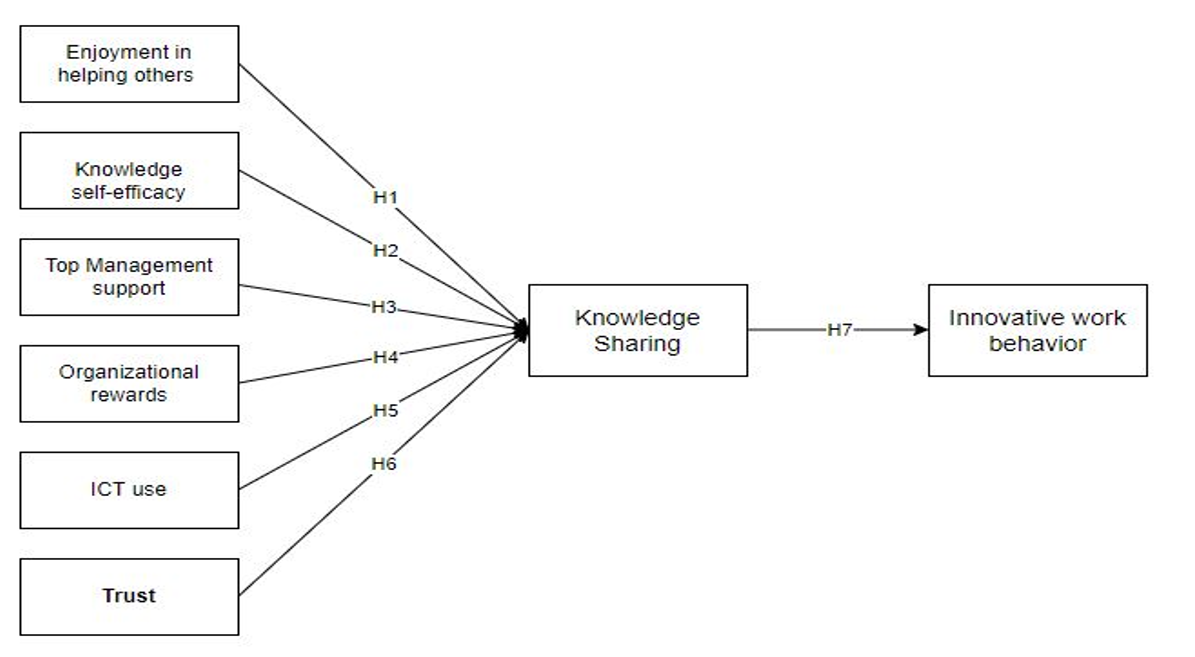
The author constructs a research model for the paper- based on Lin's research model on knowledge-sharing8. This model builds on the overall model of the strategic decision-making process with three aspects: impact factors, processes, and outcomes. It analyzes the influence of three groups of individual factors (interest in helping others, knowledge autonomy), organizational factors (support of senior administrators and organizations), and technology factors (using information and communication technology) on knowledge-sharing and its processes. As a result, there is a relationship with knowledge-sharing.
The author is based on Lin's research model as this model has been verified in many studies, including Podrug et. al. on information and communication technology company employees, and the research of this study is also cited in 1,197 articles on the Google Scholar system50. Therefore, it is a trust model that can be used for empirical research on knowledge-sharing in organizations (Figure 1).

Proposed Research model
Hypothesis
The influence of personal factors in the process of knowledge-sharing
Enjoyment in helping others
Self-determination theory, as proposed by Deci and Ryan, explores the internal drive that motivates an individual, independent of any external influences or forces 51. The enjoyment derived from assisting others is a manifestation of self-regulation that is influenced by the gratification experienced via engaging in and accomplishing a task. The pleasure derived from assisting others is based on the principle of altruism, which stands in contrast to selfishness, characterized by a commitment to unbiased behavior and selfless care for the well-being of others. Lin contended that knowledge-sharing is driven by the sharers' intrinsic incentives8. Wolfe, C., & Loraas, T. also showed that individuals have an inherent motivation to share information since they derive pleasure from assisting others52. Altruism can drive an individual to share knowledge with others, regardless of the personal rewards they may obtain 53. Thus, the author posits the following hypotheses:
Hypothesis H1: The enjoyment of helping others has a positive effect on the process of knowledge-sharing.
Knowledge self-efficacy
According to Janssen's social cognitive theory, individual autonomy is influenced by the capacity to arrange certain behaviors, enabling people to gain autonomy and communicate information through collaboration. The self-determination hypothesis, as proposed by Deci and Ryan in 2008, defines the demand for competence as the desire to possess confidence, a clear understanding of what needs to be done, and the ability to independently do tasks51. Knowledge autonomy refers to an individual's ability to independently utilize their own knowledge to solve work-related challenges. This skill has been demonstrated to have a positive impact on the sharing of knowledge. Employees who believe that their expertise may enhance job efficiency and boost production are more likely to adopt a positive attitude towards knowledge-sharing, leading them to actively engage in sharing knowledge with others 52. Autonomy can foster a culture where individuals are motivated to actively disseminate information to their peers46. Multiple studies have demonstrated a positive correlation between employees' confidence in their expertise and their willingness to share that knowledge in order to complete their assigned duties53, 54, 21. Having knowledge autonomy enhances work performance and facilitates the resolution of work-related challenges16. Consequently, some possibilities are suggested as follows:
Hypothesis 2: Knowledge autonomy has a positive effect on the knowledge-sharing process.
The influence of organizational factors on knowledge transfer and acquisition processes
The impact of extrinsic motivation on an individual's behavior is determined by Self-determination theory51 and motivation theory. These theories propose that extrinsic motivation arises from external pressure43. Hence, the external factors that drive individuals to engage in behaviors like knowledge-sharing can include the endorsement of a supervisor, the prospect of getting a reward, and so on.
Top Management support
The extent to which employees actively engage in knowledge-sharing is contingent upon the level of support provided by management inside the business53. The influence of management assistance on knowledge-sharing among employees is widely recognized 23. Islam et al. highlighted the significance of administrator support in facilitating knowledge-sharing55. They noted that leaders play a crucial role in promoting employee learning through the sharing of individual experiences and encouraging employees to transfer knowledge in order to create new knowledge. The research hypotheses that have been suggested are as follows:
Hypothesis 3: Administrator support has a positive effect on the knowledge-sharing process.
Organizational reward
Organizational rewards have been argued to be useful in encouraging individuals to do what they want 38. Organizational rewards include salaries, financial fee bonuses, as well as promotions, and employment security. Islam presented results suggesting that the reward mechanism has a more significant role than technical support in promoting knowledge-sharing41. Bartol and Srivastava proposed that financial incentives can promote knowledge-sharing by motivating individuals to make personal contributions to databases, engage in formal contacts within and between groups, and share knowledge across different working units 39. According to Wolfe and Loraas, incentives have the ability to encourage knowledge-sharing, regardless of its nature, funding, and associated costs52. According to Bock and Partners, several studies indicate that knowledge-sharing is more probable when individuals believe that the advantages they gain are greater than the disadvantages they perceive56. Hansen and Avital conducted study that posited formal incentives or prizes as the primary variables shaping an employee's perception of knowledge-sharing 57. They suggest that an organization's formal incentive strategy directly impacts an employee's perspective on knowledge-sharing. According to Connelly and Kelloway, incentives serve as motivating factors for knowledge-sharing32. Employees in a business consistently anticipate acknowledgment and compensation for sharing their knowledge and skills with others. Therefore, the author proposes the following hypotheses:
Hypothesis 4: Organizational rewards have a positive effect on knowledge-sharing.
The influence of technological factors on the process of knowledge transmission and acquisition
The utilization of information and communication technology. The Technology Acceptance Model (TAM) posits that the utilization of technology in everyday tasks, relationships, and communication among individuals or members of a group or society has an impact on behavior, such as the sharing of knowledge. Enhancing knowledge accessibility and eliminating geographical and temporal obstacles for knowledge workers can enhance the efficacy of information and communication technology (ICT) in facilitating knowledge-sharing. According to Hendrik's study, information and communication technology, with its capacity to disseminate knowledge throughout many departments of a business, might facilitate improved comprehension within the intricate organizational setting 58, 59. Information technology is often regarded as an essential instrument for facilitating the acquisition of valuable knowledge47. Collaboration technologies, including internal network systems, facilitate cooperation and knowledge sharing among individuals. This collective knowledge is then integrated into the organization's overall knowledge base, enhancing its effectiveness. According to Zhao and Luo, information technology has a significant role in reducing barriers to knowledge-sharing37. Teece also emphasized the importance of information and communication technology in this regard60. Identifying pertinent knowledge across many departments within an organization is crucial for establishing a technical framework that facilitates the sharing and distribution of knowledge. Subsequently, the author puts forward the subsequent hypotheses:
Hypothesis 5: The use of information and communication technology has a positive effect on knowledge-sharing.
The relationship between trust and knowledge-sharing
Trust
Trust is an optimistic anticipation of an individual's integrity, competence, and benevolence towards the capabilities of their fellow colleagues within the business. Trust is a significant factor in social connections, as opposed to commercial transactions 38. Therefore, trust will facilitate knowledge-sharing, as voluntary sharing of one's knowledge with another is social exchange theory. A study conducted by Conner and Prahalad reinforced the assumption that knowledge-sharing is easier if there is mutual trust between companies61. Trust plays a very important role in knowledge-sharing7. The higher the trust, the easier it is to accept knowledge from our peers because we believe that knowledge is beneficial to ourselves. According to Von Krogh et al., trust and openness in the organization promote knowledge-sharing behaviors of employees 39. In communication, conversation and collaboration among colleagues, managers, leaders, encouragement and encouragement of public officials to participate in knowledge activities are important. Formal, social, and collaborative relationships are important in sharing different perspectives and knowledge in the workplace. The author agrees with the previous study and thinks that in the workplace if lecturers have confidence in the experience and working capacity of their colleagues, it will motivate them to share knowledge. Therefore, hypothesis H6 is proposed as follows:
Hypothesis H6: If lecturers receive trust from colleagues, they will have more knowledge-sharingbehavior.
The relationship between theknowledge-sharing process and innovative working behavior.
Innovative work behavior is defined as "an individual's act of achieving purposeful initiative and recommendation (in a job role, group or organization) of new and useful ideas, processes, products or procedures"40. The act of creative work consists of three distinct tasks: idea generation, the development of new ideas; promoting ideas, getting outside support; and idea application, the production of a model or prototype of an idea28, 35. Therefore, previous studies have suggested that individuals with goodwill and innovative abilities should expand their contributions beyond their job requirements and at the same time recognize a continuous stream of innovation 62. Knowledge-sharing is a factor that encourages individuals to create knowledge and turn it into greater power. As employees become more involved in the knowledge-sharing process, they acquire a greater amount of knowledge. These conditions facilitate employees' innovative behavior. Therefore, we believe that knowledge-sharing behaviors have a significant impact on individuals' innovation behaviors:
Hypothesis 7: Knowledge-sharing process has a positive effect on innovative work behavior.
Research Methodology
Research design
Using two tools: focus group interview and questionnaire test interview63. The first phase of this research is to uncover insights into the enjoyment scale, knowledge efficiency, top management support, organizational rewards, use of information and communication technologies, and knowledge-sharing and potential for innovation, and discussion will comment on preliminary scales. The questionnaire was then sent directly to university lecturers in Ho Chi Minh City, Vietnam.
Variable measurement
The study mainly used a 7-degree Likert scale to measure observation variables, where "1" is " Strongly disagree " and "7" is "strongly agree". The scales are referenced from previous studies in the same field.
The research was conducted in a group discussion with a panel of 08 experts in the field of education management, principals, vice principals, department heads and central directors of universities and colleges located in Ho Chi Minh City.
Scale calibration results
All 8/8 experts interviewed said that the same influencing factors as well as observed variables. However, it is necessary to adjust the subject/name to suit the research objectives at universities in Vietnam (Table 1).
Variable measurement
|
Variable |
Measurement Items |
Previous research |
|
Enjoyment in helping others (EHOs) |
EHO1. I enjoy sharing my knowledge with colleagues. EHO2. I enjoy helping colleagues by sharing my knowledge EHO3. It is gratifying to assist someone by imparting my expertise. EHO4. It brings me great pleasure to share my knowledge with my colleagues. |
|
|
Knowledge self-efficacy (KSE) |
KSE1. I possess a strong belief in my capacity to offer significant knowledge that is highly regarded by my peers at the institution. KSE2. I possess the requisite proficiency to offer significant insights to my university. KSE3. Sharing my expertise with coworkers (reversed coded) has no impact. KSE4. I have less valuable knowledge compared to most other employees (reversed coded). |
|
|
Top management support (TMS) |
TMS1. Senior executives believe that promoting the exchange of knowledge among colleagues is advantageous. TMS2. Senior executives consistently endorse and motivate staff to disseminate their expertise among their peers. TMS3. Top managers have a crucial role in providing the required assistance and resources to facilitate the sharing of information among lecturers. TMS4. Senior executives are eager to ensure that the instructors are willing to share their expertise with their peers. |
|
|
Expected organizational rewards (EORs) |
EOR1. Compensating me with a higher wage for sharing my knowledge with colleagues is appropriate. EOR2. Compensating me with a bigger incentive for sharing my knowledge with colleagues is appropriate. EOR3. Getting promoted for imparting my knowledge to colleagues ought to be the result. EOR4. Increasing my job stability should be a reward for imparting knowledge to colleagues. |
|
|
the usefulness of ICT(ICT) |
ICT1. Lecturers utilize electronic storage, such as online databases and data warehousing, to efficiently access knowledge. ICT2. Lecturers utilize knowledge networks (including intranets, groupware, and virtual communities) to communicate with their colleagues. ICT3. My university makes use of technology that enables staff members to exchange knowledge within the company. ICT4. Thanks to technology, teachers at my university may disseminate their expertise to those outside the institution. |
|
|
Trust |
Trust1. I believe that I am treated fairly in an organization. Trust2. I believe I am not harmed when I share my knowledge with my colleagues. Trust3. I believe that other teachers in the school will help me when needed. Trust4. Lectures trust each other at my university. |
|
|
Knowledge-sharing (KS) |
KS1. The knowledge shared by the lectures at my university is accurate KS2. The knowledge shared by the instructors at my university is complete. KS3. The knowledge shared by members of my school is reliable. KS4. The knowledge which is shared by the lecturers of my university is always up-to-date. |
|
|
Innovative work behavior (IWB) |
IWB1. I create new ideas for improvements IWB2. I often search for new working methods, techniques, or instruments. IWB3. I'm always working hard to test new ideas. IWB4. I transform innovative ideas into University work. |
|
Depending on the complexity of the model and the basic characteristics of the measurement model, Hair et al, propose the following minimum sample sizes: Sample size can affect several aspects. of the SEM, including the model's parameter estimation, suitability, and statistical capacity. In principle, the larger the sample size, the better, but not less than 200 and the minimum for the SEM model will be 5 times the number of observed variables66. In the research model of this topic, there are 31 observed variables, so the minimum number of samples must be 200. Based on the overall research in Ho Chi Minh City, Vietnam has 63 universities (39 public universities, 16 non-public universities and 8 institutes); The author directly distributed 350 questionnaires to the lecturers and staff of universities in Ho Chi Minh City for a period of two weeks to achieve this minimum sample size.
Research results
Demographic analysis result
In the preliminary quantitative study (Table 2), conducting the process with 383 sample questionnaires, the number of votes collected was 361 votes (94.25%), after data processing, the number of votes was used to analyze 350 votes (91.38%), the votes were eligible to perform the standard research set. Statistics of 350 observations in quantitative research show that in the sample of lecturers from universities in Ho Chi Minh City, male and female genders are similar (male accounted for 55.14% and female accounted for 44.85%); in which the majority are in the age group from 36 to 45 (accounting for 33.42%), followed by the age group of 45 and older (accounting for 32.57%); The educational level of the lecturers who participated in the survey mainly graduated with a master's degree or higher (accounting for 95.15 %); the number of trainers with 1 to 5 years of working experience accounted for 26.00% of the total observations, followed by 6 to 10 years of experience accounting for 24.57% of the total observations.
Demographic profile of respondents
|
Item |
Frequency analysis | |
|
Frequency |
Percent (%) | |
|
Gender | ||
|
Male |
193 |
55.14 |
|
Female |
157 |
44.85 |
|
Total |
350 |
100 |
|
Age | ||
|
Under 25 |
17 |
4.85 |
|
26 - 35 |
102 |
29.14 |
|
36 - 45 |
117 |
33.42 |
|
More than 45 |
114 |
32.57 |
|
Total |
350 |
100 |
|
Education | ||
|
University Graduated student |
52 |
4.85 |
|
Master |
131 |
29.14 |
|
Ph.D |
101 |
33.42 |
|
Associate Professor/ Professor |
33 |
32.57 |
|
Total |
350 |
100 |
|
Working experience | ||
|
Under 1 year |
32 |
9.14 |
|
1 - 5 year |
91 |
26.00 |
|
6 - 10 year |
86 |
24.57 |
|
More than10 year |
141 |
40.28 |
|
Total |
350 |
100 |
Reliability analysis result:
The reliability of the questionnaire scale was tested using Cronbach's alpha for the entire 32-item measurement system divided into 8 factors. Cronbach's alpha for scales ranging from 0.771 to 0.861 in the model. Since all measurement confidences are greater than 0.7, all results show that the measurements for the scale are reliable. Therefore, the data were explored to be suitable for further analyses. The results of the reliability analysis for each factor are presented in Table 3.
Reliabilities analysis result
|
Factor |
Cronbach’s alpha |
|
Enjoyment in helping others |
0.803 |
|
Knowledge self-efficacy |
0.830 |
|
Top management support |
0.840 |
|
Organizational rewards |
0.836 |
|
ICT use |
0.804 |
|
Trust |
0.771 |
|
Knowledge-sharing |
0.847 |
|
Individual innovative behavior |
0.861 |
Hypothesis testing result
From the results of performing CFA analysis to assess the suitability of the whole model, the author proceeded to put 32 observed variables that were satisfied into the model for SEM analysis and hypothesis testing. The author performs SEM analysis from the originally proposed research model and then performs model correction to obtain a better model. The official theoretical model proposed by the author includes 6 independent variables: EH, KE, TS, OR, IT, and TR affect an intermediate variable KS, from the variable KS affecting the dependent variable PI.
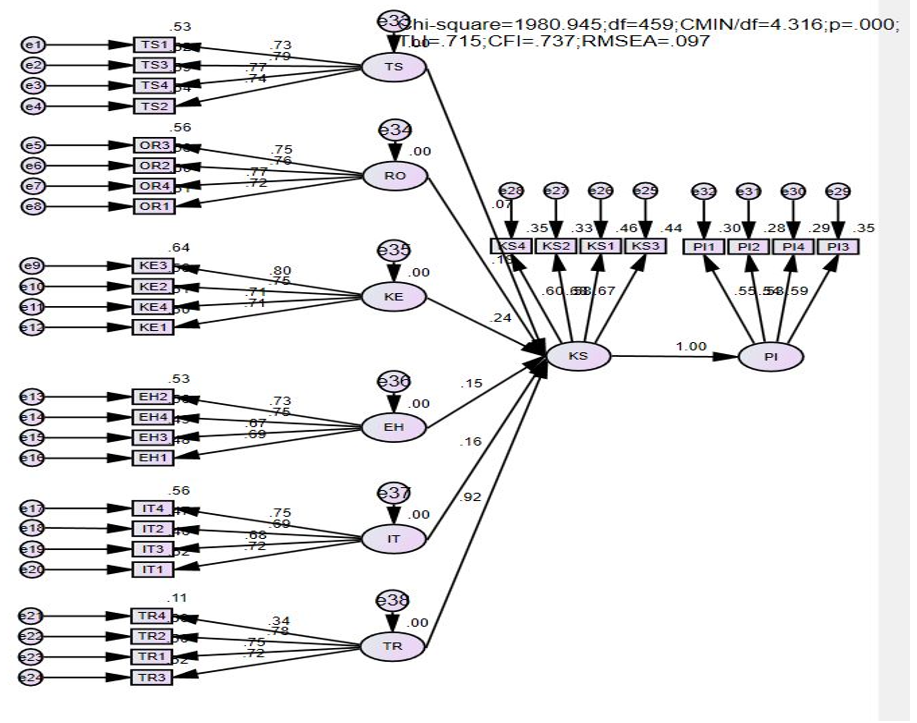
SEM Results of the Research Model
Indicators from the results of the first linear structural model analysis in Figure 2 show that: it can be concluded that the model fits the survey data.
The test results have the following indicators:
Hypothesis testing result
|
Estimate (β) |
S.E. |
C.R. |
H-test | ||||
|
KS |
<--- |
TS |
.060 |
.031 |
1.913 |
.056 |
Rejected |
|
KS |
<--- |
RO |
.149 |
.033 |
4.519 |
*** |
Supported |
|
KS |
<--- |
KE |
.199 |
.034 |
5.800 |
*** |
Supported |
|
KS |
<--- |
EH |
.129 |
.034 |
3.819 |
*** |
Supported |
|
KS |
<--- |
IT |
.129 |
.032 |
3.999 |
*** |
Supported |
|
KS |
<--- |
TR |
1.648 |
.285 |
5.789 |
*** |
Supported |
|
PI |
<--- |
KS |
.886 |
.089 |
9.922 |
*** |
Supported |
Conclusion and discussion
Research summary
Share knowledge with the influence of individual factors
Knowledge-sharing is concluded to be influenced by the enjoyment of helping others. Many authors agree with this statement, including19. To share knowledge or not share knowledge depends on the personality and emotional state of each lecturer. Knowledge is an individual asset, so when they enjoy sharing, they feel comfortable with knowledge-sharing, and they will be willing to pass on their knowledge to their colleagues and acquire knowledge from their colleagues. This enjoyment comes from each lecturer, but it cannot be denied that the surrounding environment has a significant impact on each individual's mood and feelings. Thus, in addition to the enjoyment of helping others, other factors belonging to the organization and technology can promote knowledge-sharing among instructors at universities in Ho Chi Minh City, Vietnam.
Share knowledge with the influence of organizational factors
Knowledge efficiency and Organizational rewards: As a result of quantitative analysis, it was found that the organization's reward and knowledge effect affect knowledge-sharing. Many authors also agree with this statement such as Han and Anantatmula, Al-Qadhi et al., Podrug et al., and even Lin concluded that knowledge effectiveness and school rewards influence both central processes of knowledge-sharing, namely, knowledge transmission and acquisition8, 50, 53, 67.
Share knowledge with the impact of technology factors
Using Information and Communication Technology: Information and communication technology is a factor influencing knowledge-sharing. This conclusion coincides with many studies, including those by Bock et al; Podrug et al. 50, 56. However, when studying the impact of information and communication technology use on the two processes of knowledge transmission and acquisition, the author Lin concluded that the use of information and communication technology only affects knowledge acquisition but not knowledge transmission 8. Lin argued that in employee organizations, knowledge tends to be used to an individual's advantage, not as an organization's resources, so knowledge cannot be shared simply through online databases or internal networks8. By the Structural Equation Modeling of Analysis (SEM) with the observed sample of university lecturers in Ho Chi Minh City, the author affirms that the use of information and communication technology supports knowledge-sharing. This conclusion was derived from quantitative research and proved by many scholars around the world. Universities in Ho Chi Minh City have paid much attention to technology investment, especially during the Covid-19 pandemic that has taken place over the past 2 years, in which universities have actively invested in technology; use, maintain and regularly update critical information infrastructure; actively invest in building a social network system, group software system, and an intranet system that will create conditions for lecturers to actively share knowledge.
Effect of Trust on Knowledge-Sharing
Research results suggest that knowledge-sharing is influenced by the trust of instructors. This conclusion aligns with the findings of several investigations, including the research conducted by Davenport and Prusak, Costa et al., and Zárraga and Bonache 7, 68, 69. Exploitation of trust will be prevented, and teachers will actively share knowledge by relying on trust in the honesty, responsibility, and credibility of their colleagues. They will impart their expertise and abilities to their colleagues only if they trust that their colleagues will not exploit that knowledge and talents to challenge them or feign closeness solely to benefit from their generosity. In this study, in order to enhance knowledge-sharing in universities in Vietnam, the university administrators need a solution to influence the trust of each lecturer.
Knowledge sharing and innovative work behavior
Numerous research have examined the correlation between knowledge-sharing and innovative work behavior. Several studies that recognize this correlation include the research conducted by Radaelli et al, Jaberi, and Akram et al.43, 70, 71. According to research conducted at universities in Ho Chi Minh City, the author has determined that there is a correlation between knowledge-sharing and individual inventive work behavior. The rigorous quantitative investigation revealed a statistically significant association between knowledge-sharing and individual innovative work behavior. The interpretation of these data is based on the findings from the interview with the lecturer. During the interview, the author observed that instructors who engage in proactive communication and seek knowledge tend to be highly involved in collaborating with colleagues to provide innovative ideas for practical implementation.
Limitations and directions for further research
Limitations
In this study, we conducted only a small survey of instructors working in HCMC, Vietnam, and we have not yet been able to deploy widely across Vietnamese countries. Based on the theoretical model of knowledge-sharing by Lin, Linh et.al, etc., proposed, we only conduct empirical verification to see the model. This is suitable for the teaching community of universities in Vietnam, without looking for other variables that may affect knowledge-sharing as well as individual innovation ability.
Directions for further research
In order to enhance the quality of the data acquired, we want to broaden the survey coverage in various university sites in Vietnam by conducting a greater number of surveys. Furthermore, apart from the characteristics suggested by Lin, Linh et.al, and others, we will broaden our investigation to identify additional factors that impact the knowledge-sharing process and innovation skills of university professors in Vietnam.
ABBREVIATIONS
SPSS: Statistical Package for the Social Sciences
SEM: Structural Equation Modeling
AMOS: Analysis of Moment Structures
CONFLICT OF INTEREST STATEMENT
The authors declare that they have no conflicts of interest
AUTHOR CONTRIBUTIONS
Author Duong The Duy: Responsible for the content: research ideas, data investigation, data processing.
Author Duong Anh Thy: Responsible for the content: writing the article content.