


Untangling the relationship between influencers’ expertise and consumer purchase intention on live streaming social commerce
- School of International Business-Marketing, University of Economics Ho Chi Minh City, Ho Chi Minh City, Vietnam
- School of Management, University of Economics Ho Chi Minh City, Ho Chi Minh City, Vietnam
- Faculty of Economics - Management, Dong Nai Technology University, Bien Hoa City, Dong Nai Province, Vietnam
Abstract
The rapid growth of the Internet and the advancement of modern technology have led to the development and population of social commerce in the last few years. Many individuals and business firms use social commerce to give live streaming with the purpose of providing products and services to consumers. Some people become influencers on live streaming social commerce because they have a lot of fans who are willing to follow and purchase from these influencers. Given the popularity of the influencers on live streaming social commerce in today’s online environment, this study uses the stimuli-organism-response (SOR) model as the theoretical foundation to investigate the effect of influencers’ expertise on consumer trust and consumer engagement, which affect consumer purchase intention on live streaming social commerce. To test the research model and hypotheses, this study adopts a quantitative survey questionnaire to collect a sample data of 434 consumers from different live streaming rooms of some TikTokers in Vietnam. The sample data was screened by SPSS statistical software. Structural equation modeling with SmartPLS is also used to analyze the sample data and test the research hypotheses. Empirical results indicate that influencers’ expertise is positively related to consumer trust. Similarly, influencers’ expertise is also positively related to consumer engagement. In addition, consumer trust is positively related to consumer engagement. Consumer trust is also positively related to purchase intention. Furthermore, consumer engagement is positively related to purchase intention. This study extends SOR model to clarify how the expertise of influencers influence consumer trust, engagement, and purchase intention. The findings provide evidence for researchers and business practitioners to understand the relationship between influencers’ expertise and consumer behavior in the live streaming social commerce in emerging markets.
Introduction
The combination of social media and e-commerce has led to the advent and growth of social commerce 1. This new form of business has attracted many people to make live streaming and sell products to consumers. Some people have become influencers because they are famous and have influence on other people on social commerce2. Researchers and business managers have investigated different factors of influencers that influence consumer behavior, including influencers’ marketing campaign3, attractiveness4, attributes5, content and engagement strategy 6, and message content7. Although many factors of influencers have been investigated as the antecedents of consumer behavior, the relationship between influencers and consumers is complex and multidimensional4. Thus, further research is needed to reveal the influence of influencers on consumer behavior on the live streaming social commerce3, 4, 6.
Vietnam is an emerging market that has become a large potential market for social commerce in the last few years. According to the statistics of Statista.com, the number of online shoppers in Vietnam has reached 57 million in 2023. Share of online shoppers to shop on social commerce accounts for 65% of all online shoppers. Furthermore, nearly 80% of internet users in Vietnam reported that they often follow influencers on social media and purchase products from these influencers. Vietnam social commerce has become a vibrant and dynamic market with high potential in the Southeast Asia region 8. Unfortunately, a few studies have explored the influence of influencers on consumer behavior in the specific context of social commerce in Vietnam9. This leads to a lack of understanding and limited knowledge to help researchers and business managers in exploring and doing business in this specific market 8, 9.
To fill this research gap, this study investigates how influencers’ expertise leads to consumer trust and engagement, which lead to consumer purchase intention. This study takes advantage of consumers from TikTok platform in Vietnam to collect data and test the research hypotheses. Stimuli-organism-response (SOR) model 10, 11 is used to explain the relationship between the variables in the research model. Accordingly, the expertise of influencers is an external factor that works as a stimulus (i.e., stimulus) to affect consumers. Consumer trust and engagement are internal factors that belong to the consumers' internal psychological process (i.e., organism). Purchase intention is a behavioral outcome (i.e., response) of consumers when they perceive and respond to the stimulus from influencers. The findings of our research is expected to provide new understanding for researchers and business managers so that they can make better decisions in enhancing consumers’ trust, engagement, and purchase behavior from influencers on live streaming social commerce in the specific context of Vietnam market.
The structure of this research is as follows. The next section discusses theoretical basis, key concepts and hypotheses. The third section presents methods. The fourth section shows the results. The final section discusses the findings and implications.
Literature and hypotheses
Stimuli-organism-response model
Stimuli-organism-response (SOR) model is proposed to explain the influence of environmental factors on individuals 11. SOR comprises three components: stimuli, organism, and response. Stimuli are the factors in the external environment. Organism is the internal psychological process of an individual. Response is the observable behaviors of an individual 11. Accordingly, the stimuli (S) component exerts influence and triggers individuals to undergo an internal psychological process (O) to address the stimuli. Consequently, the individuals engage in actual behaviors or respond (R) to the stimuli12. In the field of consumer behavior, SOR is often used to explain how consumers respond to different stimuli from the marketing environment 13. For example, consumers respond to products, price, promotion, place, physical environment, employee services, and salespeople 14.
Influencers’ expertise and its influence
Expertise refers to the knowledge, skills, and experiences that an influencer has 15. An expert influencer often has the ability to provide rich and high quality information to customers, show his/her knowledge about the products or services, and understand consumers’ needs and demands16, 17. Expertise of influencers is an important factor that affects consumer behavior on online shopping and social media environment 18.
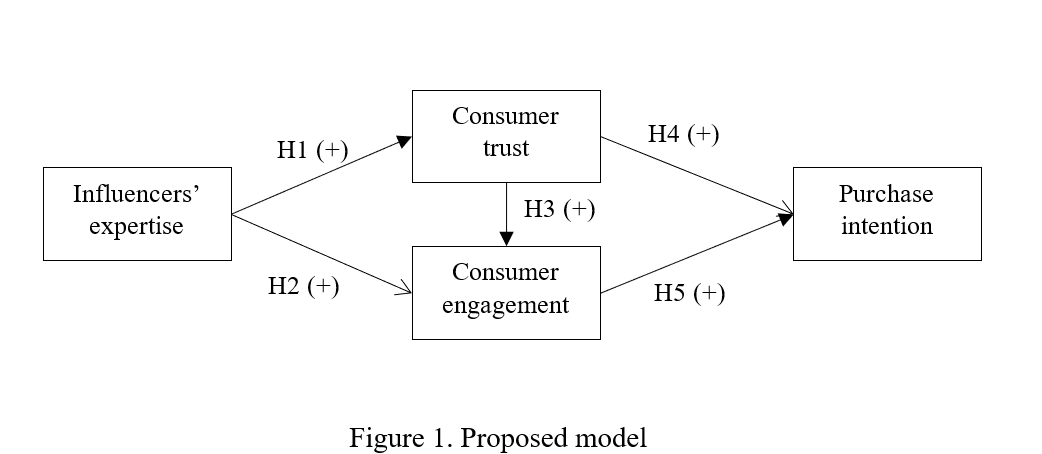
In the live streaming social commerce, consumers often watch and interact with influencers 19, 20. Normally, influencers introduce the products, provide information, answer questions, and suggest solutions for consumers 21. An influencer with high expertise often provides rich and high-quality information. He/she also demonstrates good knowledge and understanding of the products/services, thus recommends good products/services that fit consumers’ needs and demands22. Therefore, consumers tend to trust and spend more time and effort with the influencers who have high expertise [19, 20]. According to SOR, the expertise of influencers acts an external stimulus that provides reliable information and good suggestions for customers. As a result, consumers form their trust and engage with the influencers. Hence, the following hypotheses are developed.
H1. Influencers’ expertise is positively related to consumer trust.
H2. Influencers’ expertise is positively related to consumer engagement.
Consumer trust and its influence
Trust is defined as “a willingness to rely on an exchange partner in whom one has confidence”23. It is the confidence that a person has in his/her partner’s reliability24, 25. Trust presents in an individual’s cognition, evaluation, and feelings 26, 27. In the field of consumer behavior, researchers have suggested that consumer trust is often affected by different positive factors of the marketing stimuli, such as product quality, product characteristics and performance, warranty and after sale service, store environment, service quality, etc. 28. Furthermore, consumer trust often leads to consumers’ positive consumer behaviors, including purchase behavior, positive worth of mouth, satisfaction, and loyalty 24, 26.
Consumer trust has been demonstrated as an important component of online shopping and e-commerce 29. Lou and Yuan argued that consumers tend to trust influencers who have rich knowledge and understanding of products/services because they can provide accurate and reliable information and suggest good solutions to satisfy consumers’ needs 30. Furthermore, when consumers trust an influencer, they are more willing to spend time to follow and purchase from the influencer27, 31. For example, Lu and Chen reported that consumer trust plays an important role in fostering their engagement and purchase behavior toward influencers on social media32. Thus, it is believed that consumer trust will have an influence on consumer engagement and purchase intention on live streaming social commerce. The following hypotheses are developed.
H3. Consumer trust is positively related to consumer engagement.
H4. Consumer trust is positively related to purchase intention.
Consumer engagement and its influence
Consumer engagement is defined as “repeated interactions that strengthen the emotional, psychological or physical investment a customer has in a brand” 33. More specifically, consumer engagement refers to ““a psychological state that occurs by virtue of interactive, cocreative customer experiences with a focal agent/object (e.g., a brand)…It is a multidimensional concept subject to a context- and/or stakeholder-specific expression of relevant cognitive, emotional and/or behavioral dimensions.” 34. In the context of live streaming social commerce, Dang-Van et al.4 identified three components of consumer engagement. Conscious participation is the cognitive effort consumers invest in the live streaming. Enthusiasm is the feeling of excitement consumers have toward the live streaming. Social interaction is the behavioral interaction consumers participate in the live streaming 35. These components indicate the investment of time, energy, and effort that consumers spend with the influencers and/or their live streaming4.
Prentice et al. stated that when consumers engage with an online brand community, they tend to purchase from this community because consumers have a strong tie with it 36. Furthermore, Zheng et al. indicated that high engaged consumers often develop positive beliefs and attitudes with the influencers on live streaming. These consumers are more willing to purchase from the influencers because they have a strong connection and interaction with them37. Prior studies such as He et al. 38, Sun et al. 21, and Yu and Zheng 39 have reported a positive relationship between consumer engagement and purchase intention. On the basis of the findings from prior studies and SOR model, it is believed that consumer engagement (i.e., organism) will enhance purchase intention (i.e., response) on live streaming social commerce. Therefore, the following hypothesis is developed.
H5. Consumer engagement is positively related to purchase intention.
The proposed model is showed in Figure 1 below.

Proposed model
Methods
Measures
This study adopts a seven-point Likert type scale to measure each item. The scale measures the degree of agreement of the respondent on each item, which ranges from 1 (strongly disagree) to 7 (strongly agree). To measure variables in the research model, we adopted measures from the existing literature. More specifically, expertise of influencers was assessed with 5 items developed by Ohanian 40. Consumer trust was assessed with 3 items developed by Sirdeshmukh et al. 41. Consumer engagement was assessed with 10 items from Zhang et al. 7. Purchase intention was assessed with 3 items from Dang and Pham 42. Table 2 shows the constructs and their corresponding items.
Data collection and analysis methods
This study translated the measures from English to Vietnamese and then conducted a pilot test to confirm the face validity of the measures. This pilot test was performed with the participation of 40 consumers. In the formal survey, we collected data from consumers on TikTok live streaming platform in Vietnam. The survey was conducted using a convenient technique in which respondents in different live streaming rooms of some famous TikTokers were invited to join the survey. The survey was conducted in February 2024. To ensure the ethical issue in our research, this study followed the ethical standards and guidelines of the American Psychological Association. Accordingly, the respondents were invited based on their willingness. The answer of each respondent was kept anonymous. The respondents agreed to join the survey with their oral consent. The final sample data have 434 valid questionnaires. Table 1 presents the demographic characteristics of the sample data in this study.
Characteristics of the respondents
|
Characteristics |
Frequency |
Percent | |
|
Gender |
Female |
312 |
71.9 |
|
Male |
102 |
23.5 | |
|
Other |
20 |
4.6 | |
|
Age |
Under 20 |
134 |
30.9 |
|
20 – under 30 |
267 |
61.5 | |
|
30 – under 40 |
24 |
5.5 | |
|
40 or above |
9 |
2.1 | |
|
Education |
High school or below |
91 |
21.0 |
|
University |
325 |
74.9 | |
|
Master or above |
18 |
4.1 | |
|
Income |
Under 10 million VND |
314 |
72.4 |
|
10 – under 20 million VND |
91 |
21.0 | |
|
20 – under 30 million VND |
18 |
4.1 | |
|
30 million or above VND |
11 |
2.5 | |
|
Marital status |
Single |
303 |
69.8 |
|
Marriage |
62 |
14.3 | |
|
Other |
69 |
15.9 | |
|
n= 434 | |||
To analyze the sample data, this study uses PLS-SEM statistical software. The reasons to choose it includes: (1) It has the ability to address complex model with various interrelationship between constructs, (2) It is not sensitive to the assumption of normality, and (3) it can provide reliable solution when the sample size is small43. In addition, this study follows Dang-Van et al. 4 and Zheng et al. 37 to include respondents’ characteristics in the analysis for their potential impact on the dependent variable. The control variables include age, gender, income, education, and marital status.
Results
Results of measurement model
This study adopts PLS-SEM to perform a measurement model (confirmatory factor analysis). Results of this model indicate that factor loadings of all measurement items were above 0.90. Table 2 shows the results of the measurement model.
Results of measurement model
|
Influencers’ expertise Ohanian |
Factor loadings |
|
This influencer is an expert. |
0.943 |
|
This influencer is experienced. |
0.950 |
|
This influencer is knowledgeable. |
0.953 |
|
This influencer is qualified. |
0.937 |
|
This influencer is skilled. |
0.927 |
|
Consumer trust Sirdeshmukh et al. | |
|
I feel that this influencer is very dependable. |
0.934 |
|
I feel that this influencer is responsive to consumers. |
0.903 |
|
I feel that this influencer is trusted. |
0.945 |
|
Consumer engagement Zhang et al. | |
|
Conscious participation Anything related to this influencer’s live streaming grabs my attention. |
0.944 |
|
I like to learn more about this influencer. |
0.943 |
|
I pay a lot of attention to anything about this influencer’s live streaming. |
0.931 |
|
Enthusiasm I spend a lot of my discretionary time with this influencer’s live streaming. |
0.935 |
|
I am heavily into this influencer’s live streaming. |
0.951 |
|
I am passionate about this influencer’s live streaming. |
0.952 |
|
My days would not be the same without this influencer’s live streaming. |
0.920 |
|
Social interaction I love participating in this influencer’s live streaming with other viewers. |
0.941 |
|
I enjoy taking part in this influencer’s live streaming more when I am with others. |
0.959 |
|
Participation in this influencer’s live streaming is more fun when other people do it too |
0.952 |
|
Purchase intention Dang & Pham | |
|
I am willing to buy products from this influencer. |
0.952 |
|
I will make an effort to products from this influencer in the near future. |
0.953 |
|
I intend to buy products from this influencer. |
0.958 |
Results of the measurement model also generate evidences for the reliability and validity of the measures. As showed in Table 3, Cronbach’s alpha of all variables was greater than 0.90, indicating a good reliability. Furthermore, values of composite reliability (CR) and average variance extracted (AVE) of all variables were greater than 0.70 (for CR) and 0.50 (for AVE), providing sufficient evidence for a good convergent validity43. In addition, results of the Heterotrait-Monotrait ratio of correlations (HTMT) among variables are showed in Table 4. The values of HTMT between variables were less than 0.90, indicating good discriminant validity44.
Reliability and convergent validity of the measures
|
Constructs |
Cronbach’s Alpha |
CR |
AVE |
|
Influencers’ expertise |
0.982 |
0.984 |
0.839 |
|
Consumer trust |
0.919 |
0.949 |
0.860 |
|
Consumer engagement |
0.967 |
0.971 |
0.772 |
|
Purchase intention |
0.951 |
0.968 |
0.911 |
Discriminant validity of the measures
|
Constructs |
1 |
2 |
3 |
4 |
|
1. Influencers’ expertise |
-- | |||
|
2. Consumer trust |
0.546 |
-- | ||
|
3. Consumer engagement |
0.588 |
0.839 |
-- | |
|
4. Purchase intention |
0.493 |
0.805 |
0.749 |
-- |
Results of structural model
This study uses PLS-SEM with 1,000 bootstrap samples to test the research hypotheses. Results of this structural model is showed in Figure 2. It is indicated that all controlled variables were not significantly related to purchase intention. This result shows that consumers’ demographic characteristics did not have any effect on their purchase intention.

Hypothesis testing
Figure 2 shows that influencers’ expertise was positively related to consumer trust (β=0.521, p=0.000) and consumer engagement (β=0.521, p=0.000), providing evidence to support hypotheses H1 and H2. In addition, consumer trust was positively related to consumer engagement (β=0.747, p=0.000) and purchase intention (β=0.617, p=0.000), providing evidence to support hypotheses H3 and H4. Furthermore, consumer engagement was positively related to purchase intention (β=0.333, p=0.000), providing evidence to support hypotheses H5. The results of hypothesis testing indicate that all hypotheses in this study were supported.
Discussion and conclusions
This study investigates how influencers’ expertise increases consumer trust and consumer engagement, which lead to their purchase intention in the live streaming social commerce in Vietnam. The findings reveal interesting results that provide implications for researchers and practitioners. The following sections will discuss the theoretical and practical implications of the findings.
Theoretical implications
First, the expertise of influencers is clarified as an important predictor of consumer trust and consumer engagement in this study. This finding illustrates that when influencers have knowledge and experience, they can provide rich and high-quality information, recommend the best products and services for consumers based on their expertise. This helps to increase consumer trust and motivate them to invest much more time and effort with the influencers. In other words, influencers’ expertise can be seen as an important factor on live streaming social commerce because it leads to consumer trust and engagement. That is, the higher the expertise the influencers possess, the more trust and engagement consumers have.
Second, consumer trust is found as an important factor that affects consumer engagement and purchase intention in this study. This result indicates that when consumers form a high level of trust, they tend to engage with and purchase more from the influencers. Trust is often viewed as a key factor between consumers and influencers on social commerce. When consumers trust an influencer, they are more willing to invest more time and effort to follow and interact with the influencer. They also tend to recommend and say positive things about this influencer. Because trust is a foundation for consumers’ decision-making, they often rely on their trust to purchase a certain products from an influencer. Thus, this study provides evidence to improve the predictive ability of consumer trust in explaining consumer engagement and purchase intention on live streaming social commerce.
Third, this study finds the positive relationship between consumer engagement and purchase intention. The finding suggests that when consumers invest much more time and effort with their influencers, they are likely to purchase more from the influencers. More specifically, when consumers are willing to spend time and engage with an influencer, consumers tend to interact and attach with the influencer. This willingness of interaction and communication enhances consumers’ intention to purchase from the influencer. In addition, this study adopts SOR model to build and explain the relationships among variables in the research model. Thus, our findings extend SOR to provide new insight to the relationships among influencers’ expertise, consumer trust, consumer engagement, and purchase intention in the live streaming social commerce in Vietnam. Therefore, this study provides implications for researchers who intend to explore the relationship between influencers and consumer behavior in live streaming social commerce in emerging markets.
Practical implications
This study suggests that business practitioners should invest more to develop influencers and attract consumers on their live streaming social commerce. Business firms should recruit influencers who have high level of expertise. At the same time, they should also have strategies and programs to train and develop expertise of influencers. In addition, business firms should have policies and actions to enhance consumer trust and consumer engagement on their live streaming platforms. As indicated in this study’s findings, when influencers have rich knowledge, skills, and experiences, they can use their expertise to build consumer trust, motivate consumers invest much more time and effort, and enhance consumers’ purchase behaviors. Our findings may benefit firms and influencers who intend to conduct their business on live streaming social commerce in emerging markets, like Vietnam.
Limitations and future direction
This study suffers some limitations that affect the quality of the research. The cross-sectional sample data affects the validity in testing the casual relationship between variables. Furthermore, our sample data was collected from Vietnam, which affects the generalizability of the findings. Besides, this study considers only expertise of influencers as one core predictor of consumer behavior. Many aspects of influencers such as attractiveness, influencing strategy, and marketing campaign may affect consumer behavior. These limitations should be addressed in future research.
ABBREVIATIONS
SOR: Stimuli-organism-response
PLS-SEM: Partial least square structural equation modeling
HTMT: Heterotrait-Monotrait
CR: Composite reliability
AVE: Average variance extracted
CONFLICT OF INTEREST
The authors declare that they have no conflicts of interest.
(Tuyên bố xung đột lợi ích: Nhóm tác giả xin cam đoan rằng không có bất kì xung đột lợi ích nào trong công bố bài báo)
AUTHORS’ CONTRIBUTION
Hai-Ninh Do: Conceptualization, supervision, data analysis, draft writing and revision.
Bang Nguyen-Viet: Data collection, data analysis, draft writing and revision.
Thy Han Le: Data collection, data analysis, draft writing and revision.
Thuy Linh Pham: Conceptualization, supervision, data analysis, draft writing and revision.