


The effect of destination social responsibility on residents’ pro-environmental behaviors in Da Lat City
- Dalat University
Abstract
This study applies the SOR (Stimulus – Organism – Response) cognitive-emotional-behavioral theoretical model to examine how destination social responsibility impacts residents’pro-environmental behaviors through positive emotions, destination preference, and destination attachment. The SOR model is an approach to psychology that studies specific situations and environments and allows researchers to take a closer look at the psychological and socio-emotional influences on human behavior. On that basis, an integrated model was proposed and tested using survey data from Dalat, a city in Vietnam. The research was conducted based on a survey of 351 residents. On that basis, linear structural modeling (SEM) is used to learn and analyze the impact relationships between variables in the research model. Research results show that awareness of destination social responsibility has a positive impact on residents’ environmentally responsible behaviors through three intermediate factors: positive emotions, destination preference; and destination attachment, which have a positive influence on residents’ pro-environmental behaviors. Meanwhile, destination social responsibility also impacts in the same direction as positive emotions and destination preference; Both positive emotions and destination preference have a positive impact on destination attachment. In addition, the study’s results of the study also show that destination social responsibility does not directly affect residents’ pro-environmental behaviors, but only has an indirect impact through three intermediary factors such as positive emotions, destination preference and destination attachment. These research results not only clarify the relationship between tourism destination social responsibility and residents’ environmentally responsible behaviors but also have a certain significance in providing practical guidance for destination operators to develop effective destination social responsibility messages that promote environmentally responsible activities among residents. The research results are also a good reference for stakeholders such as destination management organizations and local tourism service providers in working towards sustainable tourism development.
Introduction
Tourism development raises concerns about environmental degradation at tourist destinations1. Meanwhile, the environment at the destination and the residential community are essential and indispensable factors in creating tourism products2. Residents have been recognized as an important destination stakeholder in sustainable tourism development strategies3. The number of people in Dalat city accounts for a relatively large proportion with the urban population of 142,776 residents accounting for 89% and the rural population of 17,887 residents accounting for 11%4. Moreover, Dalat has 24 tourist attractions and 90 other attractive attractions, so targeting environmental protection behaviors at the destination is very important to contribute to maintaining and developing the destination5. Destination social responsibility is a new environmental concept that demonstrates the social responsibility of destination stakeholders to promote responsible tourism growth1. Residents engage in environmentally responsible actions differently, because their personal norms respond differently to sustainable practices at the destination6. Therefore, the attitude of local residents is one of the important principles for responsible tourism development because the supportive participation of residents in pro-environmental behaviors is very important to ensure sustainable tourism development7. Sustainable tourism development is specifically through actions demonstrating the DSR of relevant parties such as destination management organizations and local tourism service providers, tourists, and residents. An exemplary implementation of destination social responsibility brings positive impacts to local economic development and enhances the attraction of tourist destinations8. The topic of destination social responsibility is also one of the topics that many scholars have been interested in researching recently. Specifically, Su et al (2018) learn about destination social responsibility that affects residents' environmental behavior1; or Su et al (2016) talk about the impact of tourism destination social responsibility on the quality of relationships with residents and the economic efficiency of tourism destinations; Hu et al (2019) learn about the impact of destination social responsibility on residents’ tourism support behavior2, Li et al (2022) studied the effect of DSR on tourists' pro-environmental behavior9, Lee et al (2021) studied the impact of DSR on tourists' pro-environmental behavior through the VIP model6. However, there are very few studies exploring the relationship of DSR to the environmentally responsible behavior of local residents at the destination.
Residents are critical stakeholders in protecting the natural environment at tourist destinations. Furthermore, in recent times, activities lacking social responsibility in destinations such as leveling forests to build amusement parks and accommodation facilities in Dalat have become more and more frequent, and the climate is getting hotter due to urbanization, heavy pollution destroys the tourist destination of Cam Ly waterfall or the water source at Xuan Huong Lake is no longer as fresh as before. This is without a sense of social responsibility to overcome and improve the destination. Tourism will decline and gradually deteriorate in the eyes of tourists. Moreover, it is also impossible to maintain sustainable tourism development10.
Moreover, if you want to maintain a green environment at a tourist destination, it requires the contribution of specific stakeholders such as: residents at the destination, tourists, destination management organizations, local government. Residents are one of the important stakeholders contributing to environmental protection, because local people are direct participants in the process of producing and selling tourism products to tourists. Therefore, their behaviors have a direct impact on the destination environment. Therefore, studying the impact of destination social responsibility on residents' environmentally responsible behaviors are very important for destination management organizations and tourism service providers in Dalat. This article analyzes the influence of DSR on residents' environmentally responsible behavior as well as identifies the influence of three intermediary factors: positive emotions, destination love and destination attachment, on Dalat city residents' environmentally responsible behavior. This research also contributes to strategic and operational management practice guidelines for both tourism companies and governments to promote residents’ pro-environmental behaviors.
Literature review
Destination Social Responsibility (DSR)
The concept of destination social responsibility (DSR) was developed from the concept of corporate social responsibility (CSR) to pay attention to the social responsibility and obligations of businesses7, 8, 11. DSR reflects the social responsibility activities of stakeholders at the destination to achieve sustainable tourism development12. According to Su & Huang (2012), DSR is the operational obligation of stakeholders at a destination10. According to Su et al (2016), DSR is the stakeholders' collective ideology and effort of stakeholders at a destination to carry out socially responsible activities as perceived by local residents13. According to stakeholder theory and social exchange theory, residents’ perception of social responsibility will affect their perception of the impact of tourism, thereby affecting their attitudes and behaviors1. DSR is defined as awareness of obligations and activities that apply to all stakeholders including tourists, residents, workers, investors, governments, tourism service providers and competitors3. In recent years, more and more tourist destinations have begun to promote socially responsible activities, such as local community participation in tourism, sustainable environmental management and public relations14. DSR can also be defined as the obligations and activities of stakeholders at a tourism destination to achieve sustainable tourism growth.
Pro-environmental Behaviors
Destination social responsibility activities have a significant impact on individuals' perceptions and behavior towards a tourism destination15. Pro-environmental behaviors are also known as environmentally responsible behaviors and environmentally friendly behaviors. Environmental protection behavior originates from individuals' desire to reduce negative impacts on the natural environment and promote sustainable development of resources16, 17. Human attitudes and behaviors will significantly impact resources and environmental protection at the destination9. Individuals' pro-environmental behaviors acts as an active decision-making behaviors regarding environmental protection and are influenced by many factors17. According to Lee at al (2019), pro-environmental activities aim to strengthen environmentally sustainable management in nature-based destinations and protected areas18. Environmentally responsible behaviors are often described as behaviors that value the environment and these behaviors are demonstrated by actions such as recycling, education, green consumption, and community activities19, 20. On the other hand, in the context of thriving ecotourism, the pro-environmental behaviors of stakeholders focus on mutual understanding of the impact of one's behaviors and compliance with the standards of ecological destination21. Many different terms also use pro-environmental behaviors are also used by many different terms to describe by many scholars, including: environmentally responsible behaviors, environmentally significant behaviors, environmentally related behaviors, sustainable behaviors22.
SOR Model
The relationship between DSR and residents' pro-tourism behaviors can be explained based on the SOR model (Stimulus – Organism – Response Model) of Mehrabian & Russell23. This is the model used to describe the relationship between the stimulus (S) which is DSR felt by residents, the resulting emotion (O) and their subsequent reaction (R).24 The relationship between DSR and residents' behaviors is shown specifically through the model, which shows that DSR affects their behavioral emotions through positive emotions, destination preferenceand destination attachment and their subsequent response is pro-environmental behaviors25.
The SOR model describes the connection between input factors (stimuli), processes (subjects), and outputs (responses) and assumes that tourism destination social responsibility awareness affects positive emotions, destination preference and destination attachment and ultimately influences the residents’ pro-environmental behaviors26. Moreover, the SOR model also posits that cognitive and emotional experiences play a mediating role in the relationship between arousal and behavioral response23. According to the SOR model, people's behavioral responses are influenced by their perception of the tourism destination's social responsibility (arousal) through employees' beliefs, awareness of the importance of the task, and commitment to local tourism development (process) and feedback is the responsible behavior of employees (result)27. The study develops and tests an extended SOR model to predict residents’ environmentally responsible behaviors by exploring the link between stimulation (DSR), process (positive emotions, destination preference and destination attachment) and feedback (pro-environmental behaviors) of residents28, 29 and the chosen topic in this research is Dalat city.
Stakeholder theory
Stakeholder theory clearly states that different individuals and groups can support and interact in implementing good tourism destination social responsibility30. Stakeholders demonstrate their responsibility at the tourism destination to create destination social responsibility through resulting benefits for local people, improving their lives and minimizing negative economic impacts. economic, environmental and social. According to stakeholder theory, people who are aware of destination social responsibility and have responsible behavior towards the destination can receive benefits from destination social responsibility. This reduces costs and local tourism development31. Stakeholder theory is relevant to destinations because the destination is seen as an interdependent network of stakeholders (destination management organizations and tourism service providers) that are interdependent. Stakeholders also tend to cooperate more in implementing tourism destination social responsibility32. According to Byrd et al (2009), tourism destinations have four main stakeholder groups in the context of tourism destinations: business employees, government, tourists and residents33.
Social exchange theory
According to this theoretical perspective, the attitudes and behaviors of people, in general, and employees, in particular are basically the result of the cognitive processing of information signals originating from their working environment, not must come from individual characteristics34. According to Su & Huang (2019), social information exchange theory holds that two parties act based on their benefits and costs, and exchange can only be achieved if both feel they benefit. more than what you spend. Therefore, to gain more benefits from destination social responsibility, employees can apply destination social responsibility behavior to contribute to the sustainable development of tourism destinations31. Social exchange theory analyzes the interaction between two parties by focusing on the benefits they receive from their responsible behavior through perceived destination social responsibility. Social exchange theory is widely used to study the responsible attitudes and behaviors of stakeholders, including employees working in the field of KS through the perception of destination social responsibility35.
Hypotheses development
The relationship between DSR and stakeholders’ pro-environmental behaviors has been conducted in several studies worldwide. The results of studies show that DSR is an essential factor that positively influences stakeholders’ environmentally responsible behavior such as tourists1, 6, 9, 12. However, studies addressing the impact of DSR on local residents' pro-environmental behaviors are still very limited1; residents are the tourist destination's core stakeholders. Therefore, their attitudes, behaviors and their pro-environmental behaviors are play essential roles in the tourism development of the destination24. Besides, there are very few previous studies examining the role of mediating variables in the relationship between DSR and residents' pro-environmental behaviors. In this study, the authors review and analyze the impact of DSR on residents’ pro-environmental behaviors in Dalat based on relevant intermediary factors such as positive emotions, destination preference and destination attachment. The concepts for these intermediate variables and the basis for forming the model with the intermediate variables are explained next.
Positive Emotions
Emotion is a specific action arising from perceptions, assessments, and thoughts about events to confirm an individual's emotions12. Emotion is a mental state of readiness that arises from cognitive evaluation of events or thoughts; they can lead to specific actions to confirm the emotion31. Emotions refer to individuals' emotional responses associated with their experiences32. Positive emotions lead to positive behaviors33. According to psychologists, behaviors are regulated by human emotions; self-awareness will create positive or negative emotions. This is the condition that causes the related behaviors1.
Destination Preference
Several studies have determined that destination preference is the first factor in destination identification. When local residents love a destination, they create a sense of identity that forms, maintains and develops destination identity1, 34, 35, 36. Destination preference creates a relationship with the level of destination satisfaction, thereby demonstrating residents’ positive behaviors in activities that benefit to destination36. Destination preference refers to the functional links with a place according to the activity goals of the people at that place based on the contextual characteristics and physical conditions that support residents’ activities37. Furthermore, destination preference is critical to studying stakeholders’ behaviors38. Preferences will impact individual decisions, scholars have introduced the preference structure into the destination context and defined the concept of destination preferences30, 38. Destination preference is acquired through experiences of tourism activities and leads to the performance of behaviors that benefit the destination12. In short, destination preference will influence the decision to take specific actions to bring good values and development to the destination.
Destination attachment
The concept of destination attachment has its roots in social identity theory and organizational identity. According to social identity theory, people tend to go beyond their personal identity to develop a social identity to express their sense of self39, 40. Destination attachment represents the extent to which an individual perceives himself or herself as sharing the same defining attributes41. According to Morgan et al (2010), destination attachment is the interaction between effects and emotions, knowledge and beliefs, behaviors and actions between residents and a specific destination. From there, there is a link of social responsibility with the destination42. According to Hu et al (2019), destination attachment emerges through individuals' perceptions and experiences with specific places and their meaningful environments that can be influenced by environmental quality, culture, mobility and recreational opportunities. In particular, destination attachment is closely tied to the social responsibility and sustainability of a destination. It requires effort and dedication to conserve a destination's natural environment, protecting ecosystems, history, culture and communities, and ensuring financial security, social cohesion and control2.
DSR and Positive Emotion
DSR creates positive assessments and thoughts, positive emotions are formed and through that helps form responsible behaviors, specifically responsible behaviors toward the environment at the destination12. Awareness of destination social responsibility is also one of the important causes that significantly affects people's beliefs and emotions10. According to Romani et al (2013), DSR initiatives aim to support the accomplishment of goals that benefit the community, so it contributes to creating positive emotions for stakeholders at the destination43. DSR is also seen as a tool to regulate emotions. Besides, DSR positively affects empathy and creates positive emotions for the community44. Based on the above observations, the following hypothesis is proposed:
H1: Destination social responsibility has a positive impact on residents' positive emotions
DSR and Destination Preference
According to Su et al (2018), environmental conditions, image and reputation of the destination have a direct impact on destination preference and community commitment of local residents1. Therefore, through destination social responsibility initiatives, such as ecological environment protection, cultural and heritage preservation, responsible tourism, poverty reduction tourism with sustainable investment goals on sustainability,... This creates a psychological relationship between residents’ destination preference2. Furthermore, according to Li et al (2022), DSR conveys the destination's cultural values, which also leads to the formation of destination preference9. DSR reflects people's awareness of the origin of their own existence and they will develop a sense of being a part of the community, thereby creating an emotional bond between residents and the specific destination, which could be destination preference16. DSR is likely to greatly increase tourism destination preference3. DSR raises awareness of the positive impacts of tourism and improves destination preference among local residents11. Moreover, awareness of destination social responsibility increases people's perceived values towards the destination, thereby strengthening their preference for the destination8. Based on the above observations, the following hypothesis is proposed:
H2: Destination social responsibility has a positive impact on residents' destination preference
Positive Emotion and Destination attachment
Emotions are an indispensable element in the product consumption experience25. According to Lee et al (2011), positive evaluations of the destination will lead to positive emotions and these positive emotions making members desire to identify with the destination45. Wegge et al (2012) assert that levels of destination attachment are higher when people express positive emotions and lower when people express negative emotions46. People who experience positive emotions demonstrate higher levels of destination attachment than individuals who exhibit negative emotions12. Therefore, the following hypothesis is proposed:
H3: Positive emotions have a positive impact on destination attachment
Destination Preference and Destination attachment
Hu et al (2019) determined that residents' destination preference is the first factor in destination attachment2. When residents have destination preferences, they will create a feeling of forming, maintaining and developing destination attachment1. Destination preference increases the feeling towards the destination of the resident community, thereby creating attachment to the tourist destination13. Destination preference is one of the components that create destination attachment3. Residents' destination preference creates a psychological state of connection between them and the destination2. Destination preference also creates people's self-concept in enhancing their destination attachment6, 47. Based on the above observations, we propose the following hypothesis:
H4: Destination preference has a positive impact on destination attachment
Destination attachment and Pro-environmental behaviors
Pro-environmental behaviors include environmental concerns and commitments47. Pro-environmental behaviors are described as individual behaviors that try to conserve the environment by solving environmentally related problems22. Destination attachment influences positive actions expressed by responsible behaviors in general and environmentally responsible behaviors in particular12. Therefore, in this study, the following hypothesis is proposed:
H5: Destination attachment has a positive impact on residents' pro-environmental behaviors
DSR and Pro-environmental behaviors
According to stakeholder theory, community residents as the core stakeholder group of the destination can benefit from DSR initiatives such as enjoying the green environment, improving the quality of life live or increasing income1. Based on the social exchange theory, when residents benefit from DSR initiatives, they will show support for the destination through response behaviors such as supporting for the tourism development or pro-environmental behaviors3. Therefore, both residents and destinations can gain respective benefits from the exchange2. This shows that destination social responsibility awareness can effectively influence residents to promote positive evaluations or perceptions, demonstrating positive behaviors such as environmentally responsible behaviors at the destination. From the above premises, the following hypothesis is proposed:
H6: Destination social responsibility has a positive impact on residents' pro-environmental behaviors
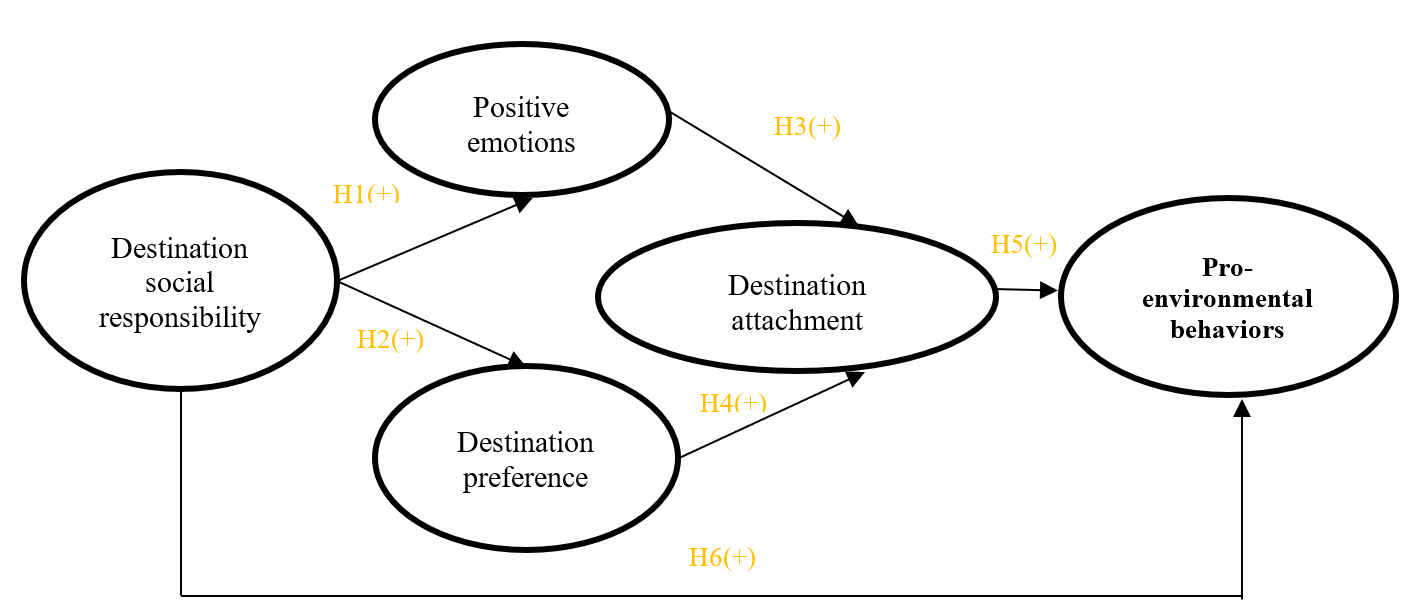
From the above hypotheses, the model’s impact of perceived destination social responsibility on residents’ pro-environmental behaviors is proposed (Figure 1).
Proposed research model
RESEARCH METHODOLOGY
Research design and measurement
This study conducted a survey that included closed-ended questions as a quantitative research method. The measurement items in the questionnaire include elements of the research model such as destination social responsibility (six items)2, 10, positive emotions (three items)12, destination preference (four items), destination attachment (five items)2, 10 and residents' pro-environmental behaviors (six items)2, 12. All items were rated on a five-point Likert scale (1= strongly disagree and 5= strongly agree).
To ensure content validity, four tourism lecturers and twenty management professionals working in the tourism field reviewed the measurement items to determine their appropriateness for assessing residents’ behaviors.
Qualitative methodology
In this stage, qualitative methods are used to identify and modify observed variables to suit the research area. The authors organized a group discussion with 20 managers of tourist destination organizations, as well as experts and lecturers working in the tourism industry in Dalat city. Moreover, 35 local residents were conducted a pilot survey to adjust the scale accordingly and complete the questionnaire.
Sampling and data collection
For EFA analysis, the sample size is based on an observation variable ratio of 5:1, which means that a measured variable needs at least 5 observations and preferably 10 or more observations. This study has 24 measured variables, so the appropriate sample size is 24048. For the linear structural model SEM, because it is based on large sample distribution theory, a large sample size is required; therefore, the minimum required sample size is 200, 300 is good and 500 is very good49. To response the above requirements, the research team issued a number of 550 votes. We conducted the survey over a period of 14 weeks from October 2023 to mid-February 2024. The survey team came destinations to distribute questionnaires to residents. Most of the questionnaires were directly guided by the surveyors so that residents could answer and type in the corresponding options. The total number of votes collected after the survey was 382, however the survey team eliminated 31 invalid votes, leaving 351 valid responses. This sample size is guaranteed and consistent with the requirements of this study.
Scale Development
The authors inherited the scales from previous studies, through qualitative research to adjust and perfect the scales. Residents in Dalat city filled out the survey using the scales presented in Table 1.
Scale items
|
Constructs |
Items |
Sources |
|
DSR |
DSR1: Dalat tourism organizations are concerned with environmental responsibility in tourism development |
Su & Huang (2012) |
|
DSR2: Dalat tourism organizations are very interested in contributing to the local community in tourism development. | ||
|
DSR3: Dalat tourism organizations have been successful in generating and distributing tourism revenue | ||
|
DSR4: Dalat tourism organizations treat stakeholders in tourism activities well |
Hu & et al (2019) | |
|
DSR5: Dalat tourism organizations act ethically and comply with all legal obligations to fulfill social responsibilities in tourism development | ||
|
DSR6: Dalat tourism organizations are very concerned about health and safety issues in tourism activities | ||
|
Positive emotions |
PE1: Tourism activities in Dalat make me feel excited |
Su & Swanson (2017) |
|
PE2: Travel activities in Dalat make me feel cheerful and happy | ||
|
PE3: Travel activities in Dalat make me feel comfortable/relaxed | ||
|
Destination preference |
DP1: Dalat is my favorite place |
Hu & et al (2019) |
|
DP2: I am more satisfied with Dalat than other places | ||
|
DP3: I like participating in activities in Dalat | ||
|
DP4: For me, nothing can replace the activities I enjoy in Dalat | ||
|
Destination attachment |
DA1: I am very attached to Dalat |
Su & Huang (2012) |
|
DA2: I'm interested in what other people think about Dalat | ||
|
DA3: I am interested in the successful development of Dalat | ||
|
DA4: I feel happy when others say positive things about Dalat |
Hu & et al (2019) | |
|
DA5: I feel uncomfortable when someone criticizes Dalat | ||
|
Pro-environmental behaviors |
PB1: I follow the regulations on environmental protection in Dalat |
Su & Swanson (2017) |
|
PB2: I protect the environment and natural resources in Dalat | ||
|
PB3: I reported to the Destination Management Board about the pollution and environmental destruction in Dalat | ||
|
PB4: When I see trash or tree branches, I put them in the trash |
Hu & et al (2019) | |
|
PB5: I accept some inconveniences to achieve the goal of environmental protection in Dalat | ||
|
PB6: I try not to affect the flora and fauna when participating in tourism activities in Dalat. |
Data analysis and processing methods
The research uses descriptive statistical analysis methods, testing the reliability of the scale, exploratory factor analysis EFA (Exploratory Factor Analysis), confirmatory factor analysis CFA (Confirmatory Factor Analysis), using the method SEM (Structural Equation Modeling) linear structural model analysis method to test the research hypotheses proposed in the model. Finally, use the standardized regression coefficient to show the different levels of influence between each pair of hypotheses to clarify the analytical content of the study.
RESULTS AND DISCUSSION
Described samples
Sample characteristics for 351 residents in Dalat show that the proportion of men is 54.1% compared to 45.9% of women. Tourism-related jobs account for 56.6%; jobs not related to travel account for 43.3%. Characteristics of the study sample are described in Table 2.
The table describes the study sample according to demographic characteristics
|
Gender |
N |
% |
Occuption |
N |
% |
|
Male |
190 |
54.1 |
Tourism-related job |
201 |
57.3 |
|
Female |
161 |
45.9 |
Not tourism-related job |
150 |
42.7 |
|
Age |
Level of education | ||||
|
18 to 25 |
58 |
16.5 |
Junior High School or Below |
172 |
49.0 |
|
26 to 45 |
164 |
46.7 |
Senior High School |
146 |
41.6 |
|
46 to 60 |
110 |
31.4 |
Undergraduate Degree |
31 |
8.8 |
|
60 or older |
19 |
5.4 |
Postgraduate Degree |
2 |
0.6 |
Reliability Statistics
The reliability of the destination social responsibility scale and residents' pro-environmental behaviors was assessed through the Cronbach's Alpha coefficient and the results are shown in Table 3. The results in Table 3 show that all Cronbach's Alpha coefficients are all greater than 0.7; The total variable correlation coefficients of the scales are all greater than 0.3 except PB5 (I accept some inconveniences to achieve the goal of environmental protection in Dalat) which was eliminated due to corrected item-total correlation is less than 0.3.
Results of testing scale reliability
|
Constructs |
Number of observed variables |
Cronbach's Alpha coefficient |
|
Destination social responsibility (DSR) |
6 |
0.846 |
|
Positive emotions (PE) |
3 |
0.835 |
|
Destination preference (DP) |
4 |
0.758 |
|
Destination attachment (DA) |
5 |
0.841 |
|
Pro-environmental behaviors (PB) |
5 |
0.872 |
EFA exploratory factor analysis
The results of EFA analysis of the scale of independent variables using the PAF (Principal Axis Factoring) extraction method with Promax perpendicular rotation show that the KMO (Kaiser-Meyer-Olkin) coefficient = 0.913 (>0.5) and the significance level Sig. = 0.0000 (<5%) proves that the observed variables are correlated with each other in the whole population, so EFA factor analysis is appropriate for the research data.
The impact of DSR on residents’ pro-environmental behaviors through 3 intermediary factors: Positive emotions (PE), Destination preference (DP) and Destination attachment (DA) as research suggests. EFA analysis aims to determine the appropriateness of the number of extracted factors. With the PCA (Principal Components Analysis) method, we obtain the following results:
– Eigenvalue coefficient > 1, Eigenvalue represents the amount of variation explained by the factor, factors with Eigenvalue less than 1 will not summarize information better than an original variable. Results from the study show that the 5 survey factors have Eigenvalues all greater than 1.
– Total Variance Explained: shows what percentage of the measured variables are extracted by the factors. In this study, the total variance extracted is 65.876%, greater than 50%, the general meaning is greater than the individual part and the error number, if this condition is met, the EFA model is appropriate.
Through analysis of the rotated matrix (Pattern Matrix), all observed variables are accepted because the loading factors are greater than 0.5. So the 23 observed variables are divided into DSR groups and 3 intermediate groups that affect the environmentally responsible behavior of local residents and continue to be included in the analysis.
EFA analysis results
|
Items |
Factor loading coefficient | ||||
|
1 |
2 |
3 |
4 |
5 | |
|
DSR1 |
.766 | ||||
|
DSR2 |
.683 | ||||
|
DSR3 |
.834 | ||||
|
DSR4 |
.786 | ||||
|
DSR5 |
.672 | ||||
|
DSR6 |
.667 | ||||
|
PB1 |
.893 | ||||
|
PB2 |
.758 | ||||
|
PB3 |
.776 | ||||
|
PB4 |
.862 | ||||
|
PB5 |
.721 | ||||
|
PE1 |
.851 | ||||
|
PE2 |
.860 | ||||
|
PE3 |
.865 | ||||
|
DP1 |
.782 | ||||
|
DP2 |
.721 | ||||
|
DP3 |
.673 | ||||
|
DP4 |
.879 | ||||
|
DA1 |
.750 | ||||
|
DA2 |
.863 | ||||
|
DA3 |
.827 | ||||
|
DA4 |
.736 | ||||
|
DA5 |
.835 | ||||
CFA confirmatory factor analysis
CFA analysis was performed to evaluate the overall measurement model. Unidimensionality, reliability, convergent validity, and discriminant validity were assessed. The results show CMIN/DF = 1.037 < 3, CFI = 0.973 > 0.9, TLI = 0.982 > 0.9, GFI = 0.952 > 0.9, RMSEA = 0.008 < 0.06. The results demonstrate that the model fits the data and the scale ensures unidimensionality. The results show that the standardized weight > 0.5, statistically significant (p < 0.05), CR value > 0.7 shows that the model meets the convergence criteria. Table 5 shows composite reliability (CR) > 0.7; Variance extracted (AVE) has a value of 0.590–0.646 (>0.5). Therefore, the scale is reliable. For discriminant validity, the square root of the extracted variance (AVE) has a value of 0.761–0.809 larger than the standardized correlation coefficient between pairs of DSR --> PE, DSR--> DP, PE -- > DA, DP --> DA, DA --> PB has values from 0.335–0.664 and the maximum individual variance value is smaller than the extracted variance. Therefore, the factors in the destination social responsibility scale have discriminant value. The results of CFA analysis of the scales show that all observed variables have estimated coefficient values greater than 0.5. Therefore, the factors of destination social responsibility of Dalat are meaningful in the scale.
Results of CFA analysis
|
CR |
AVE |
MSV |
PB |
DSR |
TP |
PE |
DA | |
|
0.863 |
0.696 |
0.445 |
0.768 | |||||
|
DSR |
0.846 |
0.549 |
0.436 |
0.432 |
0.786 | |||
|
TP |
0.832 |
0.584 |
0.446 |
0.653 |
0.647 |
0.761 | ||
|
PE |
0.840 |
0.645 |
0.403 |
0.335 |
0,622 |
0.453 |
0.809 | |
|
DA |
0.773 |
0.547 |
0.418 |
0.361 |
0.617 |
0.601 |
0.351 |
0.730 |
According to the test results of common method bias (CMB), the % of Variance value of the first factor in the Extraction Sums of Squared Loadings column in Table 6 shows that the extracted variance of 38,539 is less than 50%. Thus there is no presence of CMB.
Results of SEM model analysis
The study uses linear structural modeling (SEM) to test the research hypotheses proposed in the model. The results are shown in Table 4.
The fit index of the theoretical model (Model fit) from SEM analysis is as follows: Chi square index/df = 1.103 < 3, CFI = 0.968, TLI = 0.954, GFI = 0.963 (>0.9) and RMSEA = 0.013 < 0.08. This result shows that the theoretical model is compatible with market data. All relationships from H1 to H5 have positive regression coefficients (except H6); Therefore, hypotheses from H1 to H5 show the same direction because of the scale design. Therefore, the relationships in the model all meet the standards of theoretical relationship value.
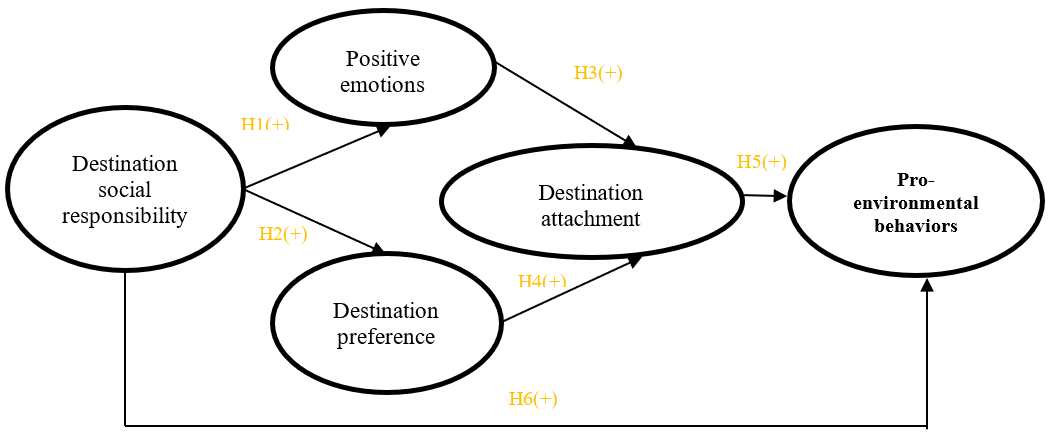
The results of estimating the research model are shown in Figure 2 as follows:

Model analysis results
Results Variance Magnification Factor VIF
|
VIF | |
|
DSR---> PE |
1.000 |
|
DSR---> DP |
1.000 |
|
PE---> DA |
1.098 |
|
DP---> DA |
1.000 |
|
DA---> PB |
1.098 |
According to the results of the VIF variance magnification factor in Table 6, all VIF values are less than 5. Thus, multicollinearity doesn’t occur in the model.
Test hypotheses and estimates of the research model
|
Hypothesis |
Estimate |
SE |
CR |
P value |
Estimate | |
|
H1 |
PE <-- DSR |
0.710 |
0.067 |
10.141 |
*** |
0.634 |
|
H2 |
DP <-- DSR |
0.708 |
0.065 |
9.108 |
*** |
0.655 |
|
H3 |
DA <-- PE |
0.244 |
0.053 |
4.612 |
*** |
0.279 |
|
H4 |
DA <-- DP |
0.516 |
0,091 |
6.603 |
*** |
0.520 |
|
H5 |
PB <--DA |
0.670 |
0.077 |
6,169 |
*** |
0.561 |
|
H6 |
PB <-- DSR |
-0.031 |
0.060 |
-0,630 |
0.348 |
-0.049 |
|
R2 - Squared Multiple Correlations | ||||||
|
Destination preference (DP) |
0.521 | |||||
|
Positive emotions (PE) |
0.404 | |||||
|
Destination attachment (DA) |
0.498 | |||||
|
Pro-environmental behaviors (PB) |
0.542 | |||||
The results of estimating the standardized regression coefficients on the relationships in the research model show that hypotheses H1, H2, H3, H4 and H5 are all statistically significant (p < 0.05); so these hypotheses are all accepted. As for hypothesis H6 (Destination social responsibility has a positive impact on residents' pro-environmental behaviors) is not accepted because it is not statistically significant (p > 0.05). From the standardized regression order, it shows that the absolute value of the destination preference scale is the largest, so this scale has the strongest impact on residents’ pro-environmental behaviors of Dalat city, followed by destination attachment affects pro-environmental behaviors and finally, the positive emotions scale affects residents' pro-environmental behavior less. Squared Multiple Correlations (R): R value of Destination preference is 0.521 so DSR explains 52.1% of the variation in destination preference. R value of destination attachment is 0.498; So DSR and destination attachment explain 49.8% of the variation in destination attachment. The value of Positive emotions is 0.404; So DSR and Positive emotions explain 40.4% of the variation in destination attachment. R value of Pro-environmental behaviors is 0.542; Therefore, DSR, destination preference, positive emotions, and destination attachment explain 54.2% of the variation in residents’ pro-environmental behaviors of Dalat city. Analysis results show that the relationship between variables in the model is stable and the proposed model has good explanatory ability (Table 7).
DISCUSSIONS AND MANAGERIAL IMPLICATIONS
Discussions
Residents’pro-environmental behaviors of Dalat is positively influenced by three intermediate factors: Destination preference, Positive emotions and Destination attachment. Specifically, residents feel excited, happy and comfortable when participating in tourist activities at Dalat, they care about what others think about Dalat, and are interested in the development and success of Dalat. They also feel uncomfortable when someone criticizes or is dissatisfied with this destination.
These positive factors will positively impact pro-environmental behaviors through actions such as residents always following regulations on environmental protection and natural resources; they report to the Destination Management Board about environmental pollution and destruction in Dalat. They consciously put trash and tree branches in the trash. Furthermore, local residents try not to affect the flora and fauna when participating in tourism activities in Dalat.
Apart from the research of Lee et al (2021)6 and Su & Swanson (2017)12, there are very few previous studies examining the impact of DSR of tourists to behave responsibly towards their environment. Su et al (2018) studied the contribution of DSR to residents' environmentally responsible behaviors1. The research results developed an integrated model to demonstrate that DSR has an influence on residents’ pro- environmental behaviors through general community satisfaction. Research results also show that DSR increases residents’ awareness of the positive impacts of tourism, improves overall satisfaction as well as contributes to residents’ pro-environmental behaviors1. Lee et al (2021) studied DSR on tourists' environmentally friendly behaviors through the VIP model (Values–Identity–Personal norms), the research results showed that DSR through price Biosphere values, environmental identity, and tourists' personal norms have a significant relationship with tourists' pro-environmental behaviors6. In addition, Su & Swanson (2017) investigated the influence of DSR on the environmentally responsible behaviors of first-time and repeat tourists, and the research results demonstrated negative emotions (including positive and negative emotions), destination attachmentis a mediating variable between DSR and pro-environmental behaviors. The findings show that DSR has a positive impact on tourists' pro-environmental behaviors through the mediating variables of positive consumption emotions and destination attachment12. Compared to previous studies, the study has examined the role of the intermediate variables Destination preference, Positive emotions and Destination attachment in the relationship between DSR and residents’ pro-environmental behavior. Furthermore, the study also explores whether there is a direct relationship between DSR and environmentally responsible behavior of local residents. Research results show that DSR has an indirect effect on residents' environmentally responsible behavior through three intermediate variables: Destination preference, Positive emotions and Destination attachment, but DSR does not have a direct impact on residents’ pro-environmental behavior.
Managerial implications
Research results show that three intermediate factors, positive emotions, destination preference and destination attachment, positively impact residents’ pro-environmental behaviors. The analysis results also show that DSR affects positive emotions, destination preference and destination attachment in the same direction. Furthermore, this study highlights the important role of DSR in promoting pro-environmental behaviors among local residents. Based on the research results, the authors propose several managerial implications for destination management organizations and tourism service providers in Dalat including:
Strengthen residents’ environmentally responsible activities
Destination management organizations and tourism service providers in Dalat should strengthen the launch of environmentally responsible movements among residents so that they can participate in forms of launching movements such as not littering, keeping the city green and clean, planting trees and flowers to create landscapes, not wasting, etc. creating a fresh, pollution-free atmosphere.
Contribute back to the community
Develop plans to contribute back to Dalat community such as preserving natural resources, planting trees, not cutting down forests and trees indiscriminately; protect forest resources, preserve the integrity of nature, do not affect wildlife, do not kill or trade wild animals, conserve and develop wild animals, etc.
Enhance good treatment with stakeholders
To well implement destination social responsibility, destination management organizations and tourism service providers need to strengthen good treatment of stakeholders through service improvement actions that not only satisfy tourists. tourism but also contributes to raising awareness of residents, tourists, businesses, etc. about the sense of social responsibility in tourism activities.
Improve revenue generation and reasonable allocation of tourism revenue sources
Promote revenue generation and reasonable allocation of tourism revenue sources, create jobs and income for local residents through tourism activities; these contributions to the destination social responsibility awareness will contribute to enhancing the destination's attractiveness and are one of the important factors in forming residents’ pro- environmental behaviors.
CONCLUSIONS
Research results show that residents’ pro-environmental behaviors of Dalat city residents is explained through three intermediary factors: positive emotions (PE), destination preference (DP) and destination attachment (DA). Among them, destination preference (DP) has the strongest impact on residents' environmentally responsible behaviors. Destination attachment (DA) has the second most influence on pro-environmental behaviors, and Positive Emotions (PE) has the least influence on local residents' pro-environmental behaviors. In addition to the indirect impact of DSR on pro-environmental behaviors through three intermediary factors, the authors want to further exploit the direct relationship of DSR on residents’ pro-environmental behaviors in Dalat city. Analysis results show that DSR plays an important role and has an indirect influence on residents' pro-environmental behaviors through three intermediate factors: destination preference, destination attachment and positive emotions; however, DSR does not directly impact residents' pro-environmental behaviors. The analysis results also show that DSR has a positive impact on destination preference and positive emotions; Furthermore, destination preference and positive emotions both have a positive impact on destination attachment. Regarding the relationship with residents’ pro-environmental behaviors of Dalat city, research results demonstrate that both destination preference, positive emotions and destination attachment have a positive impact on residents’ pro-environmental bahaviors at tourist destinations.
Compared to previous studies, the authors' research has proven that Dalat residents have a good awareness of the destination social responsibility, they will have positive emotions, destination preference, and destination attachment thereby creating pro-environmental behaviors. The results of this study are similar to the results of studies by Su et al (2018)1, Lee et al (2021)6, and Su & Swanson (2017)12. The research results also discovered that the impact of DSR on residents' pro-environmental behaviors is significant through three intermediary factors and without the direct impact of DSR to residents’ pro-environmental behaviors of Dalat city.
Limitations and future research directions
Compared with previous studies, this study has examined the role of intermediate variables in the relationship between DSR and residents’ pro-environmental behaviors. Besides, the study also examines whether there is a direct impact of DSR on residents' pro-environmental behaviors. Although certain results have been achieved, there are still some limitations. First, the study tested the hypothesis with residents in the city center, excluding residents in districts and communes on the outskirts of Dalat city. Therefore, future studies can expand the scope of research areas. Second, DSR is a multidimensional construct50. To simplify the model, this study uses a common scale of DSR to measure, so future studies can explore other roles in the model. These limitations will help open up further research directions in the future.
In summary, DSR plays an important role in the growth and development of sustainable tourism. Both conceptual and practical implications were presented in this study. Through DSR, the research has explained the process that determines residents' pro-environmental behaviors. The research results have synthesized the conceptual framework of DSR and the environmentally responsible behavior of local residents. Additionally, the study has proposed a model illustrating the relationship between DSR and environmentally responsible behavior. The conceptual framework describes the role of DSR in influencing residents' environmentally responsible behavior through three mediating factors: Positive Emotions, Destination Preference, and Destination Attachment. The research findings provide valuable insights for researchers interested in this field and offer practical implications for tourism destination managers in Dalat City to better understand the factors influencing local residents' environmental behavior. Consequently, this study supports the development of strategies aimed at improving residents' environmentally responsible behavior at the destination. The research results identify the proposed model as a solid conceptual framework to describe the role of DSR in relation to residents’ environmentally responsible behaviors through three mediating factors: Positive emotions, Destination preference, Destination attachment. Researching the impact of DSR on local residents’ pro-environmental behaviors contributes to helping destination management organizations understand the impact of DSR. Thereby, they will be aware of the role and importance of DSR as well as grasp the intermediary factors that affect residents' pro-environmental behaviors. From there, there will be measures to increase residents’ awareness of DSR to promote pro-environmental behaviors in Dalat.
LIST OF ABBREVIATIONS
AVE: Average Variance Extracted
CMB: Common Method Bias
CR: Construct Reliability
CFA: Confirmatory Factor Analysis
CFI: Comparative Fit Index
CMIN: Chi-square
DA: Destination attachment
DP: Destination Preference
DSR: Destination Social Responsibility
EFA: Exploratory Factor Analysis
H: Hypothesis
KMO: Kaiser Meyer Olkin
PAF: Principal Axis Factoring
PB: Pro-environmental Behaviors
PCA: Principal Components Analysi
PE: Positive Emotions
R: Square Multiple Correlations
RMSEA: Root Mean Square Error of Approximation
SEM: Structural Equation Modeling
SOR: Stimulus Organism Response
TLI: Tucker Lewis Index
CONFLICTS OF INTEREST
The authors declare that there is no conflict of interest in publishing this article.
AUTHOR CONTRIBUTIONS
Author Mai Thi Kieu Lan is mainly responsible for the content of the entire research article, building the research model, designing the survey, conducting the survey, entering and editing data, running the data, validate the scale, read and analyze data, complete the entire article and be the main author to submit the article.
Author Hoang Trong Hung builds hypotheses
Author Nguyen Thi Thanh Ngan writes the theoretical basis
Author Vo Minh Phuong conducts a theoretical overview
Author Nguyen Thi Huynh Phuong writes the research methodology.
ACKNOWLEDGEMENTS
This research article was supported by Dalat University