


Towards to sustainable corporate performance through circular economy practices and corporate social responsibility in Vietnam
- Ho Chi Minh City University of Economics and Finance, Vietnam.
Abstract
Modern technology has made it impossible to run a sustainably oriented business, particularly for small-to-medium enterprises (SMEs). The study examines the mediating role of eco-innovation (ECI) and green supply chain management (GSCM) in the food industry context in a developing country to inspect the nexus between corporate social responsibility ̣(CSR), circular economy practices (CEP) and sustainable corporate performance for SMEs. Smart PLS (version 4.0) structural method modeling (SEM) and quantitative methods were used to analyze 408 respondents collected from mid- to high-level managers in Vietnamese companies that work in the food industry. Results show that GSCM and ECI affect the sustainability of corporate performance. Furthermore, the research suggests that organizations and governments could promote ECI and GSCM in order to enhance CEP-SCP and CSR-SCP relationships. The study proposes some interesting implications that could assist high-level managers in an organization to attain sustainable performance. This study is significant because it highlights how CEP and CSR in GSCM and ECI might contribute to sustainability. Consequently, it encourages SMEs to implement operational and strategic reforms that have a major positive influence on the environment, society, and economy.
Introduction
Nowadays, organizations are increasingly realizing the strategic benefits of integrating green considerations into social responsibility activities. This includes focusing on sustainable and environmentally friendly products, which can lead to improved resource investment efficiency, marketability, corporate branding, higher revenues, and maintaining a competitive advantage 1. However, the impact of environmental preservation on firm performance is often overlooked in management literature2.
Moreover, it is supposed that the development of circular economy-related innovations promotes sustainability and resilience by creating innovative solutions for sustainable practices 3. In addition to improving material and energy savings, Circular Economy Practices (CEP) reduce system vulnerability to impulsive astonishments4. Hence, CEP is critical for sustainable development that balances economic growth, environmental concerns, and social standards.
As a complementary concept to the circular economy, eco-innovation (ECI) appeared as a way to address sustainability challenges in a linear economy5. Additionally, ECI is required to support green manufacturing for sustainable growth as an absorbency of sustainable practices 6. Corporations' ECI capacity is closely associated with their resources, powers, and wisdom, in light of quantity and quality 7.
In general, previous research articles only stopped at studying the direct relationships between the variables Corporate Social Responsibility (CSR), Circular Economy Practices (CEP) and Sustainable Corporate Performance (SCP) without mentioning the intermediate relationship between Eco-innovation (ECI) and Green Supply Chain Management (GSCM) in these relationships. Therefore, within the scope of this research article, the study will mention the impact of CSR on SCP as well as CEP on SCP. More specifically, this study also examines the interfering role of ECI and GSCM in the relationship between CSR, CEP, and SCP. Thus, this study aims to answer the following key questions:
RQ1: How do ECI, GSCM, CSR, and CEP impact SCP?
RQ2: How do ECI and GSCM mediate the relationship between CEP and SCP as well as CSR and SCP?
The research focuses on SMEs in the food industry in Vietnam. This field was chosen due to the complexity and vulnerability of the food value chain to environmental changes, and the involvement of multiple stakeholders with diverse backgrounds. The research targets the survey subjects, which are business managers from mid to high levels who work in the food industry of Vietnamese companies that prioritize CSR, economy, and sustainability. The purpose of the research is to provide an integrated model of CSR, ECI, CEP, GSCM, and SCP. Furthermore, this study urges company executives to carefully evaluate doable steps to enhance environmental performance, which certainly boosts corporate competitiveness and efficiency and promotes sustainable business practices. Strategic thinking for long-term corporate growth toward a sustainable balance between social, economic, and environmental advantages is another result of this research.
Literature review and hypothesis development
Underpinning theories
The resource-based view (RBV) theory8, stakeholder theory 9, and legitimacy theory10 were the three supporting theories used in this study. The aim of this research is to look at how CSR and CEP influence SCP in the mediating relationship between ECI and GSCM. RBV and stakeholder theory were both developed in the context of management strategy at the same time, According to Freeman et al takeholder theory and RBV may be reconciled, which might result in the growth of tactic management 11. RBV has a big effect on the discipline. As a result, including these four factors in the RBV of the business aids in its sustainability 11. The notion of integrating stakeholder theory components into RBV is becoming more and more appealing as corporations view stakeholders as proof of favored competition. According to Harrison et al., a company's strategic resources determine both its competitive advantages and long-term performance 12.
According to the stakeholder theory, which was developed by Freeman (an organization would operate and behave in a certain way in response to demands from various stakeholders 9. These demands might take the form of claims of legitimacy or power dependence. As a result, given the context this study is exploring, the three theories may have conceptual underpinnings in common.
Corporate social responsibility (CSR)
CSR has been gradually and extensively researched in the business domain. The literature defines CSR in a diversity of ways, from a requirement to stakeholders' prospects of being included in the triple bottom line, which combines economic, social, and environmental considerations13. CSR is a vital concept that is involved in research on business and society interactions. In the past 30 years, a great deal of research has been done to examine CSR's causes, effects, and dimensions 14, 15. In today’s dynamic context, reducing emissions and pollutants is seen as a crucial component in the management of production efficiency. In light of this, CSR is thought to be the prime option to promote ECI adoption, thus, enhancing business environmental performance and achieve SCP 16.
Circular economy practices (CEP)
CEP relates to the integration of environmental concerns into company activities. By shifting away from the old linear paradigm of "take-make-waste," the circular economy aims to reduce waste and maximize resource utilization17. Unlike the linear economy, which extracts raw materials to produce products that are discarded after use, CEP decouples economic activity from compromising environmental impacts. CEP promotes the creation of more advanced, eco-friendly, and productive substitutes that may turn trash into a resource for the production cycle 18. The success of CEP adoption will be influenced by a combination of internal (e.g. firm's resources, capabilities, and skills) and external variables (e.g. public policy, market conditions, technological innovation, and stakeholders) 19.
Eco-innovation (ECI)
Eco-innovation, also referred to as environmental or green innovation, is conceptually defined as any type of creation that can result in more effective resource and energy use, lower environmental damage from production and business operations, and increased environmental resilience in the direction of achieving sustainable development goals20. ECI was also defined by Ben and Chen as a corporation's capacity to "exploit natural resources and develop eco-capabilities''21. This is related to ECI strategies and the capacity to protect the environment from harm throughout the production process. According to a study by Cai and Li, eco-innovation may provide long-term gain and assist future development, in addition to having good effects on the ecosystem by decreasing waste, pollution, and emissions. Therefore, it is crucial to enhancing ECI in a business 22.
Green supply chain management (GSCM)
Green product design, procurement, distribution, processing, and waste management are all components of green supply chain management. GSCM may alternatively be defined as a collection of actions focused on cooperation and assessment to meet financial and environmental goals. In order to enhance business performance over the long term, GSCM integrates social and environmental metrics into SCM processes. To minimize the impact of suppliers' goods on the environment, GSCM requires appraising their environmental performance 23. Additionally, Le et al. claimed that the goal of GSCM in the context of CE is to offer facilities and systems across the supply chain phases in addition to management-related practices 24. GSCM approaches would assist businesses to possess much better perceptions in the eyes of customers, the community, employees, and the government by lessening their environmental effects25.
Sustainable corporate performance (SCP)
The SCP scale in the study included financial outcomes, functional or internal performance, learning and development, and employee and customer satisfaction. In addition to the economic perspective often used to evaluate small businesses, contribution to society, personal satisfaction, spiritual perspective, customer perspective, learning and development perspective are also perspectives to evaluate the effectiveness of a business/organization26. An integrated approach to SCP creates enhanced value delivery for customers and stakeholders, supports organizational sustainability, enhances the potential and productivity of the organization as a whole, and leads to greater performance 27. Consequently, they are able to make well-informed decisions about their organization's performance.
Hypothesis development
CSR and SCP
Over the years, international research has focused on CSR and its effects on SCP. Indriastuti and Chariri assert that CSR has a good and considerable influence on firms' ability to function sustainably 28. By lowering environmental expenditures through minimizing waste, conserving energy, and maximizing sales, CSR plays an essential role in enhancing the competitiveness of businesses in the market 29. This enhances the company's reputation, fosters customer loyalty, and improves financial performance. Additionally, according to López Belen et al., firms should not only concentrate on maximizing short-term profits but also pay attention to CSR, which may assist businesses in sustaining long-term values that are advantageous to preserving sustainable competitive advantage in the long run 30. Consequently, the following theory is put forth:
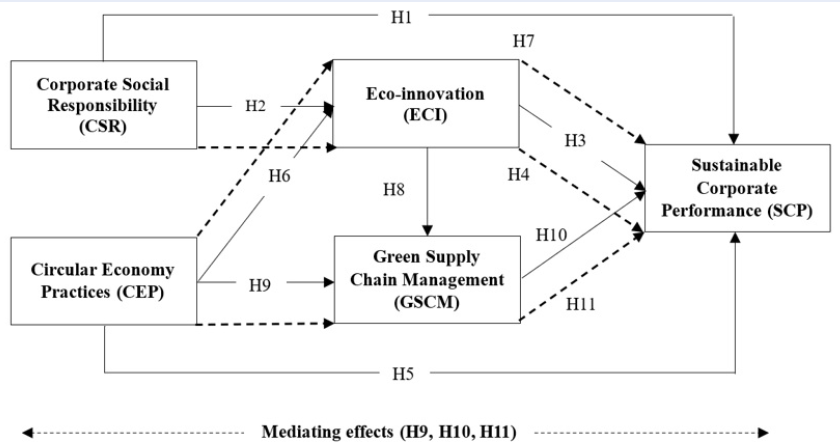
H1. CSR positively affects SCP.
ECI as a mediator in the relationship between CSR and SCP
While the connection between CSR and general innovation is better documented and studied, the connection between CSR and ECI has received very little notice in the literature, and has gradually appeared in the past couple of years. Le has recently revealed that higher CSR would lead to a beneficial and considerable promotion of ECI31. Issa and Bensalem also informed a meaningful association between CSR strategy and ECI, establishing from the possibility that a CSR approach may serve as an important source of ECI 32. In addition, scholars have figured out that the outcomes of ECI will result in benefits over competitors, such as a bigger market share, better performance, and a wider distribution network 33. Le also demonstrated that the amount of ECI influences SCP in a way that distinguishes a company from its rivals by offering consumers cutting-edge items that are eco-friendly31.
In light of this, ECI is considered as a vital factor in converting CSR initiatives into the essential creation of sustainable conduct. As a consequence of ECI, companies will have an edge over their competitors in terms of market share, performance, and distribution networks 33. Therefore, hypotheses are proposed as below:
H2. CSR positively affects ECI.
H3. ECI positively affects SCP.
H4. ECI mediates the relationship between CSR and SCP.
CEP and SCP
CEP authorizes business activities that advance the environment, society, and economy in the specified context in a number of ways. Moreover, a single company uses CEP to raise the SCP 24. CEP is crucial for promoting sustainable growth while upholding social norms and environmental concerns. Numerous studies have demonstrated the favorable benefits of CE practices on SCP, including waste and hazardous substance reduction, resource optimization, and energy efficiency enhancement34. There are various advantages and potential for SMEs: greater sustainability, a better public image, financial savings for the business, increased production, and environmental recovery through decreased CO2 emissions 19. Thus, a hypothesis is assumed as follows:
H5. CEP positively affects SCP.
ECI as a mediator in the relationship between CEP and SCP
detrimental effects of corporate activities on the environment are viewed as incentive factors for ECI. While CE adoption emphasizes the relevance of environmental challenges globally, ECI and corporate ecology share multiple subjects, notably sustainable innovation, corporate social responsibility, and technologically-based business strategies. Systematic ECI can lead to an increase in circularity 35. This relationship is also demonstrated in the research of36.
The European Commission reported the relationship between CEP and SCP, meaning implementations in CEP improve efficacy in the operation of resources and energy, lessen the adverse effects of manufacturing and business implements on the environment, and increase flexibility to environmental diversity toward the achievement of organic development goals20. Combining the previous discussion of the connection between CEP, ECI, and SCP with the academic context, the relationship between CEP, ECI, and SCP could be proposed as below:
H6. CEP positively affects ECI.
H7. ECI mediates the relationship between CEP and SCP.
ECI and GSCM
Sustainability can be improved through GSCM37. Thus, it can be said that ECI is one of the primary components contributing to GSCM. Additionally, GSCM is thought to be a successful strategy for lowering emission intensity and other environmental risks38. Sustainability is the foundation of this environmental innovation, which blends elements of the environment with typical supply chain operations39. To leverage the advantages of ECI, businesses must discover methods to incorporate environmental concerns into their supply chain operations that must be made more sustainable, and waste, emissions, and energy use should be reduced. As a result, the following theory is put forth:
H8. ECI positively affects GSCM.
GSCM as a mediator in the relationship between CEP and SCP
CEP is expected to promote GSCM through methods that boost resource circulation throughout supply chain systems. In CE, wasted resources and energy are recycled to create new business opportunities18. CEP serves as a platform for the exchange of specialized resources to improve the supply chain's overall efficiency in collecting payments24.
Accordingly, the adoption of GSCM can provide a competitive advantage and improve organizational performance 23. Thus, GSCM may also lead to SCP by increasing resource efficiency, maximizing material value production, reducing waste and emissions, extending product life cycles, and increasing productivity. Therefore, the mediating role of GSCM in the nexus between CEP and SCP is hypothesized as below:
H9. CEP positively affects GSCM.
H10. GSCM positively affects SCP.
H11. GSCM mediates the relationship between CEP and SCP
The discussion from above and the established research hypotheses served as the foundation for the proposed research model, which is illustrated in Figure 1. As a result, the research model for this study includes five variables. SCP is the dependent variable, ECI and GSCM are the mediators, and CSR and CEP are the two independent variables. They are built using the items listed in Table 1 below. The items in the structures are listed in Table 1.

Proposed research model
Research Methodology
Measurement scale
Table 1 below lists the variables, items, and related sources used in this study, which served as the foundation for the establishment of the scale. A 5-point Likert scale ranging from "strongly disagree" to "strongly agree" is used in the poll. Respondents select the point that most accurately represents their opinions.
Constructs and items
|
Constructs |
Items |
Descriptions |
References |
|
Corporate Social Responsibility (CSR) |
CSR1 |
We provide products and services tailored to meet society's functional needs. |
|
|
CSR2 |
Our firm communicates transparently with stakeholders about products, services, social responsibility, and policies. | ||
|
CSR3 |
We continuously improve our processes to boost product quality, conserve resources, and maximize efficiency. | ||
|
CSR4 |
Our firm invests in upgrading technology to ameliorate product quality and reduce emissions and pollution. | ||
|
CSR5 |
We prioritize providing our employees with a clear career path and opportunities for developing their skills and competencies. | ||
|
Eco- innovation (ECI) |
ECI1 |
Our firm brings new products and services to the green market faster than our competitors. |
|
|
ECI2 |
Customers often identify our new products and services as innovative. | ||
|
ECI3 |
Over the past three years, our company has introduced a greater number of environmentally innovative products and services than our competitors. | ||
|
ECI4 |
We are continuously upgrading our business processes. | ||
|
Circular Economy Practices (CEP) |
CEP1 |
Our company improves the process of turning trash into a production input. |
|
|
CEP2 |
We are dynamic about sharing particular resources to increase overall effectiveness. | ||
|
CEP3 |
Our firm encourages reducing energy use. | ||
|
CEP4 |
We encourage garbage recycling. | ||
|
Green Supply Chain Management (GSCM) |
GSCM1 |
We regularly tweak our marketing strategy to match the situation of the downstream supply chain. |
|
|
GSCM2 |
To increase resource efficiency, we regularly enhance our production method. | ||
|
GSCM3 |
Periodically, we make improvements to our production process to conserve energy. | ||
|
GSCM4 |
We set shared sustainable development objectives with supply chain participants. | ||
|
GSCM5 |
We forecast market demand using technology and real- time big data. | ||
|
Sustainable Corporate Performance (SCP) |
SCP 1 |
Our firm achieves revenue growth over time. |
|
|
SCP2 |
Over time, we are able to reduce waste. | ||
|
SCP3 |
We have successfully managed to reduce our energy consumption. | ||
|
SCP4 |
We provide employment sustainably to the community over time. | ||
|
SCP5 |
Over time, we gradually increase our customer base and experience growth. |
Preliminary research
To begin the research, a pilot survey with 100 samples collected from middle managers and senior managers in the Vietnamese food industry was conducted employing SmartPLS 4.0. The results indicate that every item has an outer loading value greater than 0.7. In addition, Cronbach's alpha values, AVE values, and reliability values of these variables are all greater than 0.7 43, 44. The findings also indicate that the scale generated by synthesizing earlier studies may be used in primary research. As a result, these items are utilized in the study as an extension of our original investigation.
Sample and data collection
The information was gathered using an online questionnaire-based survey. The collection was run from April 2023 to September 2023. 500 questionnaires were distributed to the target population, including middle managers and senior managers from the Vietnamese food industry. A total of 420 answer sheets were obtained, representing an 84% response rate. The veracity of the gathered replies was then determined. Consequently, 408 valid responses (or an 81.6% response rate) remained after 18 were eliminated for being incomplete. PLS-SEM, or partial least-square structural equation modeling, was then used to examine the candidates. Because PLS-SEM is suitable for model types with complex structures, it was used in this investigation. Moreover, the application was utilized instead of CB SEM because it was more practical for defining structure or investigating the extension of an already-existing structural theory. Furthermore, PLS SEM is simpler to use than CB SEM since the program automatically integrates and calculates all of the criteria of the measurement model. According to Hair et al.et al., a complex structural model—like the one proposed in this work—incorporates both direct and indirect relationships 45.
Results
Sample characteristics
The statistical categorization of the gathered samples is shown in Table 2. Based on our observations, these traits accurately reflect the study population.
Representativeness of collected samples
|
Indexes |
Frequency (n = 408) |
Proportion (%) |
|
Gender | ||
|
Male |
206 |
50.5 |
|
Female |
202 |
49.5 |
|
Age (years) | ||
|
Less than 36 |
96 |
23.5 |
|
From 36 to less than 45 |
155 |
40.0 |
|
From 46 to less than 55 |
107 |
26.2 |
|
Above 55 |
50 |
12.3 |
|
Education | ||
|
College |
78 |
19.1 |
|
Bachelor degree |
196 |
48.0 |
|
Master degree |
105 |
25.7 |
|
PhD degree |
29 |
7.2 |
|
Working experience (years) | ||
|
From 5 to less than 10 |
183 |
44.8 |
|
From 10 to less than 15 |
126 |
30.9 |
|
Above 15 |
99 |
24.3 |
|
Business Industries | ||
|
FMCG’s manufacturing companies |
266 |
65.2 |
|
Agricultural products’ manufacturing companies |
142 |
34.8 |
Assessment of measurement model
The framework has been assessed in accordance with the appropriate criteria, including reliability, convergent validity, discriminant validity, and predictive relevance. The statistical results have shown that both Cronbach's alpha and C.R. surpassed the recommended threshold of 0.7, implying that the scales used in the model are dependable46. The variance inflation factor (VIF) values of all items are smaller than 5, which is an accepted value 47. Table 3 provides a summary of the factor loadings and Cronbach's alpha, as well as C.R, AVE, and VIF.
The study's findings show satisfactory convergence with loading factors and AVE over 0.7 and 0.5, respectively. Furthermore, Q-square values beyond zero exhibit that the model has predictive relevance and well-reconstructed values, as illustrated in the table below48.
Scale’s reliability, convergent, discriminant validity and predictive relevance
|
Variables |
Items |
Factor loading |
VIF of items |
Cronbach's alpha |
Composite reliability (rho_a) |
Average variance extracted (AVE) |
Q2 |
|
Circular Economy Practices (CEP) |
CEP1 |
0.840 |
2.030 |
0.834 |
0.841 |
0.668 | |
|
CEP2 |
0.845 |
2.024 | |||||
|
CEP3 |
0.782 |
1.748 | |||||
|
CEP4 |
0.800 |
1.797 | |||||
|
Corporate Social Responsibility (CSR) |
CSR1 |
0.788 |
1.816 |
0.855 |
0.857 |
0.633 | |
|
CSR2 |
0.765 |
1.708 | |||||
|
CSR3 |
0.821 |
2.025 | |||||
|
CSR4 |
0.828 |
2.074 | |||||
|
CSR5 |
0.775 |
1.647 | |||||
|
Eco- innovation (ECI) |
ECI1 |
0.859 |
2.177 |
0.868 |
0.869 |
0.717 |
0.218 |
|
ECI2 |
0.860 |
2.278 | |||||
|
ECI3 |
0.843 |
2.024 | |||||
|
ECI4 |
0.822 |
1.897 | |||||
|
Green Supply Chain Management (GSCM) |
GSCM1 |
0.851 |
2.390 |
0.896 |
0.900 |
0.707 |
0.257 |
|
GSCM2 |
0.875 |
2.638 | |||||
|
GSCM3 |
0.885 |
2.906 | |||||
|
GSCM4 |
0.785 |
2.108 | |||||
|
GSCM5 |
0.803 |
2.160 | |||||
|
Sustainable Corporate Performance (SCP) |
SCP1 |
0.890 |
3.224 |
0.918 |
0.919 |
0.754 |
0.330 |
|
SCP2 |
0.889 |
3.176 | |||||
|
SCP3 |
0.862 |
2.703 | |||||
|
SCP4 |
0.900 |
3.473 | |||||
|
SCP5 |
0.796 |
1.905 |
Fornell and Larcker criterion
|
CEP |
CSR |
ECI |
GSCM |
SCP | |
|
CEP |
0.817 | ||||
|
CSR |
0.307 |
0.796 | |||
|
ECI |
0.411 |
0.486 |
0.847 | ||
|
GSCM |
0.389 |
0.454 |
0.584 |
0.841 | |
|
SCP |
0.410 |
0.448 |
0.600 |
0.546 |
0.868 |
To inspect the distinctiveness of the factors, the Fornell and Larcker criterion was employed to evaluate the discriminant validity. The square root of the AVE was higher than the correlations between latent variables, providing support for discriminant validity. Table 4 shows that the AVE is greater than its correlations, thus indicating that it is validated 49.
Heterotrait-Monotrait Ratio (HTMT)
|
CEP |
CSR |
ECI |
GSCM |
SCP | |
|
CEP | |||||
|
CSR |
0.359 | ||||
|
ECI |
0.479 |
0.561 | |||
|
GSCM |
0.446 |
0.517 |
0.659 | ||
|
SCP |
0.467 |
0.503 |
0.670 |
0.602 |
Moreover, the research uses the Heterotrait-Monotrait Ratio of Correlations (HTMT) as an indicator of discriminant validity to ensure that the variables are measuring different constructs. The results of this study, as presented in Table 5, demonstrate that the HTMT is less than 0.85, which strengthens the discriminant validity 50.
Goodness of fit (GoF)
The research utilizes several indexes to evaluate the proposed model's goodness of fit, including GoF, SRMR, and R2 51. The model's GoF score has been calculated using the suggested acceptance level of 0.36, resulting in a value of 0.51, which exceeds the "large fit" threshold52. Additionally, the standardized root mean square residual (SRMR) value of 0.048 is below the recommended threshold of 0.08 as proposed by Hu and Bentler53; and Henseler et al.50. The model also has a relatively good adjusted R coefficient of 0.443, indicating that the variables studied explain 44.3% of the variation in SCP. Overall, these results suggest that the present model is well-fitted and can be considered as a reliable representation of the data.
Assessment of structural model
The evaluation of the structural model was carried out by performing bootstrapping analysis, which resulted in Table 6. Furthermore, to first examine multicollinearity and common method bias, Harman's one-factor test is used for detecting such biases. Our exploratory factor analysis with one fixed factor showed that the total variance extracted was 38.018%, which is lower than the threshold of 50% recommended by Cooper et al. for analyzing common method bias, confirming that the study satisfies the conditions of common method bias and non-multicollinearity54. The SEM analysis results can be seen in Figure 2.
Based on the findings presented in Table 6, the research hypotheses were found to be acceptable. Specifically, the result (β = 0.398, t = 8.514, p < 0.05) supports and confirms H1, which asserts that CSR has a positive and significant impact on ECI. A similar conclusion can be delivered for H2, H3, H4, H5, H6, H7, H8, since the result, relatively, (β = 0.289, t = 7.057, p < 0.05), (β = 0.179, t = 3.214, p < 0.05), (β = 0.511, t = 8.145, p < 0.05), (β = 0.343, t = 5.080, p < 0.05), (β = 0.232, t = 3.560, p < 0.05), (β = 0.133, t = 2.271, p < 0.05), (β = 0.138, t = 3.061, p < 0.05) which reveal a constructive and substantial connection between CEP and ECI, CEP and GSCM, ECI and GSCM, ECI and SCP, GSCM and SCP, CSR and SCP, CEP and SCP with 95% confidence. Besides, the results show that the research hypotheses are supported by the lower and upper confidence intervals, which do not contain zero.
Additionally, VAF was used to evaluate the extent of ECI in the connection between CEP and SCP, CSR and SCP as well as the role of GSCM in the nexus between CEP and SCP. According to the results (β = 0.099, t = 3.785, p < 0.05, 20% ≤ VAF = 41.7% ≤ 80%), (β = 0.136, t = 4.840, p < 0.05, 20% ≤ VAF = 50.5% ≤ 80%), (β = 0.042, t = 2.180, p < 0.05, 20% ≤ VAF = 23.3% ≤ 80%), it is inferred that the relationship between CEP and SCP, as well as CSR and SCP, is partially mediated by ECI and GSCM, which means H9, H10 and H11 is accepted.
Bootstrapping results
|
Hypothesis |
Paths |
Coefficient |
T statistics |
P values |
CI 2.5% |
CI 95% |
VAF % |
|
H1 |
CSR → ECI |
0.398 |
8.514 |
0.000 |
0.293 |
0.473 |
N/A |
|
H2 |
CEP → ECI |
0.289 |
7.057 |
0.000 |
0.202 |
0.361 |
N/A |
|
H3 |
CEP → GSCM |
0.179 |
3.214 |
0.001 |
0.066 |
0.287 |
N/A |
|
H4 |
ECI → GSCM |
0.511 |
8.145 |
0.000 |
0.378 |
0.622 |
N/A |
|
H5 |
ECI → SCP |
0.343 |
5.080 |
0.000 |
0.207 |
0.474 |
N/A |
|
H6 |
GSCM → SCP |
0.232 |
3.560 |
0.000 |
0.108 |
0.360 |
N/A |
|
H7 |
CSR → SCP |
0.133 |
2.271 |
0.023 |
0.024 |
0.251 |
N/A |
|
H8 |
CEP → SCP |
0.138 |
3.061 |
0.002 |
0.043 |
0.224 |
N/A |
|
H9 |
CEP → ECI → SCP |
0.099 |
3.785 |
0.000 |
0.051 |
0.152 |
41.7 |
|
H10 |
CSR → ECI → SCP |
0.136 |
4.840 |
0.000 |
0.082 |
0.191 |
50.5 |
|
H11 |
CEP → GSCM → SCP |
0.042 |
2.180 |
0.029 |
0.011 |
0.085 |
23.3 |

SEM analysis diagram
Discussion and Implications
Discussion
The statistical findings support the research's hypothesis. First, the study addresses the effect of CSR and CEP on ECI, in parallel with the effect of CEP on GSCM. Most specifically, the result reveals that ECI is influenced by CSR practices, supported by previous studies 31, 32 and CEP, consistent with the previous scholar35. The statistical results also demonstrated the levels of these two impacts on the ECI, which shows that CSR has a stronger influence on the ECI than CEP. Furthermore, the significance value of the nexus between ECI and GSCM is surprisingly high, demonstrating the supportive impact of ECI on GSCM.
Second, the results indicate the constructive impact of ECI and GSCM on SCP. The result shows that these variables directly influence SCP. This conclusion supports the findings of above hypothesis discussion that integrating GSCM and ECI in the business’s operations and the general supply chain enhances business achievement and lower compromised environmental impacts. By doing this, supply chain participants may minimize resource waste, remove negative effects on the environment and society, and preserve ecological harmony, all of which enhance overall performance.
Third, the subject also supported the interfering role of ECI and GSCM in the two nexuses, CSR-SCP and CEP-SCP. Therefore, better conduct of CSR and CEP foster better ECI and GSCM, in turn boosting the SCP increase. A company's code of conduct should be integrated with social and environmental issues and values into its business development strategy to ensure effective CSR initiatives and practices. Consequently, when enterprises implement CSR effectively, they are more likely to promote ECI and GSCM, which ultimately results in SCP promotion.
Theoretical implications
In this study, the following theoretical implications are provided for the green literature: Firstly, it develops a factual framework that is unified with ECI and GSCM to co-mediate CEP-SCP and CSR-SCP relationships. In particular, better CSR and CEP lead to better ECI and GSCM, ultimately resulting in greater SCP. Secondly, by providing further evidence on the effect of CEP and CSR on ECI and GSCM toward sustainability, the findings contribute to the existing literature stream on CEP and CSR. Businesses should integrate environmental and social responsibilities into their decision-making, comply with social norms and values, and manage stakeholder interests ethically and maturely. Consequently, stakeholders become more supportive of the performance, thereby reducing the legitimacy gap. This study therefore confirms the feasibility of RBV theory and stakeholder theory in a setting where CEP, CSR, ECI, and GSCM are integrated as strategic resources for attaining sustainable performance. Thirdly, it is a food industry-specific scale extension for CSR, CEP, ECI, GSCM, and SCP. Finally, by examining the reasons why SMEs adopt green strategies, this study contributes to legitimacy theory.
Practical implications
This research outlines a path for firms to achieve SCP that supports production and consumption. It suggests that incumbent businesses and startups should view CSR as a duty to multiple stakeholders in the current situation. By adopting this tactic, businesses incorporate social, economic, and environmental considerations into their strategies, ensuring that their actions deliver benefits in all three dimensions. Given the current dynamic context, these three attributes are highly pertinent to stakeholders. Demonstrating a commitment to addressing these challenges throughout the supply chain enhances competitive advantages and SCP. Companies in the food value chain should heed the study's findings, considering global food security concerns driven by population growth and volatility. Timely innovation, aligned with CE principles, is essential. Effective assimilation of CE ideas can enhance competitive advantage and SCP within the CE industry.
CE is currently not well understood by SMEs in underdeveloped countries, making it unknown how CE will be included in food value chains. The notion of GSCM and its practical implementation are still in their infancy. In developing nations such as Vietnam, there are few regulatory frameworks connecting environmental and social concerns with CSR. It is recommended that businesses deliberately address economic, social, and environmental issues in a proactive manner to strengthen their sense of social responsibility. This method supports international efforts to accomplish sustainable development goals and is advantageous to enterprises, stakeholders, the world, the country, and society as a whole. Business owners should adopt a broader perspective, prioritizing sustainability and embracing CEP and CSR. To achieve SCP, businesses must address stakeholder, social, and environmental concerns at their core. Integration of the CE perspective into business practices is essential for competitiveness in today's integrated era.
Conclusion and limitations for future scope of study
Conclusion
The study's conclusions satisfied the paper's primary objective. The primary outcomes of this study include the positive relationships between CSR, CEP, ECI, GSCM and SCP, meaning that improving CSR, CEP, ECI, and GSCM practices facilitates the development of SCP in an organization. Additionally, it is demonstrated that improved CSR and CEP support improved GSCM and ECI, hence increasing SCP, by the two mediating roles that GSCM and ECI play in the linkages between CSR-SCP and CEP-SCP.
The stated goal of the study can be addressed by the results obtained. This is due to the fact that the discovered mechanism offers SMEs practical knowledge and tactics for implementing CSR and circular economy practices to support SCP through the mediation of GSCM and ECI, ultimately resulting in sustainability. This contribution is essential, especially in view of the problems associated with the world's population expansion and the possible shortage of resources mentioned earlier. Additionally, the emphasis on waste and its effects on the environment pushes businesses to innovate in order to become more sustainable. This highlights the study's theoretical and practical contributions to the current literature and their significance and applicability. Academics and business professionals may find the following theoretical and practical implications of the research interesting.
Limitations and further research
This study has several restraints. It primarily employs quantitative methods, suggesting a potential benefit from method integration. The focus on FMCG and agriculture industries may limit the generalizability of findings to other sectors, thus recommending broader sector inclusion. Additionally, the study concentrates on SMEs in Vietnam, a growing economy, warranting further investigation of non-SMEs in diverse contexts to understand contextual influences. Recognizing global economic interconnections, it's essential to acknowledge regional variations in economies, cultures, societies, institutions, and business environments, urging more research into growing economies in the region. Such efforts could advance circular economy practices, foster sustainable growth across sectors, and benefit both corporate interests and the public.
ABBREVIATIONS
CEP: Circular Economy Practice
CSR: Corporate Social Responsibility
ECI: Eco-innovation
FMCG: Fast Moving Consumer Goods
GSCM: Grren Supply Chain Management
SCP: Sustainable Corporate Performance
SMEs: Small to Medium Enterprises
CONFLICT OF INTEREST
The authors declare that they have no conflicts of interest
AUTHOR CONTRIBUTIONS
Thanh Tiep Le is responsible for the content of section Introduction, Theoretical basis, Research method, Discussion, Conclusion, implications and limitations.