


Macro factors affecting the decisions to use currency derivatives of Vietnam's import and export enterprises: A new approach from LASSO regression models
- University of Economics and Law – Vietnam National University Ho Chi Minh City, Vietnam
Abstract
The emergence of currency derivatives plays a particularly important role for import - export businesses in minimizing financial risks and ensuring profits from future purchase and sale contracts. Although currency transactions using this tool bring many benefits, it is also inevitable that some risks occur due to uncontrollable fluctuations in exchange rates, interest rates, inflation and foreign exchange reserves in international trading transactions for entrepreneurs. Therefore, the study is conducted with the objective of analyzing the macro factors affecting the decision to use currency derivatives of import-export enterprises in Vietnam. The study uses secondary data collected in the period 2015 - 2021 of 100 enterprises with import-export activities in Vietnam listed on stock exchanges. Applying the new regression model LASSO to analyze the rules, affecting the decision to use financial derivatives and compare with the results when using the S-GMM method. The main results show that all four main independent variables have a significant impact on the decision to use currency derivatives of Vietnamese import and export enterprises. These are all based on science as well as previous research. Specifically, among the four main independent variables, interest rates, inflation and exchange rates have a positive and significant impact on the decision to use currency derivatives of Vietnamese import and export enterprises; meanwhile, foreign exchange reserves have a negative impact on the decision to use currency derivatives of Vietnamese import and export enterprises. In conclusion, the research will make a major contribution to the correction of defects in the model through the LASSO regression model. After obtaining the research results, the study will provide management implications for businesses to make decisions about using the tool effectively with the least risk.
Introduction
Vietnam is a dynamic market of the Asia-Pacific region with an economy of about 400 billion USD in recent years1. That shows that Vietnam's economy is gradually stabilizing and actively integrating with the global economy. However, there are many complicated developments in the business environment, in particular, the impacts and effects of exchange rate risks2. The exchange rate will have overall effects on the economy and people, as the appreciation of the local currency will make domestic goods more expensive than foreign goods3. To limit the impact and prevent the above risks, financial derivatives were born as an optimal solution for businesses4. The use of currency derivatives can significantly reduce exchange rate risk5 and create positive impacts on growth opportunities for businesses6.
In the reality context, the global derivatives market has undergone substantial growth, as businesses increasingly turn to currency derivatives for hedging against exchange rate risk7. Derivatives are contractual agreements that derive their value from the performance of an underlying financial asset, index, or other investment instrument8, and are essentially linked to various factors such as commodity prices, raw materials, assets, exchange rates, indices, events, or the scale of the event specified within the contract9. Many developed countries have extensively used derivative financial instruments and regarded them as one of the important tools10. However, in Vietnam, the application of these financial instruments is still very limited. Very few businesses, especially import-export enterprises, have deployed and used derivative financial instruments to hedge against risk2, despite Vietnam's ranking as the 23rd largest exporter and the 20th largest importer in the world11.
In the research background, previous studies focus on analyzing different perspectives: Micro factors and the decision to use currency derivative financial instruments of businesses10, 12, 2; Macro factors affecting exchange rates13, 14, 15, 16; Exchange rates and the decision to use currency derivative financial instruments5, 17, 18. Remarkably, some studies only analyze the impact of each individual macro factors on the use of currency derivative financial instruments, such as: Interest rates19, 20; Inflation21, 22. There has been no specific study that fully investigates the relationship between macro factors and the decision to use currency derivative financial instruments. Furthermore, no previous study has applied the LASSO regression method. LASSO is an extension of OLS linear regression, performing both variable selection and regularization via coefficient of constraint, potentially improving accuracy and interpretability23, while minimizing the impact of unimportant variables on the model and minimizing prediction error24.
From the gap in the existing literature, this study explores the relationship between macroeconomic factors (Interest rate, Inflation, Foreign exchange reverse, Exchange rate) and the decision of using financial derivatives through the empirical evidence from 100 Vietnam’s Import & Export companies listed on stock exchanges over the period 2015-2021. As a result, the research paper will propose several managerial implications to prevent risks and ensure profitability for businesses.
Thereby, the study makes the following contributions to the field. About the research field: Besides the popular research methods before, the study uses a new method to process the research model through lasso regression to overcome the defects occurring in the model. In terms of practice: Based on well-founded analysis, the research team has provided policy implications for import and export enterprises' tendency to use financial derivatives in hedging against risks. Unforeseen changes affect the business
Theoretical framework
The relationship between the interest rate and decision of using currency derivatives
Several studies find an indirect relationship between interest rates and the decision to use currency derivatives through exchange rates. Zhou & Wang (2013) and Makar et al. (2013) have an assessment of foreign exchange risk and the impact of using currency derivatives through foreign exchange, the result indicates using currency derivatives as a means of hedging financial risk related to factors of exchange rate and interest capacity18, 25. Besides, the study between interest rates and the decision to use currency derivatives of enterprises also has a direct relationship when Purnanandam (2007) and Tanha & Dempsey (2017) find a positive relationship lies in companies using currency derivatives19, 20.
H1: Interest rates have a positive impact on the decision to use currency derivatives.
The relationship between the inflation and decision of using currency derivatives
Inflation directly impacts exchange rate volatility26, affecting economic growth and business activities27. Rising domestic prices make goods more expensive, leading to decreased demand for goods and exports. This decrease in foreign exchange supply and exchange rate increases28. However, some studies suggest inflation has a negative impact on exchange rates29, 30. Firms in high-inflation countries should hedge their inflation risk with currency derivatives to protect profits and revenue21. Financial derivatives help reduce risks related to fluctuations in exchange rates and commodity prices due to macro factors like inflation22.
H2: Inflation has a positive impact on the decision to use financial derivatives.
The relationship between the foreign exchange reserves and decision of using currency derivatives
According to several studies, the choice to use monetary derivative financial instruments for import-export has a direct bearing on exchange rates31, 32. The increase in foreign exchange reserves could impact the demand for imports33. In the meantime, import transactions require the use of foreign currencies at exchange rates as a form of payment34. The company's value is increased favorably by using derivative financial instruments as a tighter barrier than trading on the foreign exchange market31. Additionally, using foreign currency derivatives helps reduce an enterprise's level of exchange rate risk to a variety of degrees18, 25.
H3: Foreign exchange reserves have a negative impact on the decision to use financial derivatives.
The relationship between the exchange rate and decision of using currency derivatives
The exchange rate has a positive impact on the decision to use financial derivatives35, reducing the degree of exchange rate risk for firms to varying degrees36. Firms exposed to exchange rate risk as measured by sales abroad tend to enhance the value of their businesses by using currency derivatives37. Contrary to some previous studies, some studies show that there is not a clear relationship between the use of financial derivatives and foreign exchange risk38, 39. Other studies also argue that the use of currency derivative financial instruments does not have a significant effect on firm value in the face of risks such as foreign currency risk40.
H4: Exchange rate has a positive impact on the decision to use financial derivatives.
Research method
The data used in this paper is panel data for 100 import-export companies in Vietnam during the period 2015-2021, so theoretically this is a panel data model. The dependent variable is a dummy variable indicating whether the firm decides to use currency derivatives or not. Independent variables are macro factors including exchange rate, interest rate, inflation and foreign exchange reserves collected from World Bank and internal business factors including return on assets, business size, quick ratio and financial leverage which are collected and calculated from annual reports. Data is entered into STATA 17 software to perform descriptive statistics and estimate econometric models to characterize the dataset and evaluate the impact of independent variables in the model. The paper uses 3 approaches to estimate models including: Logit Model, System - Generalized Method of Moment and LASSO method.
(i) Logit Model41 used for analysis is the impact of each macro variable and 4 control variables on the dependent variable individually and the impact of all macro variables and 4 control variables on the dependent variable. In particular, we estimate the following equations:
Where, p is the decision probability of the observations in time t; X are independent variables of observation i corresponding to each time t; β is the regression coefficient corresponding to each X.
(ii) System - Generalized Method of Moment42 is used to overcome the defects of the model when the dynamic estimation technique is used to introduce the dependent lagged variable Y into the model to consider the influence of the past value on the model. present value and adjustment of the dependent variable over time. In particular, we estimate the following equations.
Where Y is the lagged variable of the dependent variable; v is a fixed effect; u is the random error.
(iii) LASSO has the ability to improve accuracy and interpretability compared to classical regression methods23, bringing the regression coefficients of independent variables with no significant impact to approximately zero and minimizing the heteroscedasticity43. Research approaches using Lasso methods because they handle well in the case of multicollinearity of the model and show ideal properties to minimize numerical instability that can occur due to overfitting problems44, from there the accuracy in the study is improved. LASSO regression is also an adjusted multivariable linear regression method, in which the estimated parameters are based on the minimum of the expression45:
Results and discussion
Main Results
Logit Model
Logit Model
|
Dependent Variable | |||||
|
Variable |
Model 1 |
Model 2 |
Model 3 |
Model 4 |
Model 5 |
|
ROAit |
-0.0194** |
-0.0188** |
-0.0194** |
-0.0191** |
-0.0182** |
|
(0.00786) |
(0.00799) |
(0.00785) |
(0.00799) |
(0.00786) | |
|
ln(FSit) |
0.0557 |
0.0662 |
0.0533 |
0.0659 |
0.0512 |
|
(0.0480) |
(0.0478) |
(0.0481) |
(0.0478) |
(0.0485) | |
|
-0.131* |
-0.127* |
-0.132* |
-0.128* |
-0.132* | |
|
QRit |
(0.0694) |
(0.0696) |
(0.0696) |
(0.0696) |
(0.0707) |
|
FLit |
-0.0138*** |
-0.0142*** |
-0.0139*** |
-0.0144*** |
-0.0138*** |
|
(0.00493) |
(0.00494) |
(0.00493) |
(0.00494) |
(0.00495) | |
|
ERit |
0.000349** |
-0.000590 | |||
|
(0.000169) |
(0.000995) | ||||
|
IRit |
0.0564 |
-0.522 | |||
|
(0.0491) |
(1.039) | ||||
|
ln(FRit) |
0.454** |
1.688 | |||
|
(0.203) |
(1.227) | ||||
|
INFit |
-0.0391 |
-0.695 | |||
|
(0.0509) |
(1.146) | ||||
|
Constant |
-9.586** |
-2.266 |
-12.89** |
-1.869 |
-25.96** |
|
(3.974) |
(1.399) |
(5.112) |
(1.358) |
(11.23) | |
|
P-value (F-test) |
0.0000 |
0.0002 |
0.0000 |
0.0002 |
0.0001 |
|
Number of Observations |
700 |
700 |
700 |
700 |
700 |
Table 1 gives the results of the Logit Model, specifically, the P-values of the 5 models are all less than 0.05. Therefore, it can be concluded that all 5 models are significant at the 5% level. At the same time, the three control variables are return on assets, quick ratio and financial leverage are significant in 5 models at 5%, 1% and 10% respectively.
S-GMM Methods
The results of the models after overcoming the defects: multicollinearity, autocorrelation and variable variance by the S-GMM method (details in Table 2).
Results of the model estimated by the S-GMM method.
|
(1) |
(2) |
(3) |
(4) |
(5) | |
|
Variable |
Model 1* |
Model 2* |
Model 3* |
Model 4* |
Model 5* |
|
Decisionit-1 |
0.795*** |
0.745*** |
0.785*** |
0.742*** |
0.805*** |
|
(43.98) |
(32.54) |
(42.58) |
(29.60) |
(24.58) | |
|
ROAit |
0.00000639 |
-0.0000695 |
-0.00000252 |
-0.0000381 |
-0.000211** |
|
(0.06) |
(-0.98) |
(-0.02) |
(-0.44) |
(-2.09) | |
|
FLit |
0.00130 |
0.00737** |
-0.000918 |
0.00737** |
0.00957** |
|
(0.47) |
(2.23) |
(-0.28) |
(2.04) |
(2.28) | |
|
ORit |
0.00143 |
0.00347 |
0.000147 |
0.00327 |
0.00108 |
|
(0.66) |
(0.96) |
(0.06) |
(0.92) |
(0.35) | |
|
FLit |
-0.00000807 |
-0.0000107* |
-0.0000114 |
-0.00000870 |
-0.0000224*** |
|
(-0.95) |
(-1.88) |
(-1.28) |
(-1.25) |
(-2.69) | |
|
ERit |
0.0000330*** |
0.0000108 | |||
|
(4.29) |
(0.29) | ||||
|
IRit |
0.0186*** |
0.235*** | |||
|
(4.24) |
(3.18) | ||||
|
ln(FRit) |
0.0372*** |
-0.173** | |||
|
(3.85) |
(-2.50) | ||||
|
INFit |
-0.0182*** |
0.232*** | |||
|
(-3.75) |
(3.17) | ||||
|
Constant |
-0.742*** |
-0.236** |
-0.858*** |
-0.0992 |
2.148*** |
|
(-3.93) |
(-2.54) |
(-3.78) |
(-1.06) |
2.85) | |
|
Number of Observation |
600 |
600 |
600 |
600 |
600 |
|
Number of Company |
100 |
100 |
100 |
100 |
100 |
|
F Test (P-value) |
0.000 |
0.000 |
0.000 |
0.000 |
0.000 |
|
Hansen Test (P-value) |
0.425 |
0.451 |
0.318 |
0.211 |
0.202 |
|
AR1 Test (P-value) |
0.000 |
0.000 |
0.000 |
0.000 |
0.000 |
|
AR2 Test (P-value) |
0.101 |
0.123 |
0.096 |
0.121 |
0.142 |
|
Number of Instrument variable |
24 |
24 |
24 |
24 |
28 |
|
Check the stability of the estimated coefficient |
0.795 |
0.745 |
0.785 |
0.742 |
0.805 |
LASSO Methods
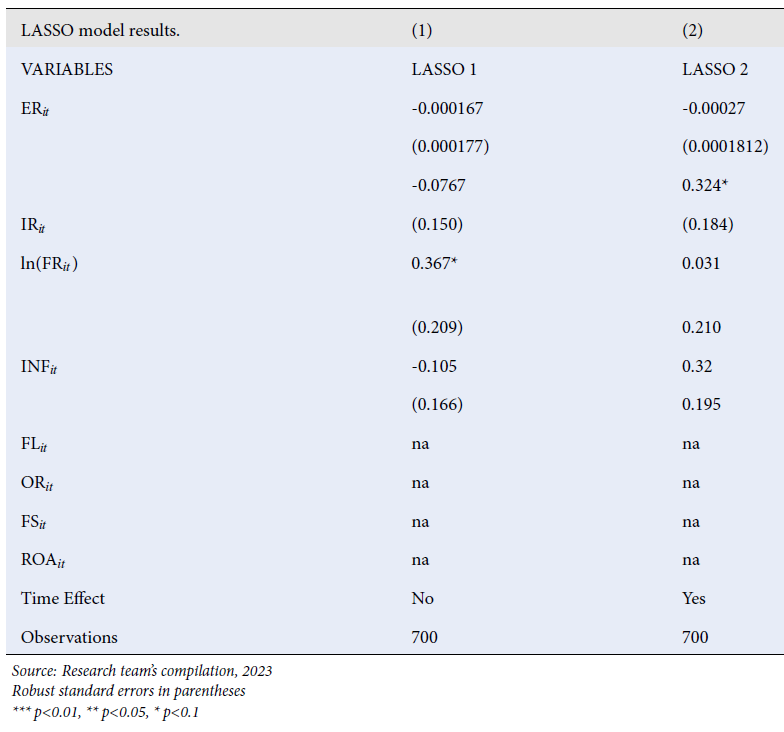
The model results after overcoming the defects: multicollinearity, autocorrelation and variable variance by the regression method of compaction and minimum selection operator (LASSO).
LASSO model results.
|
LASSO model results. |
(1) |
(2) |
|
VARIABLES |
LASSO 1 |
LASSO 2 |
|
ERit |
-0.000167 |
-0.00027 |
|
(0.000177) |
(0.0001812) | |
|
-0.0767 |
0.324* | |
|
IRit |
(0.150) |
(0.184) |
|
ln(FRit) |
0.367* |
0.031 |
|
(0.209) |
0.210 | |
|
INFit |
-0.105 |
0.32 |
|
(0.166) |
0.195 | |
|
FLit |
na |
na |
|
ORit |
na |
na |
|
FSit |
na |
na |
|
ROAit |
na |
na |
|
Time Effect |
No |
Yes |
|
Observations |
700 |
700 |
Table 3 indicates that when uncontrollable for time (LASSO model 1), only the foreign exchange reserve variable is statistically significant at the 10% level. However, when controlling for time (LASSO model 2), only the interest rate variable is statistically significant at the 10% level.
Discussion
Interest rate variable is statistically significant when estimated by S-GMM method at 1% level in both model 2* and model 5*, when using a controlled LASSO regression on the time interest rate is significant at the 10% level. When interest rates increase by 1%, the probability of using currency derivatives of import-export enterprises in Vietnam increases in the range of 0.018% (model 2*) to 0.234% (model 5*). This result supports a number of previous studies46, 20 which show that the use of interest rate derivatives will minimize shocks affecting businesses. Import-export businesses tend to manage their assets better when interest rates tend to increase.
Inflation variable is statistically significant when estimated by S-GMM method at 1% level in both model 4* and model 5*, this is not statistically significant when evaluated by the logit regression model. When inflation increases by 1%, the probability of using currency derivatives of import-export enterprises in Vietnam increases by 0.232% (model 5*). The above results are consistent with some previous studies47, 48, the change of currency shocks adversely affects the growth of enterprises. High inflation affects corporate profitability, corporate financial decision makers face inflation risk in addition to exchange rate risk and commodity price risk21.
The foreign exchange reserve variable is statistically significant when estimated by the S-GMM method at 1% in both model 3* and model 5*, this is statistically significant in model 3 when evaluated by the logit regression and LASSO regression when uncontrollable for time. When foreign exchange reserves increase by 1%, the probability of using derivatives of import-export enterprises in Vietnam increases by 0.037% (model 3*) to 0.454% (model 3) and reduced by 0.173% (model 5*). The obtained results follow a number of previous studies before Aizenman & Riera-Crichton (2008) stated that developed countries tend to be sensitive to changes in reserve assets, affecting the increase in the risk insurance of the business49. However, this impact does not have a strong direct effect on firms engaged in SME import and export business31, 50, 51.
The exchange rate variable is not statistically significant when evaluating the overall impact of both model 5 (Logit) and the model 5* (SGMM). However, when evaluating individual effects by logit regression (model 1) and S-GMM method (model 1*), this independent variable is statistically significant at 5% significance level. When the exchange rate increases by 1%, the probability of using currency derivatives of import-export enterprises in Vietnam increases by 0.000349% (Logit) and 0.000033% (S-GMM). The exchange rate has a positive impact on the decision to use derivatives36, 35. On the other hand, the results obtained disagree with some studies40, 52, 53.
The results of model 5 (Logit) rate of return on assets, financial leverage is statistically significant at 5% level, this also gives similar results when using the S-GMM estimation method (model 5*). This result is consistent with some previous studies54, 55, 56, the higher the ROA, the more money an import-export enterprise earns, the lower the financial pressure of import-export enterprises, the less the enterprises will use derivative financial instruments. Large firms are more likely to use derivatives, firm size has a significant positive relationship with hedging decisions and helps increase firm value39, 6, 57. This is also consistent with a number of other studies58, 59, 60. Meanwhile, the financial leverage variable is contrary to some studies61, 62, 63.
Conclusion
In this study, we investigated the impact of macro factors on decisions to use currency derivatives, including interest rates, inflation, foreign currency reserves, and exchange rates. We utilize an unique hand collected data set containing information that related to the decisions of using currency derivatives over the period from 2015-2021. Models such as OLS, S-GMM, and LASSO are utilized in the paper to estimate and repair model defects.
The results reveal that the elements that influence the decision to employ currency derivatives by importing and exporting firms in Vietnam are founded on scientific foundations as well as previous investigations. Macro factors are foreign exchange reserves, interest rates, inflation, exchange rates, and control variables (quick ratios, financial leverage, return on assets, and firm size) all have an impact on the decision to use derivative financial instruments of Vietnam’s export and import enterprises. Specifically, among the four main independent variables, interest rates, inflation and exchange rates have a positive impact on the decision to use currency derivatives of import-export enterprises in Vietnam; foreign exchange reserves have a negative impact on the decision to use currency derivatives. Besides, control variables such as return on assets and financial leverage have a negative impact on the decision to use currency derivatives; firm size and quick ratio have a positive impact on the decision to use currency derivatives.
From the underlying results, the paper offers four governance rules targeted at developing the degree of popularity and as a basis for utilizing monetary derivative financial instruments to protect risks in trade:
First, businesses need to actively capture and update information regularly to be able to accurately forecast market movements. This requires businesses to prepare facilities and human resources to be able to perform this task. In particular, businesses need to pay attention to patterns, levels, and routes of price and interest rate rises in the market to be able to make correct decisions, limiting mistakes in business. This is an important factor to help businesses prepare business and financial plans and negotiate with partners on supply prices, consumption of goods and services in bilateral and multilateral economic contracts.
Second, in the current corporate environment, inflation is potentially unpredictable, causing an impact on the exchange rate. The use of derivatives as a preventive measure becomes more urgent when the State Bank is tending to gradually switch to the mechanism of buying and selling foreign currencies. Therefore, businesses need to make smart decisions and use derivatives effectively to minimize risks and protect profits in their business.
Third, the State Bank needs to deploy monetary policy operating tools flexibly and synchronize macroeconomic operating solutions. In particular, controlling inflation, attracting foreign investment flows and remittances through the use of monetary policy management tools such as exchange rates and interest rates is very important. Besides, it is necessary to limit dollarization in the economy. This will contribute to attracting investment capital flows, foreign currency capital such as exports, foreign investment, remittances transferred to Vietnam to increase, leading to a trade surplus. To enhance the impact on Vietnam's foreign exchange reserves, governance measures can be proposed such as improving foreign exchange reserve management, strengthening cooperation with foreign currency partners, promoting policies to support export and foreign investment; at the same time, strengthening the capacity of monetary risk management for enterprises.
Fourth, businesses must find reasonable import and export markets and choose the most suitable payment currency to maximize their profits. To deal with exchange rate risks, businesses also need to look for banks with good trade finance capabilities, use financial derivatives such as foreign currency trading with a term and swap contracts to ensure that import and export activities are scientifically planned.
Despite our significant contributions to the growing body of research on derivatives use, this research has several limitations. First, the study has not considered the short and long-term impact of macro variables on the decision to use currency derivatives. Therefore, the most general view of the relationships between variables have not been given to provide deeper management implications and closer to reality. Second, because the time to measure the impact of macro factors is still relatively short (2015 - 2021), the number of observations is low. Therefore, the actual research still lacks explanatory power and the level of reliability is limited. Third, the study has not assessed the impact of macro factors on the decision to use currency derivatives through a two-stage regression model, that is, assessing the impact of macro factors to the exchange rate and from the exchange rate to the decision to use currency derivatives of the import and export enterprises.
ABBREVIATIONS
LASSO: least absolute shrinkage and selection operator
S-GMM: System - Generalized Method of Moment
STATA: software package developed by Stata Corp
na: not applicable
OLS: Ordinary least squares
CONFLICT OF INTEREST
The authors declare that they have no conflicts of interest.
AUTHORS’ CONTRIBUTION
Nguyen Pham Minh Chau is mainly responsible for writing the content of the research paper, including: Introduction, theoretical framework, research method, discussion and conclusion.
Nguyen Thuy Thu Ha is responsible for collecting data and writing the content of the research paper, including: Introduction, theoretical framework.
Le Ngoc Bao My is responsible for collecting data and writing the content of the research paper, including: abstract, theoretical framework.
Le Thai Nguyen is responsible for collecting data and writing the content of the research paper, including: theoretical framework, research method
Luong Huu Trien is responsible for collecting data and writing the content of the research paper, including: research method, results and discussion
Nguyen Thi Ngoc Suong jointly contributed to the conclusions and proposed policies.
Trinh Minh Quy is responsible for writing results and discussion, as well as reviewing, and correcting to complete the whole content of the article.