


The Factors influencing tourists' decision to participate in agritourism activities - A case study of Dalat city
- Dalat University, Vietnam
- School of Tourism – Hue University, Vietnam
- Can Tho University, Vietnam
- Can Tho College, Vietnam
Abstract
Agritourism is a topic that has attracted the attention of many scholars in recent years. This study analyzes the impact of factors affecting decision to participate in agritourism activities of tourists in Dalat city. The study was carried out on the basis of a survey of 180 tourists who are participating in agritourism activities in Dalat city and a linear regression model is used to analyze the impact relationship in the model. The study carried out descriptive statistical analysis, testing the reliability of the scale, exploratory factor analysis, and Pearson correlation analysis to test the research hypotheses proposed in this model. Finally, use the standardized regression coefficient to show the different levels of influence between each hypothesis to clarify the analytical content of the study. Research results show that all 6 factors such as Attraction of destination, Service price, Marketing, Travel motivation, Perception, and Reference group have a positive impact on tourists' decisions to participate in agritourism activities; the influence of six factors in order from the strongest influence to the weakest effect, specifically, the strongest effect is Perception factor, the second is the factor of Reference group. The third is Service price, the fourth is Marketing, the fifth is Attraction of destination and the factor with the weakest impact is Travel motivation. Moreover, the study also performed ANOVA test to see whether or not the difference of groups such as gender, age, occupation, education level, income affects decision to participate in agritourism activities of tourists. The results show that the higher level of education, the higher decision to participate in agritourism activities. This study offers theoretical and practical contributions to the research of agritourism in Dalat city.
Introduction
Agritourism is defined as a form that combines agricultural resources, activities, and traditions with recreational and educational purposes. Agritourism is owned by small and medium-sized family farms and involves a wide range of activities for the delight of guests1, 2. There is widespread agreement that agritourism development creates supplemental revenue for owners of farms through promoting trade in agriculture expansion, helping to farm income stabilization, and promoting local natural value2, 3, 4. Agritourism development also helps to provide jobs, increase income for local people, enhance their quality of life, alleviate poverty and sustain and promote culture and life in rural areas and regions5, 6, 7, 8. Agritourism, as the fastest growing and most profitable kind of leisure, has attracted many tourists who want to return to their roots6. Tourists want to go sightseeing, learn and experience something new, enjoy the open air, be served in a novel and pleasant way, pick fruits and vegetables, attend on-farm festivals, take casual photography, participate in in day-trip activities6, 9, 10. Recent agritourism development has sparked increased interest in the fields of farmer engagement1, 11, 12, the role, benefits of agritourism6, 13, agritourism potential14, the attitudes of residents15, farmers’ willingness (Bhatta et al., 2019)16, tourist experience10, the impacts of agritourism17, market segmentation18, and tourists satisfaction, motivations and preferences19, 20, 21 and sustainable agritourism7, 22. In fact, in recent years, agritourism has brought many benefits to both agricultural production and people's lives in Vietnam. Furthermore, Vietnam is an agricultural country; So the combination of agriculture and agritourism not only contributes to diversifying trade activities, solving output problems for agricultural products, supporting jobs, increasing income for farmers but also diversifying types of tourism to help attract tourists12. Therefore, factors influencing tourists’ decision to participate in agritourism activities of Dalat city in Vietnam is a topic that needs to be had attention and consideration by scholars.
Although there is an increasing body of research on the growth of agritourism, most studies have primarily focused on the supply side of the industry, particularly agritourism entrepreneurship by farmers approach1, 12, 16, 23, 24 whereas the tourism demand side which tourists approach is limited25. To the best of our knowledge, there has been little research done on how tourists decide whether to engage in agritourism activities while tourists' decision to participate in agritourism activities while these are clearly important to agritourism development. Therefore, there is a need for further research of tourists' decision to participate in agritourism activities in many regions. As a result, the goal of this study is to review recent research in agritourism and to examine factors that influence tourists' decision to participate in agritourism activities in the context of Dalat city – a famous destination for agritourism on the map of Vietnam.
The topic of agritourism is also one of the topics that many scholars are interested in recent years. Specifically, Bagi et al (2012) investigated the factors affecting farmers' participation in agritourism1. Abdullah (2022) studies on the factors influencing the decision to participate in development of farmers’ agricultural activities. This study includes secondary data and Likert scale questionnaire to empirically demonstrate and identify factors affecting the decision of farmers to participate in developing agro-tourism activities11. Studies related to tourists' decision to choose a type of tourism such as Um et al (1990) study the factors that determine tourists’ attitude in choosing a destination26. Woodside et al (1994) studied the tourist service selection process27.
Based on previous researchs and our observations of agritourism phenomena, many studies focus on the supply side of agritourism, whereas the demand side has gotten little attention. As a result, the goal of this study is to review recent research in agritourism and to investigate factors that influence tourists' decision to participate in agritourism activities. All factors under investigation in this study may be of importance in explaining tourists' decision to participate in agritourism activities throught the empirical results discusion. Qualitative and quantitative methods are conducted. The observed variables in this study are inherited from Crompton (1992)28, Crompton (1981)29, Woodside et al. (1994)27, Yoon et al. (2005)30, Um et al. (1990)31 and the authors adopted a qualitative method to adapt it to appropriate with the research context. The results from this study will expand our knowledge of the consequences of significant factors for tourists' decision to participate in agritourism. Based on the results of this study, some research implications also addressed for managers to attract tourists to participate in agricultural tourism activities.
Literature review
Agritourism
Agritourism is a type of tourism that combines agriculture and the tourism business10. Agritourism is a type of tourism where tourists go to rural areas to participate in farm activities including animal and crop care, cooking, handicrafts and entertainment31. Agritourism combines elements of two industries - agriculture and tourism, thereby opening up new and profitable markets for agricultural products and services, while providing tourism experiences10. Agritourism is the provision of tourism opportunities on rural farms2. According to Privitera (2010), agritourism is a good means to preserve lifestyle and landscape; providing sustainable tourism28. Agritourism includes various activities offered by farmers to attract tourists to rural areas to earn additional income for agricultural activities27. According to Ciolac et al. (2019), agritourism is seen as a means to ensure both human health and the “health” of the environment and rural settlements to achieve sustainability of the rural environment32. According to most research, agritourism must take place on a farm25, 23, 33. Phillip et al. (2010) examined agritourism and related label definitions. According to the terms such as agritourism, agrotourism, farm tourism, and farm-based tourism are frequently used interchangeably. Furthermore, the results classified agritourism into five types such as 1) non-working farm agritourism; 2) working farm, passive contact agritourism; 3) working farm, indirect contact agritourism; 4) working farm, direct contact, staged agritourism and 5) working farm, direct contact, authentic agritourism34. Wilson et al (2001) distinguished between agritourism and rural tourism, although agritourism might be considered a subset of rural tourism35. Agritourism, according to McGehee and Kim (2004), can include various types of overnight accommodations as well as day visits to on-farm attractions such as festivals and educational events24. Moreover, the research of Arroyo et al (2013), Phillip et al (2010), Morales-Zamorano et al (2020), agritourism is defined as "a service activity carried out on agricultural land (farms or plantations) whose owners supplement their income with some form of tourism, typically providing accommodation, meals, and familiarization opportunity with agricultural work"35, 36, 37. A further study by Bhatta (2019), agritourism is important in Nepal from the perspectives of both tourists and hosts16. Accordingly, agritourism, what activities can be done to make extra money for the hosts, and what activities might potential tourists enjoy on the farms. According to studies viewed, both the host and tourists are beneficial, the host can improve the service to the tourists to increase income and the tourists can participate in farm activities to enjoy and leisure. Most studies agree that agritourism primarily consists of a variety of recreational and instructional activities that take place on farms1, 11, 19, 37.
Decision to participate in agritourism activities.
Decision to participate tourism activities can be understood as the fact that tourists make the final decision to participate in a certain type of tourism, it means that tourists choose a type of tourism activity in the set of tourism activities, combination of other types of tourism available have been explored in the previous stage38. Therefore, tourists become real consumers who decide to participate in activities of the chosen type of tourism39. Decision to select and participate in a particular type of tourism at the destination is the final stage of selection and decision making that suit needs of tourist31. Furthermore, a tourist's decision to participate in agritourism activities is the tourist's implementation of their intention to participate in this type of tourism10. This is the final step after tourists have gone through the review and selection process35. Another study by Jeczmyk (2005) explained of decision to participate in tourism activities in general and agritourism activities in a destination in particular is the behavior of tourists who decide to experience agricultural products and services at destination38. The desire to broaden understanding of the field of agricultural farming is also one of the factors leading to the decision of tourists to participate in agritourism activities in destination26. Lago (2017) investigated tourism demand and agricultural availability in Quezon Province and demonstrated tourism demand-related elements in agritourism, such as the volume and characteristics of agritourists, their perceptions, motivations, preferences, decision-making processes, and behavior. The author’s finding claimed that the majority of tourists who spend their vacation or holidays on farms are influenced by recommendations from friends and family, implying that tourists travel to farms by word of mouth5. A another study investigated six categories of elements that influence farmers' participation in agritourism, including human capital, physical capital, social capital, useful perception, market accessibility, and government support policy, however farmers' ability to participate in agricultural tourism which without tourists' participation12.
Hypotheses development
Attraction of destination
According to Avetisyan et al. (2020), tourist destinations with beautiful scenery, quiet will attract tourists to experience tourism activities. Visitors also tend to rest in the countryside and participate in agritourism activities in destination40. In addition, the space, the natural environment and the convenience of the transportation at agritourism destinations also create friendliness for tourists. This is also the attractive factor of each destination that plays an important role in the decision of tourists to participate in agritourism activities41. Dalat is one of the tourist destinations that fully converges all landscape elements as well as increasingly developing agritourism activities42. Research aimed at Attraction of destinations has a positive impact on tourists' decision to participate in agritourism activities. Therefore, in this study the following hypothesis is proposed:
H1: Attraction of destinations has a positive impact on decision to participate in agritourism activities
Service price
The price is a major determinant of whether tourists will dicide and engage in tourism-related activities generally or agritourism-related activities specifically. Prices of travel services must be in line with tourists’ income43. Price of agritourism services must be suitable and commensurate with the quality of service. Moreover, competitive price is also an essential factor to motivate tourists decide to participate in agritourism activities in destination27. From the above bases, this study proposes the hypothesis that the price of tourism services in Dalat city has a positive impact on tourists' decisions to participate in agritourism activities. Therefore, the following hypothesis is proposed:
H2: Price of travel services has a positive impact on decision to participate in agritourism activities
Marketing
Marketing is an essential form that contributes to bringing tourism information to tourists. This is also an important factor that affects decision-making of tourists to participate in tourism activities43. If tourist destination has a good marketing plan, it will interactively contribute to tourists’ decision to participate in agritourism activities40. The impact of marketing provides tourists with the opportunity to make informed decisions about their agritourism engagement44. This research aims at Marketing having a positive impact on the decision to participate in agritourism activities of tourists in Dalat city. Based on the above observations, the study proposes the hypothesis that Marketing has the same impact as tourists' decision to participate in agritourism activities. Therefore, the following hypothesis is proposed:
H3: Marketing has a positive impact on decision to participate in agritourism activities
Travel motivation
Travel motivation is a prerequisite for success of tourism businesses, especially agritourism45. Tourists' motivations play a decisive role in their final decision to participate in tourism activities43. Travel motivation is a fundamental factor that effectively drives tourists' decisions about preferred services and leads to their decision-making about the tourism activities that they want to participate in46. This study examines whether Tourism motivation has a positive impact on the decision to participate in agritourism activities of tourists in Dalat. From the above observations, the following hypothesis is proposed:
H4: Tourism motivation has a positive impact on decision to participate in agritourism activities
Perception
According to Avetisyan et al. (2020), tourists are willing to participate in and pay for agrotourism activities if it suits their perception20. Tourists' perceptions related to health and well-being are considered as one of the factors for tourists decide to participate in tourism activities32. Tourists' perceptions of being broadened with a type of tourism will enhance their decision to engage in that type of tourism40. Therefore, this study proposes the hypothesis that awareness has a positive impact on the decision to participate in agritourism activities of tourists in Dalat city. Based on the above observations, the study proposes the following hypothesis:
H5: Perception has a positive impact on decision to participate in agritourism activities
Reference group
Meeting new people to consult and exchange experiences is also an important factor to motivate tourists decide to participate in agritourism activities40. Before deciding to participate in agritourism activities, tourist psychology will often consult with relatives, friends, tourists who have experienced agritourism activities and have feedback on community or even consult with the guide29. Furthermore, consulting with relatives, friends, or tourists who have experienced the service before is one of the important factors that promote the decision to participate in tourism activities in general and agritourism activities in particular46. The research aims to find out whether Reference group has a positive impact on the decision to participate in agritourism activities of tourists in Dalat. Based on the above observations, this study proposes the following hypothesis:
H6: Reference groups have a positive impact on decision to participate in agritourism activities
Based on the above correlation, we create a framework to explore the factors that influence tourists' decisions to participate in agritourism activities. This framework connects the values of factors such as Attraction of destination, Service price, Marketing, Travel motivation, Perception, Reference group to Decision to participate in agritourism activities. These six variables impact tourists' decisions to participate in agritourism activities. The research model is presented in Figure 1.

The proposed conceptual model
RESEARCH METHODOLOGY
Research location
In recent years, Dalat's agritourism has emerged as a new tourism market, attracting a large number of visitors to experience and enjoy. Since the 2010s, some agricultural farms have allowed guests to visit and pick fruits, as well as buy and sell agricultural products directly on the farm. Since then, agritourism development has received increasing attention from policymakers and municipal governments in Dalat city. In 2015, the Lam Dong Provincial People's Committee approved a project to build agritourism models47 Agritourism models are seen as a kind of renewal and innovation that contributes to the variety of attractions and the long-term development of destinations. In the following years, this type of business flourished in Dalat city. The Lam Dong Provincial People's Committee issued a set of 28 necessary requirements for agritourism sites in the first quarter of 202142. Simultaneously, the Department of Culture, Sports, and Tourism issued a license for farm business registration for agritourism sites. There are numerous farms that organize a variety of recreational activities for tourists, such as growing, harvesting, and gathering fruits and vegetables, enjoying the fresh air, intriguing tours, cooking, and learning with farm foods, and so on. These agritourism venues are a novel type of attraction that may educate both residents and tourists about the benefits of agritourism. Many tour operators offer a wide range of farming excursions, including farm-garden tours, food tours, flower tours, countryside tours, tea and coffee tours, farm day tours, and so on.
Data collection methods
This study followed two phases to collect data:
Phase 1: Preliminary research to develop the scale. In this phase, the author's team uses a qualitative methodology with the aim of identifying, modifying, and enhancing observed variables. Focus group discussion technique is implemented with 10 managers of tourism organizations and experts who are teaching tourism in Dalat city. Furthermore, authors conducted a pilot survey of 30 tourists to adjust the appropriate scale and complete the questionnaire.
Phases 2: Conducting a formal survey. According to Hair et al. (1998)48, the sample size for exploratory factor analysis (EFA) is based on an observation/measurement ratio of 5:1, that is, a measure requires five or more observations. This study includes 31 measurement items, so the appropriate sample size is 155. However, study needs a larger sample size to include significance and reliability. Therefore, in this study, the authors distributed 250 votes. The survey was conducted during 12 weeks from February 2023 to May 2023. The questionnaire was distributed by the survey team to the tourist destinations for tourists who are participating in agricultural tourism activities in Dalat. Most of questionnaires were directly guided by surveyors for visitors to answer, mark and select accordingly. The number of votes collected was 192, however the number of valid responses was 180. This sample size is consistent with the sample size bracket of Hair et al. (1998)48.
Scale development
The scale is adopted from previous studies and adjusted by the authors from qualitative research to complete the scales and as follows:
The scale of destination attraction with 10 observed variables was taken from Crompton (1992)28, this scale is relatively suitable for the research context, so the authors did not adjust compared to the original scale.
Service Price Scale has three observed variables taken from Woodside et al. (1994)27. In the original scale, there are five observed variables, based on the qualitative research of team, the authors have omitted two observed variables because they are not suitable with actual situation, and remaining three variables are used to be included in the survey.
For Marketing scale, there are three observed variables taken from Woodside et al. (1994)27. This scale is suitable for research context, so authors do not adjust compared to original scale.
Travel Motivation Scale with five observed variables was obtained from Yoon et al. (2005)30. In the original scale, there are six observed variables. Based on the qualitative research of the group, the authors have omitted one observed variable because it is not suitable with actual situation, remaining five variables are used to be included in the survey.
Perception scale consists of three observed variables taken from Um et al (1990)31. This scale is suitable for research context, so the authors do not adjust compared to the original scale.
Reference Group scale consisting of four observed variables was taken from Crompton (1981)29. In the original scale, there are six observed variables, based on the qualitative research of author's team, two observed variables have been omitted because they are not suitable with actual situation, and remaining four variables are used to be included in the survey.
Scale of Decision to participate in agritourism activities includes three observed variables from Crompton (1992)28. This scale is suitable for research context, so the authors do not adjust compared to the original scale.
The scale was inherited from previous studies and adjusted by the authors from qualitative research to complete the scale. Tourists in Dalat city filled out the survey using the scales presented in Table 1.
Measurement Items
|
Construct |
Items |
Sources |
|
Attraction of destination |
AD1: Dalat has beautiful scenery |
Crompton (1992) |
|
AD2: The weather is suitable for agritourism activities at Dalat | ||
|
AD3: Tourists can immerse themselves in nature | ||
|
AD4: Dalat has attractive local cuisine | ||
|
AD5: Dalat is safe and secure | ||
|
AD6: Dalat has good quality accommodation services | ||
|
AD7: Dalat has interested shopping activities | ||
|
AD8: Residents at Dalat are very friendly | ||
|
AD9: Dalat has convenient transportation | ||
|
AD10: Dalat is a famous tourist destination | ||
|
Service price |
SP1: Service prices for agritourism activities are reasonable |
Woodside et al. (1994) |
|
SP2: Service prices for agritourism activities are commensurate with quality | ||
|
SP3: Service prices for agritourism activities are competitive compared to other tourism activities | ||
|
Marketing |
MK1: Dalat has programs promoting agritourism through Internet sites |
Woodside et al. (1994) |
|
MK2: Dalat has programs promoting agritourism through newspapers and other media | ||
|
MK3: Promotional programs about agritourism through word of mouth | ||
|
Travel motivation |
TM1: My motive for participating in agritourism is to get close to nature |
Yoon et al. (2005) |
|
TM2: My motivation for participating in agritourism is to rest and relax | ||
|
TM3: My motivation for participating in agritourism is to exchange, learn and improve knowledge | ||
|
TM4: My motivation for participating in agritourism is to experience new things | ||
|
TM5: My motive for participating in agritourism is to satisfy my curiosity | ||
|
Perception |
PE1: Overall, my feeling about agritourism activities in Dalat is good |
Um et al. (1990) |
|
PE2: Overall, my feeling about agritourism activities in Dalat is not good | ||
|
PE3: I like agritourism activities in Dalat | ||
|
Reference group |
RG1: When participating in agritourism activities, I consult relatives and friends |
Crompton (1981) |
|
RG2: When participating in agritourism activities, I consult feedback from tourist community | ||
|
RG3: When participating in agritourism activities, I consult local people | ||
|
RG4: When participating in agritourism activities, I consult the tour guide | ||
|
Decision to participate |
DP1: My decision to participate in agritourism activities was correct |
Crompton (1992) |
|
DP2: Deciding to participate in agritourism activities helps me understand more about agricultural farming | ||
|
DP3: I will continue to participate in agritourism activities and recommend others to participate |
Data analysis and processing methods
This study used descriptive statistical analysis, reliability testing of scale, exploratory factor analysis, Pearson correlation analysis, ANOVA analysis to test the proposed research hypotheses in this model. Finally, using the normalized regression coefficient to show the different degree of influence between each hypothesis to clarify the analytical content of the study.
RESULTS AND DISCUSSION
Sample description
According to gender statistics, out of 180 survey questionnaires, the proportion of women is 45.6% explaning for 45.6% compared to 54.4% of men. From 18 years old to 30 years old, there are 94 tourists, with 52.2%, from 30 years old to under 50 years old, there are 55 tourists, with 30.6%, the rest from 50 years old and above, there are 31 tourists (17.2%) . The number of tourists who are government employees accounts for 99 people, accounting for 55%, 10 students are students, accounting for 5.6%, businessman have 42 tourists, accounting for 23.3%, and the rest are self-employed includes 29 tourists with 16.1%. Regarding education level, 44 tourists with high school education (24.5%), college students had 20 people (11.1%), university visitors 82 tourists (45.6%), post graduate students 34 tourists accounted for 18. 9%. The income level below 5 million has 17 tourists, with 9.4%, from 5 million to 10 million, 45 people ( 25%). From 10 million or more, there are 118 visitors ( 65.6%). Sample characteristics of 180 tourists participating in tourism activities in Dalat city are presented in Table 2.
Sample description table by demographic characteristics
|
Gender |
N |
% |
Occuption |
N |
% |
|
Male |
98 |
54.4 |
Office work |
99 |
55.0 |
|
Female |
82 |
45.6 |
Student |
10 |
5.6 |
|
Age |
Bussinessman |
42 |
23.3 | ||
|
18-30 |
94 |
52.2 |
Freelance career |
29 |
16.1 |
|
30-50 |
55 |
30.6 | |||
|
50 or oder |
31 |
17.2 |
Level of education | ||
|
Monthly income |
Hight school |
44 |
24.5 | ||
|
Less than 5 million (VND) |
17 |
9.4 |
2 year college |
20 |
11.1 |
|
Between 5 and 10 million (VND) |
45 |
25 |
4 year college |
82 |
45.6 |
|
10 million (VND) or more |
118 |
65.6 |
Graduate school |
34 |
18.9 |
Reliability testing
Reliability’s scale is assessed through Cronbach's Alpha coefficient. All coefficients of Cronbach's Alpha are greater than 0.6; the correlation coefficients of the sum of the scales are greater than 0.3. However, item DA10 (I travel because of curiosity) belongs to the factor of Attraction of destination; Item TM5 (I travel because of curiosity which of Tourism Motivation factor and RG4 (I often consult with the tour guide at the destination) belongs to the factor of Reference Group has been eliminated due to total correlation coefficient is less than 0.3. After removing this observed items, all remaining items were included in exploratory factor analysis. Results of testing reliability’s scales are presented in Table 3.
Next, the authors conducted exploratory factor analysis. The results show that 69.193% is greater than 50%, that is, common part is larger than partial and error, so EFA model is suitable. Through analysis of second rotation matrix (Rotated Component Matrix) for independent variables, the authors omitted three observed item AD9 (I am attracted by convenient means of transportation at destination), PE1 (I feel receiving destination is excellent), PE2 (I feel destination is very bad) due to unsuitability, the remaining 22 observed variables are divided into 6 groups corresponding to 6 factors affecting decision to participate in agritourism activities of tourists in Dalat. Results’ analysis of rotation matrix for dependent variable show that there are no observed variables removed, there are six observed variables for the tourist's decision to participate in tourism activities. EFA analysis results are continued to be included in the next analysis step.
Results of testing reliability of scale and the correlation coefficient Pearson
|
TH |
CN |
TK |
MK |
MD |
GC |
QD | |
|
Attraction of destination (AD) |
0.865 | ||||||
|
Perception (PE) |
0.368** |
0.731 | |||||
|
Reference group (RG) |
0.206** |
0.206** |
0.798 | ||||
|
Marketing (MK) |
0.209** |
0.209** |
0.267** |
0.879 | |||
|
Travel motivation (TM) |
0.298** |
0.298** |
0.293** |
0.291** |
0.780 | ||
|
Services price (TP) |
0.172** |
0.172** |
0.245** |
0.182** |
0.280** |
0.801 | |
|
Decision to participate (DP) |
0.461** |
0.461** |
0.248** |
0.221** |
0.266** |
0.264** |
0.782 |
Finally, the authors conducted a Pearson correlation coefficient test to quantify the closeness of the linear relationship between two quantitative variables. Checking the correlation coefficient r of all independent variables has a positive correlation coefficient with variable Decision to participate in agritourism activities at Sig. <0.05; So, these variables have a positive correlation with decision to participate in agritourism activities of tourists, so they can be included in the regression. Results of Pearson correlation analysis are presented in Table 3.
Multivariate regression analysis
The results of determining regression coefficients shown in Table 4 show that independent variables included in the model all have a positive linear relationship with dependent variable, with Sig. in the T-test are all less than 0.05, so all six hypotheses are accepted.
Residuals test shows that the residual distribution is approximately normal with mean = 0 and Std. Deviation = 0.982 (approximately equal to 1); so it can be concluded that the hypothesis of normal distribution is not violated when using multiple regression. So, test results on the regression model are appropriate and statistically significant. The regression model with normalized beta is:
Decision to participate in agritourism activities = 0.157*Attraction of destination + 0.329*Perception+ 0.271*Reference group + 0.199*Marketing + 0.157*Travel motivation + 0.214*Service price.
Results of Regression Analysis
|
Model |
Unstandardized coefficients |
Standardized coefficients |
t |
Sig. |
Collinearity Statistics | ||
|
Std. Error |
Beta |
Tolerance |
VIF | ||||
|
(Constant) |
0.273 |
0.184 |
1.478 |
0.140 | |||
|
AD |
0.136 |
0.043 |
0.157 |
3.101 |
0.002 |
0.787 |
1.268 |
|
PE |
0.214 |
0.032 |
0.329 |
6.477 |
0.000 |
0.783 |
1.273 |
|
RG |
0.185 |
0.033 |
0.271 |
5.460 |
0.000 |
0.819 |
1.219 |
|
MK |
0.117 |
0.030 |
0.199 |
3.819 |
0.000 |
0.744 |
1.342 |
|
TM |
0.105 |
0.032 |
0.157 |
3.188 |
0.002 |
0.833 |
1.198 |
|
0.149 |
0.034 |
0.214 |
4.274 |
0.000 |
0.806 |
1.232 | |
|
Mode |
R |
R Square |
Adjusted R Square |
Std. Error of the Estimate |
Durbin-Watson | ||
|
1 |
0.839a |
0.703 |
0.695 |
0.26043 |
2.286 | ||
The factors affecting decision to participate in agritourism activities of tourists in Dalat the strongest in turn is Perception; Perception is larger Reference group; Reference is stronger Service Price and it is stronger Marketing; Marketing is stronger Attraction of destination and Travel motivation is weakest.
For the item Attraction of destination with coefficient β1 = 0.136 is the fifth influencing factor to the decision to participate. For the Perceived, the coefficient β2 = 0.214 is the strongest factor to toutists' decision to participate. For the Reference with coefficient β3 = 0.185, this item has a second effect on the tourists’ decision to participate. For the Marketing with coefficient β4 = 0.117, this item has the fourth effect. For Travel motivation with coefficient β5 = 0.105 has the weakest influence. For Service price, the coefficient β6 = 0.149 is the third strongest factor influencing decision to participate in agritourism activities of tourists in Dalat.
Anova testing
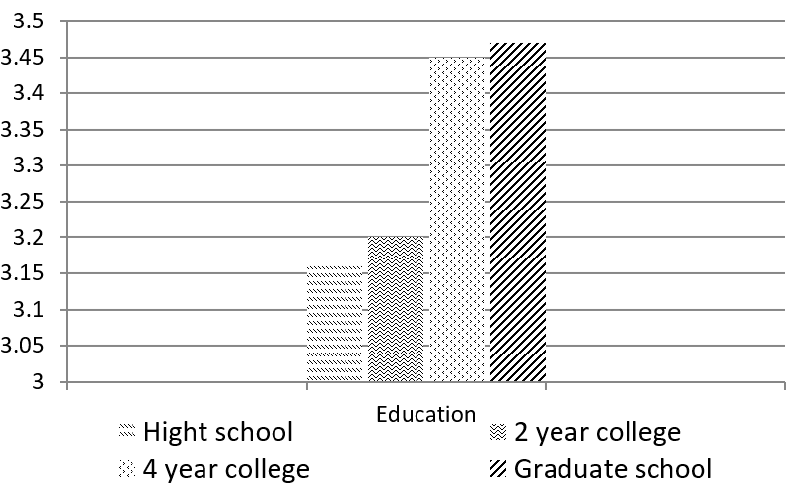
The survey study included demographic groups such as gender, occupation, age, education level, and income (Table 2). Anova test is performed in research to help determine whether there are any significant differences between subjects of three or more independent groups. Through the results of Anova analysis, it is possible to see differences in value and meaning of the research object and the variables that want to test. One-way Anova test results in Table 5 to see whether or not difference of above groups affects decision to participate in agritourism activities in Dalat. Table 5 shows the groups of gender, age, occupation, income Sig value. >0.05 so there is no difference; for the group of educational attainment, the value is Sig value.< 0.05, so there is a difference in the decision to participate in tourism activities of tourists in Dalat. Tourists with higher education level will have higher decision to participate in agritourism activities (Figure 2).
Anova test results
|
Sum of square |
df |
Mean square |
F |
Sig. | ||
|
Gender |
Between group |
0.583 |
1 |
0.194 |
0.594 |
0.611 |
|
Within group |
57.590 |
176 |
0.326 | |||
|
Total |
58.174 |
179 | ||||
|
Age |
Between group |
0.580 |
2 |
0.198 |
0.695 |
0.721 |
|
Within group |
56.988 |
176 |
0.347 | |||
|
Total |
57.178 |
179 | ||||
|
Occupation |
Between group |
2.691 |
3 |
0.672 |
2.122 |
0.079 |
|
Within group |
55.482 |
175 |
0.316 | |||
|
Total |
58.174 |
179 | ||||
|
Education |
Between group |
3.344 |
3 |
0.835 |
2.670 |
0.033 |
|
Within group |
54.829 |
175 |
0.313 | |||
|
Total |
58.174 |
179 | ||||
|
Income |
Between group |
0.578 |
2 |
0.192 |
0.589 |
0.621 |
|
Within group |
57.595 |
176 |
0.326 | |||
|
Total |
58.174 |
179 |
The study has examined the variance, the results show that the Spearman correlation Sig between ABSRES and the independent variables is greater than 0.05. Thus, no residual change occurs (Table 6). Moreover, the series correlation in the error of the model was also tested. The results show that Durbin-Watson coefficient = 2.286 is in the range from 1.5 to 2.5 (Table 4); So the regression results do not violate the phenomenon of first-order series autocorrelation49. This study also tested the hypothesis that the random errors of the regression model have constant variance. The results show that the regression errors are relatively evenly distributed on both sides of the mean line (the mean of the errors is 0) and do not follow a clear pattern (Figure 3). This shows the assumption that the error of the regression model is constant is appropriate and statistically significant.
The results of the variance’s test
|
ABSRES |
AD |
PE |
RG |
MK |
TM |
TP |
DP | ||
|
ABSRES |
Correlation Coefficient |
1.000 |
0.023 |
-0.102 |
0.016 |
0.056 |
0.112 |
-0.002 |
0.038 |
|
Sig. (2-tailed) |
0.000 |
0.709 |
0.099 |
0.799 |
0.367 |
0.069 |
0.979 |
0.542 | |
|
180 |
180 |
180 |
180 |
180 |
180 |
180 |
180 |

Mean education affects decision to participate in agritourism activities (Source: Survey results of the author's team, 2023)

Residual Scatterplot chart of the regression model (Source: Survey results of the author's team, 2023)
DISCUSSIONS AND MANAGERIAL IMPLICATION
Discussions
Dalat city is a locality with strengths and potentials for the development of agritourism. Moreover, the development of this type of tourism has made great contributions to the socio-economic development of the locality. In recent times, besides traditional agritourism, organic agritourism has developed very strongly with a variety of farm models and farms of different sizes. Agricultural resources of gardeners such as vegetables, flowers, tubers, fruits, tea, coffee, etc. and natural resources of Dalat are also focused on exploiting for agritourism development by farms and farms. The number of tourists interested in agritourism is increasing day by day. As can be seen from Table 4 highlighted that the higher the level of education, the higher the likelihood of participating in agritourism activities. The results is consistent with the study of (Tang et al., 2022) with education level, namely Junior college and Undergraduate taking up 68%. This imply that agritourism managers and businesses exploit the target market associated with a higher tourists’s education level50.
Theoretical contributions
Through research results show that relationship between hypotheses about Attraction of destination, Reference group, Marketing, Travel motivation, Service prices that have a direct impact on the decision to participate in agritourism activities of tourists. The determinants of tourists' participation in agritourism activities are explained through the factors of Attraction of destination (AD), Perception (PE), Reference group (RG), Marketing (MK), Travel motivation (TM), Service prices (SP). In which, Perception is the factor that has the strongest impact on tourists' decision to participate in agritourism activities. Travel motivation is the weakest factor affecting decision to participate in agritourism activities. This result is incompatible with the results of previous authors, Varmazyari et al.(2017) studied the motivation of tourists to influence the choice of tourist destination and show that factors such as “stay with family”, “learn and spend less”, “self-affirmation and change” are the most important factors in choosing a tourist destination. agro-tourism of tourists43. Oppong-kyeremeh & Bannor (2022) examined the willingness and motivation of farmers to engage in agritourism. The results show that the residents' willingness to participate in agritourism activities is very high and the main motivation for farmers to participate in agritourism activities is income generation, livelihood strategies and education. Due to the difference in participated stakeholders (business, farmer, tourists), factors influencing decision to engage in different agritourism activities2.
Managerial contributions
The research shows that tourists' perception is the most important factor influencing decision to participate in agritourism activities of tourists. If tourists have a good feeling about the quality of tourism services, the likelihood of them deciding to participate will be higher. Therefore, the owners of the national tourism garden need to focus on investing in activities on the quality of services and products to help increase perception of tourists. In addition, it is necessary to strengthen new services, such as for tourists to participate in farming activities, pick their own agricultural products, provide space for on-site food processing for tourists, etc. explain, give specific advice to visitors, do good reference group work. This is also one of the effective methods to promote this type of tourism to tourists. Moreover, it is necessary to have an appropriate and competitive price policy for tourists to have conditions and opportunities to experience, contributing to increasing tourist motivation of tourists; thereby increasing their decision to participate in agritourism activities.
Varmazyari et al (2017) studied the motivation of tourists to influence the choice of tourist destination. Research results show that factors such as “stay with family”, “learn and spend less”, “self-affirmation and change” are the most important factors in choosing a tourist destination. agro-tourism of tourists43. Bagi et al (2012)explore the factors affecting farmers' participation in agritourism through estimating a logical model1. Oppong-kyeremeh & Bannor (2022) examined the willingness and motivation of farmers to engage in agritourism. The results show that the residents' willingness to participate in agritourism activities is very high and the main motivation for farmers to participate in agritourism activities is income generation, livelihood strategies and education2.
Compared with previous studies, the authors' research has proven that factors such as Attraction of destination (AD), Perception (PE), Reference group (RG), Marketing (MK) ), Travel motivation (TM), Service price (SP) have a direct influence on tourists' decision to participate in agricultural tourism activities. The study also discovered that Perception (PE) is the factor that has the strongest influence on tourists' decision to participate in agritourism activities and Travel Motivation (TM) is the weakest influencing factor. Furthermore, the study also investigates whether or not the difference in gender, age, occupation, education level and income group affects the decision to participate in agritourism activities of tourists in Dalat or not. The results show that there is no difference of gender, age, occupation, income to the decision to participate in tourists’agritourism activities. However, there is a difference in educational attainment for tourists' decision to participate in agritourism activities. For tourists with higher education level, the higher their decision to participate in tourism activities.
Managerial implication
Research results show that, six factors Attraction of destination, Perception, Reference group, Marketing, Travel motivation, Service price have a direct influence on the decision to participate in agritourism activities. Based on the research results, the authors propose a number of governance implications for destination management organizations and agritourism service providers in Dalat, including:
Enhance Attraction of destination
Destination management organizations and agritourism service providers, specifically garden hosts in Dalat city should enhance attraction of destinations in general and agritourism destinations in particular by investing in develop diversified and rich agritourism products. Moreover, it is necessary to expand more models of agritourism activities, ensure environmental landscapes, invest in technical facilities, link with eco-tours to meet diverse sightseeing needs of tourists;
Enhance tourists’ perception
Agritourism establishments need to focus on diversifying agricultural products such as clean vegetables, flowers, and fruits. Improve the conditions to serve needs of tourists to participate in agritourism activities in order to improve tourists' feelings;
Well done consulting information for tourists
Tourism service providers in Dalat city need to do a good job of advising tourists on tourist information whenever there has need. Especially this is a form of tourists directly participating in agritourism activities in locality, the issue of capturing information about agritourism activities is necessary and useful for tourists;
Promote Marketing
Destination marketing is one of the factors that strongly influence decision to participate in agritourism activities of tourists. However, this factor has not yet been appreciated by tourists. Therefore, destination management organizations and tourism service providers need to have a plan to propagate and promote destination, especially in-depth communication about Dalat's agritourism in many different forms on various channels reputable mass media;
Diversifying agritourism products
In order to promote the purpose of participating in the tourism industry of tourists, tourism service providers need to diversify their local tourism products. Besides, it is necessary to strongly exploit new agritourism products, clean agritourism products, close to nature, without using toxic fertilizers or pesticides. Invest in and design diverse agritourism activities, novel and rich programs to create attractiveness and promote tourism purposes and motivations of tourists;
Implement appropriate pricing policy
This is the third most influential factor on tourists' decision to participate in agritourism activities. Tourism service providers need to have appropriate pricing policies and promotions to increase the number of tourists participating in activities. Besides, it is necessary to maintain a stable and reasonable price, not arbitrarily raise prices in the peak season.
Limitations and directions for further research
Compared with previous studies, this study has examined role and influence of factors on decision to participate in agritourism activities of tourists. Moreover, the study also examined whether or not the difference of gender, age, occupation, education and income groups affects decision to participate in agritourism activities of tourists in Dalat. The results show that there is a difference in education level for tourists' decision to participate in agritourism activities. The higher the level of education, the higher their decision to participate in agritourism activities. Although certain results have been achieved, there are still some limitations. First, this study tested hypothesis with domestic tourists, excluding foreign tourists. Secondly, the study stops at results of regression analysis, so subsequent studies can continue to analyze the linear structural equation (SEM) to explore more deeply the relationship of the factors affecting decision to participate in agritourism activities of tourists in Dalat. These limitations will help open up future studies.
CONCLUSIONS
The analysis results also show that six factors all play an important role and have a direct influence on the behavior of tourists deciding to participate in agritourism activities in Dalat. The analysis results also show influence of six factors in order from the strongest influence to the weakest effect, specifically, the strongest effect is Perception factor, the second is the factor of Reference group. The third is Service price factor, the fourth is Marketing factor, the fifth is Attraction of destination and the weakest factor is Travel motivation;
There are very few previous studies looking at factors affecting decision to participate in agritourism activities of tourists in Dalat city. Research results prove that six factors: Attraction of destination, Perception, Reference group, Marketing, Travel motivation, Service price have a direct influence on decision to participate in agritourism activities. Compared with previous studies, this study has proven that there are six factors that directly affect decision to participate in agritourism activities of tourists in Dalat city.
Agritourism plays an important role in contributing to local economic development. Therefore, it can be seen that this is a promising type of tourism, which should be fully exploited to meet tourists’ needs. Studying the factors affecting the decision to choose tourists’agritourism contributes to helping gardeners understand the impact of these factors. Thereby, there will be an improvement and promotion of this type of tourism in order to increase income, raise stakeholder awareness and develop sustainable agritourism in Dalat.
LIST OF ABBREVIATIONS
AD: Attraction of destination
PE: Perception
RG: Reference group
MK: Marketing
TM: Travel motivation
SP: Service price
EFA: Exploratory Factor Analysis
SEM: Structural Equation Modeling
H: Hypothesis
R: Square Multiple Correlation
CONFLICTS OF INTEREST
The authors hereby declare that there is no conflict of interest in the publication of this article
AUTHORS’ CONTRIBUTIONS
Author Mai Thi Kieu Lan is mainly responsible for the content of the entire research article, conducting the survey and collecting data, writing the introduction, research methods and contacting the main author to submit the article.
Author Nguyen Thi Thanh Ngan develops hypotheses and writes research results.
Author Vo Minh Phuong conducts a theoretical overview and discussions.
Author Nguyen Thi Huynh Phuong analyzes survey data.
Author Pham Quang Trieu writes conclusions and proposes managerial implications.