


The effects of perceived effectiveness of e-commerce institutional mechanisms on customer stickiness: The role of customer value co-creation in ota platforms in Viet Nam
- Hochiminh City University of Technology
Abstract
Information and communication technologies have been creating new consumption habits. Especially, after COVID-19 pandemic, online transactions become popular and using online travel agent platforms such as Booking.com, Agoda, Trip.com, Traveloka has also been a widespread practice for Vietnamese tourists. Actively participating in online travel agent platforms enables tourists to contribute their knowledge and expertise throughout the service process to co-create service value. The purpose of this study is to examine the effects of perceived effectiveness of e-commerce institutional mechanisms on customer stickiness under the mediation role of customer value co-creation on e-commerce platforms. Based on service dominant logic, the proposed research model includes 9 constructs and 15 hypotheses that mainly focuses on the relationship among customer value co-creation, perceived effectiveness of e-commerce institutional mechanisms and customer stickiness. This model is validated by data collected from 258 Vietnamese tourists who used any online travel agent platform. The results show that: (1) customer value co-creation is influenced by perceived effectiveness of e-commerce institutional mechanisms, customer experience quality, customer perceived ease-of-use, customer-to-customer interaction quality and customer perceived service climate; (2) customer value co-creation influences customer stickiness, customer empowerment and customer perceived value. Factors in the validated model explain 52.8% of the variance of customer stickiness. This study contributes to the growing service research an empirical evidence which affirms the importance of perceived effectiveness of e-commerce institutional mechanisms for value co-creation and of value co-creation on customer stickiness in ecommerce services. It adds to the existing literature by proving that an institution-based trust lever like perceived effectiveness of e-commerce institutional mechanisms can initiate other resources to jointly lead to customer value co-creation on e-commerce platforms. Managers in the tourism field can use these results as references to develop solutions improving customer stickiness through fostering customer value co-creation.
INTRODUCTION
Recently, firms from diversified business lines have fostered their customers to collaborate with them by participating in the decision making, design and distribute products or services, share opinions and knowledge, and be members in value co-creation processes 1. Value is conceptualized as “the customer’s overall assessment of the utility of a product based on what is received and what is given” [2, p.14], or as “the collaborative creation of value by the interaction of different actors, fundamentally customers and the firm” [3, p.1530]. The value co-creation process can enable customers and the firms to devote their knowledge and expertise throughout service interaction4. This reflects that value is earned from individualized experiences instead of “being embedded in the offering” [5, p.401] and value co-creation experience is a new source of competitive advantage for firms6.
Thanks to the development of information and communication technologies, there are new manners for customers to participate in value co-creation experience, especially in the service using process. Service using process encompasses important customer-firm interactions that go through crucial stages for developing long-lasting collaborative relationships between customers and the firms7. Information and communication technologies have favored the emergence of sophisticated e-commerce platforms8 including online travel agent (OTA) platforms that offer customers possibilities to interact and motivate them to collaborate with the firms9, 10. These platforms “promote value creation through relationships, facilitate user-generated contents and enrich the purchase experience” [11, p.183]. They help motivating a more social usage of technology12 and determining customers’ decisions 13.
The aim of this study is twofold. Firstly, we explore the effects of perceived effectiveness of e-commerce institutional mechanisms (PEEIM), customer experience quality, customer perceived ease-of-use, customer-to-customer (C2C) interaction quality, and customer perceived service climate on customer value co-creation. Secondly, we explore the effects of customer value co-creation on customer empowerment, customer perceived value, and customer stickiness. Basing on service dominant logic, we propose a research model with 9 constructs and 15 hypotheses that mainly focuses on the relationship among customer value co-creation, PEEIM and customer stickiness. This research model is validated with a sample of 258 Vietnamese tourism customers who used any OTA platform. This study contributes empirical evidence that brings out the significant role of customer value co-creation in the service process involved in OTA platforms.
THEORETICAL BACKGROUND
Service dominant logic
Service science is an interdisciplinary field that “combines organization and human understanding with business and technological understanding to categorize and explain the many types of service systems that exist as well as how service systems interact and evolve to co-create value” [14, p.18]. Grounded in eleven foundational premises, service dominant (S-D) logic including its definition of service as the application of competences for the benefit of another has been proposed as an appropriate philosophical foundation for the development of service science 15, 16. S-D logic is an alternative to the traditional goods-dominant paradigm for understanding economic exchange and value co-creation17. This service-centered view is based on the idea that service is the basis of all exchange, it suggests that customers and the firms initiatively share resources to jointly unfold sensible solutions to creating market needs 18. In this point of view, service systems are “value co-creation configurations of people, technology, value propositions connecting internal and external service systems, and shared information” [14, p.18].
Customer value co-creation
Customers are co-creators of value is a focused idea in S-D logic, which view customers as active actors in the production of personalized offers19. Based on S-D logic, value is described in the form of “value in use” where value is produced by both customers and the firms, not just added to the product or service4. The concept of value co-creation has gained research momentum in recent decades20, 21. During value co-creation process, Mascarenhas et al. suggested that customers are members of productive processes, they enjoy their significant role in the productive chain, which one after another reinforces their good faith toward the firms and allows the firms to access a extensive range of useful opinions and knowledge from them22. The value co-creation process can improve brand equity of the firms because it creates a circumstance that equivalent benefits retailers and customers 23.
According to many scholars [e.g. 24, 3, 5], value co-creation is the collaborative creation of value while different actors, fundamentally customers and the firms interact. Yi & Gong determined value co-creation as “a multidimensional construct including information seeking, personal interaction, information sharing, responsible behavior, helping, advocacy, feedback, and tolerance” [25, p.1281]. These behaviors show the integration of customers’ resources within service systems. Laud & Karpen defined value co-creation as “participation and contribution to the value co-creation/resource-integration process” [26, p.789]. That means value co-creation involves different aspects which engage customers and create mutual value for the firms and themselves 27. In this study, value co-creation can be understood as the high involvement of customers in product or service co-creation and customization28, 29. Not forcing customers to participate in co-creation, the firms provide chances and make the essential conditions for customers easier in creating their favorite value 30, 3.
It is important to study value co-creation because it encourages customers’ creativity and provides customers and the firms with a mutual value27. In the past, scholars acknowledged value co-creation as “the mediator of supply and demand relationships that interact and collaborate beyond the existing value chain model” [31, p.84]. Then, Prahalad argued that the firms alone cannot create value because they need interacting with customers to generate thoughts 32. Recently, growing number of scholars have considered value co-creation as an essential strategy for the e-commerce market [e.g.,33, 34, 35, 36, 13].
Perceived effectiveness of e-commerce institutional mechanisms
Institutional mechanisms are “impersonal structures implemented or created by third parties to create conditions that safeguard transaction success”, these mechanisms include “bureaucratic sanctions and safeguards that generalize beyond a given transaction and beyond specific sets of exchange partners” [37, p.42]. Institutional mechanisms characterize “modern and complex societies”, such as bank supervision of escrow accounts and legal employment contracts [38, p.972]. They are “neither transaction-specific nor party-specific”, they are “external world known in common” and are “institutionalized to ensure that all transactions will happen as promised” [39, p.63].
Institutional mechanisms in the e-commerce environment have emerged in various forms in recent years. Common online safeguards include online credit card guarantees, escrow services, and privacy protection 37, 40. For instance, online escrow service providers authorize payments only after customers accept the deal and agree to pay, providing a safety net against potential risks in order fulfillment. Similarly, credit card online payment guarantees provide resources from financial institutions to warn buyers against potential fraudulent behavior of sellers. These third parties are highly popular institutional mechanisms safeguarding e-commerce environment nowadays37, 41.
The concept PEEIM is constructed to express customer perceptions of an e-commerce institutional environment which is vendor independent. PEEIM is defined as an online customer’s general perception that safeguards appear in the e-commerce environment to protect them from implicit risks in online transactions 42. PEEIM refers to online customer perceptions that third-party safeguarding mechanisms, such as online credit card guarantees, escrow services and privacy protection exist to protect them against potential risks in the e-commerce environment43. Such third party structures or institutional mechanisms include “feedback features, escrow services, and credit card guarantees”, all of which can help facilitate online transactions conducted successfully 37.
Customer stickiness
Many scholars find that the conversion cost of networks is very low and retaining customers is not a facile mission44. Therefore, they focus on the stickiness of online behavior in order to explore how to intensify customer’s dependence on websites, and the concept of customer stickiness is proposed45. Beddoe-Stephens defined customer stickiness as the ability of a website to constantly motivate customers to browse reiteratively46. Customer stickiness describes the ability of a website to attract customers to access the website for long duration47. Li et al. pointed out that even if there are marketing operations from other social networks, customer stickiness still assures them of a reiterated visit that firm’s social network 48.
Lin reckoned that stickiness is customers’ unconscious willingness to revisit a firm’s social network49. Wang believed that customers need to pay many extra costs when they consider changing their consumption behaviors or habits, thus, to avoid losses, customers uphold their original behaviors or habits 50. The definition of customer stickiness is similar to the cement formed when customers have adopted a positive attitude towards content, features of products or services and developed faithful behaviors51. Lin et al. defined customer stickiness as the customer’ time spent on a firm’s social network52. Other scholars explain customer stickiness as all costs that customers pay when they alter in consumption behaviors or habits. According to Ren et al., customer stickiness is the power of a website to constantly make customers browse repeatedly44. Customer stickiness can be represented in the shape of return visits and repeat purchases53. It improves positive relationships between customers and the firms in the cyber context.
HYPOTHESES DEVELOPMENT
The relationship between PEEIM and customer value co-creation
The effect of PEEIM has been studied popularly in the context of online purchase. PEEIM produces a less adventurous transaction environment by cutting down contextual uncertainties through explicit regulatory assurances42. Such mechanisms are particularly important in developing the motivation to participate in the value co-creating process 7. Customers believe in institutional mechanisms will be ready for “information seeking, personal interaction, information sharing, responsible behavior, helping, advocacy, feedback and tolerance”29. The more effective institutional mechanisms are, the more diversified participation behaviors customers make54, 55. In the situation of new business model of import cross-border e-commerce platform ecosystem, Chen et al. emphasized the role of institution-based trust in fortifying customer participation35. Therefore, we propose the following hypothesis: (H1) PEEIM positively impacts customer value co-creation.
Many research results have been validating the considerable influence of customer experience quality on customers’ positive behaviors, creating a prominent level of customer experience is of importance. Customer experience is defined as “the customer’s subjective response to the holistic direct and indirect encounter with the firm which includes the communication encounter, the service encounter and the consumption encounter”56. According to Gentile et al., there are six primary components of customer experience including sensorial, emotional, cognitive, pragmatic, lifestyle, and relational component57. Verhoef et al. suggested a conceptual model of customer experience quality which includes social environment, service interface, assortment, retail atmosphere, price, and promotions58. Kim & Choi determined customer experience quality as a one-dimensional construct with the argument that customer experience is holistic in nature and customer experience quality is diversified depending on the subjectivity of value-in-use59. When institutional mechanisms are existing to reduce contextual risks in online transaction environment, customers are impulse to purchase online60 and the quality of customer’s response to e-commerce retailers is improved61. If PEEIM is effective in regulating online transaction environment, online customers may form their positive experience regarding some facets of e-commerce service62, 63. Inversely, if online customers are not sure of themselves that the effectiveness of institutional mechanisms will set appropriate rules of conduct in the e-commerce environment, they feel insecure 60, 64 and the quality of customer experience which is determined based on “total experience” decreases43. Therefore, we propose the following hypothesis: (H2) PEEIM positively impacts customer experience quality.
According to Davis, the perceived ease-of-use of a technological system is a variable belonging TAM65. This construct has been popularly employed as an antecedent of the usage of a technology for performing a task. Perceived ease-of-use is the degree to which a person believes that using a particular system would be free of effort. In e-commerce context, it applies to the degree to which customers believe that using an e-commerce platform is free of effort48, 19. The perceived expertise of customers or their self-efficacy concerned to the task will affect their value co-creation intention or value co-creation behavior 66, 67. Therefore, we propose the following hypothesis: (H3) PEEIM positively impacts customer perceived ease-of-use.
Lemke et al. propose that C2C interaction quality is “a critical element of the delivery of a superior customer experience” [56, p.850]. It refers to “the perceived judgment of the superiority of customers’ interaction with one another” 56, p.851]. The development of information and communication technologies has highlighted the importance of C2C interactions in IT-related services such as e-commerce24. C2C interaction quality is perceived basing on signs from interactions with other customers (peers) that occur explicitly and implicitly 68, 69, 70. According to Fang et al., at the general level, PEEIM captures the particular ability of institutional mechanisms to lighten contextual uncertainty 42. Some researches [e.g. 71, 72] affirmed that there is cause and effect relationship between institutional mechanisms and contextual interactions between customer and customer. Therefore, we propose the following hypothesis: (H4) PEEIM positively impacts C2C interaction quality.
Jung et al. recommended the concept of customer perceived service climate as remarkable organizational practices and procedures which are enacted in service situations73. This concept gives the signal of the extent to which a service organization teaches and prioritizes customer service. Customer perceived service climate includes how or if a service provider addresses problematic interactions, and this is “a service management best practice entrust” [74, p.1214]. According to Colm et al., customer perceived service climate is mentioned as other customer perceptions of strategic factors controlled by a firm, for example, decisions made in service design that affect service experience of customers75. In online purchase processes, when PEEIM are effective in regulating the transaction environment, customers may highly appraise the effectiveness of service climate 63. Therefore, we propose the following hypothesis: (H5) PEEIM positively impacts customer perceived service climate.
Basing on social exchange theory, a positive customer experience is similarly to motivate customers to repay the firms by engaging in spontaneous behaviors 76. People are incline to participate in value co-creation behavior when a social exchange occurs successfully, because an person who experiences a high-quality relationship is apt to requite and act cooperatively59. That is, a higher or lower level of customer experience quality is awaited to help increasing or decreasing customer co-creation behavior77. Therefore, we propose the following hypothesis: (H6) Customer experience quality positively impacts customer value co-creation.
Recent research examined the effect of perceived ease-of-use on the attitude towards e-commerce [e.g. 78], intention to adopt e-commerce [e.g. 79], and behaviors regarding value co-creation on e-commerce platform 80. The relationship between perceived ease-of-use and attitude toward using technology such as e-commerce is well established in the literature. Truly, customers will not carry out an online purchase activity unless they have the essential expertise and skills to assume the behavior 81. Navigation skills have positive influences on the likelihood that people will adopt the e-commerce platform for purchase purposes. Customer expertise in using e-commerce platform has a direct impact on how customers participate and contribute to the value co-creation process or resource-integration process12. As a consequence, it is forecasted that customer perceived ease-of-use will positively affect customer expertise, because skilled customers may have a broader and more diverse e-commerce experience82. Therefore, we propose the following hypothesis: (H7) Customer perceived ease-of-use positively impacts customer value co-creation.
According to Blasco-Arcas et al., in the situation of coproduction in buying online customized products, the personalization experienced and the interactivity experienced during the purchase positively influences customer participation5. Luo et al. proposed that C2C interactions can help learning how the co-creation experience is perceived in e-commerce platform83. It also encourages “the interchange of information and the establishment of contacts that customers integrate into the purchase” [83, p.1312]. Antón et al. discovered that inter-visitor interactions among visitors of museums can make them enhance experiential values such as “learning, entertainment, escapism, and aesthetics” [84, p.1410]. Value co-creation can occur as a result of conversations among customers, and customers are contented by reciprocating resources among each other85. Pandey & Kumar emphasize that social community affects positive experiences among customers during service encounter, hence leading to value co-creation86. Therefore, we propose the following hypothesis: (H8) C2C interaction quality positively impacts customer value co-creation.
According to Jung et al., customer service climate is used to assess whether a firm has policies and procedures in place for its customers to manage value co-creation behavior 73. This concept is based on customer-side assessment of service climate while considering the unforeseen states of customer participation. No matter how diversified customers treat one another in service environment, customer service climate provides an mediate control mechanism in these environment87. On this point, customer service climate is the same as customer perception of the other strategic factors controlled by the firms, for example, “decisions made in service design that influence a customer’s service experience” [75, p.226]. Many scholars find out the effect of customer perceived service climate on customer participation in various online context [83, 88]. Therefore, we propose the following hypothesis: (H9) Customer perceived service climate positively impacts customer value co-creation.
The relationship between customer value co-creation and customer stickiness
In the context of e-commerce, customers and the firms interact with each other and notice common topics. In that process, customers will continuously keep track of the e-commerce platform for more valuable information89. Some recent findings have highlighted that customer participation is positively associated with customer stickiness90, 91. Customer value co-creation is believed to be an important factor of stickiness92, 93. According to Rahmana & Irawan, a firm often develops a virtual community to facilitate customers’ information exchange 53. This activity provides customers with chances to represent their comments, make remarks, answer questions and give suggestions about products or services. When customers frequently interact in taking and giving information on products, they will face less uncertainty. The congruence of belief produces a feeling of satisfaction and fulfillment. Based on this perspective, Rahmana & Irawan suggested that if customers powerfully take and give their opinions and knowledge related to products or services, they will be strongly attached to keep using products or services 53. Therefore, we propose the following hypothesis: (H10) Customer value co-creation positively impacts customer stickiness.
Customer empowerment confirms the role of customers in service creation and transfer from passive receivers to active participants54, 94. Customer empowerment is “a customer’s subjective experience that they have considerable ability to intentionally produce desired outcomes” [95, p.726]. It is the act of giving customers power through advanced information and wider understanding 96, and a subjective state resulting in the perception of increasing control 97. According to Ramani & Kumar, customer empowerment focuses on the degree to which a firm give chances to its customers to engage with the brand and influence transaction type98. Palumbo affirmed that customer empowerment may emerge as the result of value co-creation where customers have the control over their health and will be conscious of the available resources in the healthcare service system 99. Khenfer et al. asserted that customer-employee interaction is necessary for a successful service process100.
Consequently, the aim of empowering customers is to heighten their service experience by implementing their opinions and knowledge, allowing the service staff to comprehend customer needs and expectations101. Customers are more strengthened when they have positive experiences and receive a personalized response from service providers. That means when customers are empowered with abilities, knowledge, and choice to perform a task, they are more empowered. Because customers are responsible for the outcome, they take responsibility for their decisions102. Moussafir & Qmichchou stated that customer empowerment refers to “the degree to which a firm provides chances to its customers to interact by communicating information, disapproval, appreciation, recommendations, opinions and knowledge about its products, services, and policies” [103, p.315]. So, the more customers participate in value co-creating processes, the more customers feel empowered103, 21. Therefore, we propose the following hypothesis: (H11) Customer value co-creation positively impacts customer empowerment.
When customers have the sensation of control and independence in the service process, they actively participate 104. Customer perceived value is the difference between customer value and customer cost for a product or service 105. When customers believe that a product or service has value, they think consuming that product or service is important2. Conformable to the consumption value theory, customer perceived value includes “five types of value: functional, social, emotional, cognitive, and conditional” [106, p.162]. Some scholars proposed three dimensions of customer perceived value, i.e. functional, social, and emotional107, 108. According to Lloyd & Luk, when customers passively take part in production process, their sense of control over the process will be cut down, and they cannot “reduce risks, control results, and obtain psychological satisfaction through participation” [109, p.178].
Giving an example in the process of video content dissemination, Markley & Davis pointed out that if there are circumstances of imitating creation which leads to the existence of a great number of alike content, customers will not be able to obtain the pleasure of service, and a negative impact on customers perceived value will be the outcome 110. Jung & Yoo also confirmed that positive customers influence the affection of customers for service111. According to Quach et al., users often attempt on the firm-initiated interaction activities in social media, and this could affect the perception of value 112. Recently, Ren et al. demonstrated that “positive customer participation behavior promotes customer perceived value, whereas negative customer participation behavior reduces it” [44, p.701]. Therefore, we propose the following hypothesis: (H12) Customer value co-creation positively impacts customer perceived value.
Mishra et al. argued that customer empowerment instills positive emotions113. Previous research pointed out that customer empowerment is related to service results such as satisfaction and word-of-mouth114, 98. These states lead to customer stickiness 115, 116. Mvondo et al. declared that empowered customers incline to buying the brand, praising it in the user community, and recommending it to others 114. Customers engaged with a product or service will actively purchase it and refer it to others, reflecting their stickiness behavior44. According to Moussafir & Qmichchou, experiencing empowerment impulses people’s motivation to repeat the task that they felt empowered103. Empowerment is consolidated in customers feeling about accomplishing the task of product development and thus it increases customers' brand loyalty117, 118. In the situation of online co-creation, Werner et al. believed that customers who perceive empowered will be positive and enthusiastic to revisit, repurchase, and they are available to improve relationships or give positive suggestions in the cyber context than less [45]. Therefore, we propose the following hypothesis: (H13) Customer empowermentpositively impacts customer stickiness.
Some scholars have focused on customer perceived value and found that customers’ perceptions may impact their behaviors, there is a link between it and customer stickiness 119, 120. Ye confirmed that customer perceived value can affect customer stickiness through customer satisfaction when they research on the online Q&A community 121. Fang & Fang confirmed that perceived entertainment affect customer stickiness in social networks122. Basing on the perception-emotion-willingness model, Liu & Zhang found that “functional and emotional value positively influence customers’ repeated purchase willingness by affecting their psychological emotions” [123, p.53]. Meanwhile, El-Adly & Eid discovered that customer perceived value has positive effect on customer satisfaction and faith to malls 124. Shang & Wu investigated mobile phone shoppers’ willingness to continue using and found the positive effect of perceived value customers’ willingness on continue using 125. Relying on social exchange theory, customer perceived value disabuses people of the intrinsic motivation of redialing with suppliers. Yuan carried out an empirical study on customers’ continuous use willingness of the mobile reading platform 126. They found that perceived value has a salient positive impact on customer satisfaction and stickiness. In online brand communities, Chen et al. discovered the positive influences of perceived value, information quality, and community identification on customer stickiness 127. Therefore, we propose the following hypothesis: (H14) Customer perceived value positively impacts customer stickiness.
Customer empowerment helps to encourage customer participation in resource creation and other collaboration operations 128 that promotes customer perceived value129 and customer asset value 130. Customer empowerment makes customers attain products or services that meet their consumption needs, besides, it forms a positive customer experience which positively affects customer perceived value131. Hu & Li confirmed that customer empowerment is a mediator in the impact of customer co-creation on their perceived value 132. Prebensen & Xie also stated that the perceived importance of tourists is a mediator in the relationship of tourist participation and perceived value 133. Thus, it can be inferred that psychological empowerment affects value co-creation results, especially perceived value134. Therefore, we propose the following hypothesis: (H15) Customer empowerment positively impacts customer perceived value.
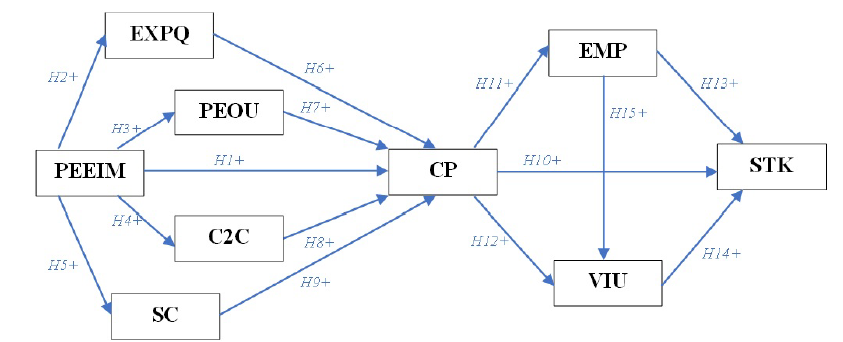
The theoretic model for hypothesis testing is shown in Figure 1.

Theoretic model for hypothesis testing (Note: PEEIM = perceived effectiveness of e-commerce institutional mechanisms; CP = customer value co-creation; STK = customer stickiness; EXPQ = customer experience quality; PEOU = customer perceived ease-of-use; C2C = customer-to-customer interaction; SC = customer perceived service climate; EMP = customer empowerment; VIU = customer perceived value). (Source: The authors)
METHODOLOGY
First, we conduct preliminary qualitative research to adjust the measurement scale which is based on previous studies. In-depth interview method is used. The number of respondents is nine. These respondents are conveniently selected until information is saturated. They include three professors and six managers in the tourism field, and are asked to review the draft of questionnaire by excluding ambiguous, uncertain, and repetitive questions. The revised questionnaire is composed of three parts: (1) introduction; (2) basic details of respondents; (3) 32 measuring variables which belonged to nine constructs that are in the form of 5-point Likert scale (5=strongly agree, 1=strongly disagree).
Next, we conduct preliminary quantitative research with the sample of 50 tourists who used any OTA platforms. The results show that the measurement scale meets the requirements of reliability and consistency. After that, the main research is conducted with quantitative method. The target population is tourists who used any OTA platforms. We use non-probability sampling. Data is conveniently collected face-to-face (at tourist agencies) or online (in community groups of tourists on social networks). There are 279 respondents, but 21 answer sheets are failed at the quality check-step. Thus, the final sample size is 258, the completion rate is 92.5%.
Partial Least Squares - Structural Equation Modelling (PLS-SEM) is proposed suitable for establishing theoretical parsimony and model simplicity135. With a large number of constructs, we apply PLS-SEM to test measurement and hypotheses because it is appropriate to complex and higher-order modelling 136. Besides, issues regarding factor indeterminacy, factor identification, distributional assumptions, and sample size can be suitably handled by PLS-SEM 137. We also use a nonparametric bootstrapping to attain the standard errors of the estimates with a path weighting scheme for the inside approximation with 1.000 replications138.
RESEARCH FINDINGS
Sample description
In the sample, 43.8% of the respondents belong to the 18-24 age group, 37.2% belong to the 25-34 age group, 34.5% are students, showing that customers who use OTA platforms are incredibly young. 52.7% of the respondents are men, 46.9% are women, 0.4% choose “other”, showing that men use OTA platforms slightly more than women. Most respondents are office staff (49.2%) and students (34.5%). They access OTA platforms several times/year (55.0%) mostly to book restaurant/hotel (44.6%) or book tour (35.7%). Traveloka, Booking, Agoda are three favourite OTA platforms in Vietnam (see Table 1 and Figure 2).
Demographic profile of respondents
|
Variable |
Answer |
Number of respondents |
Percentage |
|
Age |
18-24 |
113 |
43.80% |
|
25-34 |
96 |
37.20% | |
|
35-49 |
46 |
17.80% | |
|
From 50 |
3 |
1.20% | |
|
Total |
258 |
100% | |
|
Gender |
Male |
136 |
52.70% |
|
Female |
121 |
46.90% | |
|
Other |
1 |
0.40% | |
|
Total |
258 |
100% | |
|
Occupation |
Student |
89 |
34.50% |
|
Office staff |
127 |
49.20% | |
|
Businessperson |
27 |
10.50% | |
|
Other |
15 |
5.80% | |
|
Total |
258 |
100% | |
|
Tourism service |
Book tour |
92 |
35.70% |
|
Book plane, train, car ticket |
37 |
14.30% | |
|
Book restaurant, hotel |
115 |
44.60% | |
|
Look up information |
14 |
5.40% | |
|
(read blog, compare prices...) | |||
|
Total |
258 |
100% | |
|
Access frequency |
Once/week |
3 |
1.20% |
|
Several |
51 |
19.80% | |
|
times/week | |||
|
Once/month |
2 |
0.80% | |
|
Several |
59 |
22.90% | |
|
times/month | |||
|
Once/year |
1 |
0.40% | |
|
Several |
142 |
55.00% | |
|
times/year | |||
|
Total |
258 |
100% |

Some popular OTA platforms in Vietnam (Source: The authors)
Measurement model validity and reliability
The Cronbach’s Alpha index ranges from 0.707 to 0.906 exceeding the recommended threshold of 0.70139. Internal reliability is established with strong composite reliability ranging from 0.733 to 0.912. Almost all of the standardized factor loadings exceed 0.70 excepting C2C3 (0.658) and C2C4 (0.648). However, these two items are retained because their loadings approach 0.70 and they aid content validity140. The average variance extracted (AVE) ranges from 0.528 to 0.842 supporting convergent and discriminant validity. The standardized loadings range from 0.648 to 0.901. The item correlations passes the HTMT test by not surpassing a 0.85 threshold 141. The square root of each construct’s AVE exceeds the inter-correlations for each construct to exhibit sound psychometric properties142. None of the variance inflation factor values exceeded the concerning threshold level of 5 so multicollinearity is not a threat to the measures139 (see Table 2 and Table 3).
Measurement scales
|
No. |
Scale |
Source of scale |
Number of items |
Code |
Standardized loadings |
Cronbach’s Alpha |
|
1 |
PEEIM |
|
3 |
PEEIM1 |
0.825 |
0.845 |
|
PEEIM2 |
0.901 | |||||
|
PEEIM3 |
0.836 | |||||
|
2 |
Customer value co-creation |
|
3 |
CP1 |
0.838 |
0.825 |
|
CP2 |
0.839 | |||||
|
CP3 |
0.867 | |||||
|
3 |
Customer stickiness |
|
4 |
STK1 |
0.883 |
0.891 |
|
STK2 |
0.835 | |||||
|
STK3 |
0.844 | |||||
|
STK4 |
0.868 | |||||
|
4 |
Customer experience quality |
|
4 |
EXPQ1 |
0.800 |
0.842 |
|
EXPQ2 |
0.753 | |||||
|
EXPQ3 |
0.860 | |||||
|
EXPQ4 |
0.774 | |||||
|
5 |
Customer perceived ease-of-use |
|
3 |
PEOU1 |
0.932 |
0.906 |
|
PEOU2 |
0.900 | |||||
|
PEOU3 |
0.866 | |||||
|
6 |
C2C interaction quality |
|
4 |
C2C1 |
0.756 |
0.707 |
|
C2C2 |
0.808 | |||||
|
C2C3 |
0.658 | |||||
|
C2C4 |
0.648 | |||||
|
7 |
Customer perceived service climate |
|
4 |
SC1 |
0.715 |
0.855 |
|
SC2 |
0.871 | |||||
|
SC3 |
0.801 | |||||
|
SC4 |
0.723 | |||||
|
8 |
Customer empowerment |
|
4 |
EMP1 |
0.869 |
0.857 |
|
EMP2 |
0.781 | |||||
|
EMP3 |
0.790 | |||||
|
EMP4 |
0.802 | |||||
|
9 |
Customer perceived value |
|
3 |
VIU1 |
0.862 |
0.834 |
|
VIU2 |
0.850 | |||||
|
VIU3 |
0.867 | |||||
|
Total |
32 |
Means, standard deviations, correlations and reliability estimates
|
Construct |
Mean |
SD |
AVE |
CR |
α |
1 |
2 |
3 |
4 |
5 |
6 |
7 |
8 |
9 |
|
C2C |
3.663 |
0.864 |
0.528 |
0.733 |
0.707 |
0.727 | ||||||||
|
CP |
3.588 |
0.836 |
0.728 |
0.815 |
0.813 |
0.635 |
0.853 | |||||||
|
EMP |
3.619 |
0.859 |
0.681 |
0.847 |
0.844 |
0.668 |
0.557 |
0.825 | ||||||
|
EXPQ |
3.369 |
0.896 |
0.667 |
0.832 |
0.832 |
0.626 |
0.532 |
0.530 |
0.817 | |||||
|
PEEIM |
3.344 |
0.969 |
0.747 |
0.835 |
0.830 |
0.530 |
0.488 |
0.599 |
0.423 |
0.864 | ||||
|
PEOU |
3.908 |
0.804 |
0.842 |
0.912 |
0.906 |
0.487 |
0.530 |
0.419 |
0.314 |
0.208 |
0.918 | |||
|
SC |
3.489 |
0.868 |
0.674 |
0.845 |
0.836 |
0.681 |
0.595 |
0.625 |
0.514 |
0.507 |
0.394 |
0.821 | ||
|
STK |
3.450 |
0.901 |
0.732 |
0.881 |
0.878 |
0.697 |
0.582 |
0.675 |
0.599 |
0.584 |
0.354 |
0.589 |
0.856 | |
|
VIU |
3.757 |
0.847 |
0.739 |
0.824 |
0.824 |
0.512 |
0.618 |
0.456 |
0.398 |
0.279 |
0.696 |
0.458 |
0.498 |
0.860 |
Hypothesis testing
The model’s predictive relevance is assessed by assessing the effect size and explained variance of the endogenous constructs. The results show that the R values of the endogenous constructs range from 0.043 to 0.545, meanwhile the f effect sizes range from 0.023 to 0.449 for the supported hypotheses145 (see Table 4 and Figure 3). The effect sizes range from small to medium to large effects, per the criteria of 0.02, 0.15, and 0.35, respectively139. Therefore, the model’s predictive relevance is supported. In structural model estimation, the path from PEEIM to customer value co-creation (β=0.169; p=0.014<0.05) is significant, in support of (H1). The paths from PEEIM to customer experience quality (β=0.423; p=0.000<0.001), customer perceived ease-of-use (β=0.208; p=0.004<0.05), C2C interaction quality (β=0.530; p=0.000<0.001), customer perceived service climate (β=0.507; p=0.000<0.001) are significant, in support of (H2), (H3), (H4), (H5), respectively. The paths from customer experience quality (β=0.163; p=0.020<0.05), customer perceived ease-of-use (β=0.283; p=0.000<0.001), C2C interaction quality (β=0.170; p=0.038<0.05), customer perceived service climate (β=0.197; p=0.002<0.05) to customer value co-creation are significant, in support of (H6), (H7), (H8), (H9), respectively. The paths from customer value co-creation to customer stickiness (β=0.228; p=0.002<0.05), customer empowerment (β=0.557; p=0.000<0.001), customer perceived value (β=0.528; p=0.000<0.001) are significant, in support of (H10), (H11), (H12), respectively. The paths from customer empowerment (β=0.487; p=0.000<0.001) and customer perceived value (β=0.134; p=0.040<0.05) to customer stickiness are significant, in support of (H13) and (H14). Finally, the path from customer empowerment to customer perceived value (β=0.162; p=0.034<0.05) is significant, in support of (H15).
Results of hypothesis testing and explained variance
|
Hypothesized relationships |
Standardized path coefficient |
R2 (construct) | |
|
H1 |
PEEIM -> Customer value co-creation |
0.169** |
0.545 (Customer value co-creation) |
|
H2 |
PEEIM -> Customer experience quality |
0.423* |
0.179 (Customer experience quality) |
|
H3 |
PEEIM -> Customer perceived ease-of-use |
0.208** |
0.043 (Customer perceived ease-of-use) |
|
H4 |
PEEIM -> C2C interaction quality |
0.530* |
0.218 (C2C interaction quality) |
|
H5 |
PEEIM -> Customer perceived service climate |
0.507* |
0.257 (Customer perceived service climate) |
|
H6 |
Customer experience quality -> Customer value co-creation |
0.163** | |
|
H7 |
Customer perceived ease-of-use -> Customer value co-creation |
0.283* | |
|
H8 |
C2C interaction quality -> Customer value co-creation |
0.170** | |
|
H9 |
Customer perceived service climate -> Customer value co-creation |
0.197** | |
|
H10 |
Customer value co-creation -> Customer stickiness |
0.228** |
0.528 (Customer stickiness) |
|
H11 |
Customer value co-creation -> Customer empowerment |
0.557* |
0.310 (Customer empowerment) |
|
H12 |
Customer value co-creation -> Customer perceived value |
0.528* |
0.400 (Customer perceived value) |
|
H13 |
Customer empowerment -> Customer stickiness |
0.487* | |
|
H14 |
Customer perceived value -> Customer stickiness |
0.134** | |
|
H15 |
Customer empowerment -> Customer perceived value |
0.162** | |
DISCUSSION AND CONCLUSION

Research model results (Source: The authors)
Theoretical implications
This study contributes some theoretical implications. Firstly, value has been believed being co-created through interactions between online customers and the firms13, 33. Although many scholars propose that the new role of customers should be discussed from the perspective of value co-creation, there is still a lack of corresponding empirical evidence134. The results of value co-creation should involve customer value and enterprise value because both of them are integral54. Existing research on value co-creation limits the value of co-creation to the customer domain146 because it mostly mentions the effect of customer value co-creation on customer experience value and pays few attention to the profit of value co-creation for the firms 133, 147. This study considers that using e-commerce platforms sets up a fundamental stage of the wide process related to customer-firm value co-creation, especially in the situation of using OTA platforms in tourist industry. This study can help understand the value co-creation process of customers and the firms more deeply, relying on customer perspective.
Secondly, the concept of customer stickiness interprets the value created by customers as an essential property of a firm. Customer stickiness is a benefit of customer value co-creation to mention the firms’ interest from value co-creation together with customer empowerment and customer perceived value. In the process of moving towards customer stickiness, firms must strengthen value co-creation activities by supplying necessary resources21. In this study, we introduce the concepts of customer value co-creation, customer empowerment and customer perceived value which are important sources of customer stickiness. By validating stickiness is a result of customer value co-creation, customer empowerment and customer perceived value, we confirm the modification of value co-creation from customer perception to enterprise value realization.
Thirdly, though the applicability of value co-creation in e-commerce industry is rising, previous studies overlook an important antecedent: PEEIM. This study fills the research gap by advancing the understanding of PEEIM as trust production mechanisms. In this study, we introduce the concepts of PEEIM, customer experience quality, customer perceived ease-of-use, C2C interaction and customer perceived service climate which are important sources of customer value co-creation. While PEEIM is considered an institutional resource; customer experience quality, C2C interaction and customer perceived ease of use represent various resources belonging to the focal customer, other customers, and technology in a respective way. A large number of studies have explored their direct influences on trust43 but few research recognized that different sources of trust production, such as PEEIM, could complement each other. Findings of this study add to the existing literature by proving that an institution-based trust lever like PEEIM can initiate other resources to jointly lead to customer value co-creation on e-commerce platforms.
Practical implications
Customers are the center of marketing decisions, the cornerstone of collaborative processes at any step of a new product or service development process. The collaboration between customers and the firms during the using service process creates new dynamics that should be settled by managers. Customers may adopt positive attitudes and behaviors towards an e-commerce platform if they spend their resources on participating in value co-creation activities. To better encourage customers to participate in value co-creation process and improve their stickiness, managers of e-commerce platforms should enhance PEEIM together with other key factors such as customer experience quality, customer perceived ease-of-use, C2C interaction quality, customer perceived service climate, customer empowerment and customer perceived value. For example, to help customers deeply participate in value co-creation process, the firms ought to develop flexible platforms which customers can buy a product or service and create important and personalized experiences. An appropriate management of engagement platform can encourage customer collaboration in co-creation processes and better customers’ feelings toward the firms. Encouraging co-creative experiences during online purchase helps increase the ability of finalizing transactions and creating long-term relationships.
In addition, perceived ease-of-use of the online co-creation platform manifests a supplier value-creating process that supports the co-creation activity by making it operationally efficient. Thus, firms should design e-commerce platforms as user-friendly platforms while perceived ease-of-use is explaining online co-creation to a high degree. The firms can easily perform co-creation online because a high perceived ease-of-use is a motive that is relevant to a deficiency of customer familiarity with the online co-creation task. On the other hand, this study highlights the importance of cues concerned with C2C interactions and coproduction (i.e., co-design of the offering, peer communication through forums, blogs, virtual communities, social networks, among others). These signs intensify the potential of platform, motivate customers to conduct collaborative activities and create tight relationships between customers and the firms. Inducing customers to value-creating activities is essential for the firms because it provides enhanced purchase experiences which can encourage positive customer response such as stickiness.
Moreover, firms should pay closer attention to decreasing customers’ perceived risks related to retailers’ uncertainty. E-commerce platforms should be transpicuous in sharing information to limit customers’ discomfort while encouraging consumers to seek and provide information in the form of their feedback. Especially, firms should be completely transparent on security and privacy issues and pricing across channels thanks to offer adequate, efficient, and efficacious customer support across all channels and augment customer engagements through their e-commerce platforms or other relevant channels. Finally, with our findings, firms should undertake to build an effective institutional infrastructure for the entire e-commerce environment and communicate the risk-mitigation value of the e-commerce institutional infrastructure to customers. A safe e-commerce environment makes faith building less difficult, thus devoting to the prosperity of e-commerce in their market segment.
Research limitations and future research prospects
This study has certain research limitations. Firstly, the data collection process involved only respondents selected in convenience. Because customers may have differences in economic status, cultural background, consumption levels, future research can choose diversified areas for data collection, and use the comparative analysis method to check relevant conclusions. Secondly, this study involves only customers, and it is not able to fully reflect the operational mechanism of the value co-creation system in e-commerce context. Future research can involve other stakeholders in the value co-creation system to establish more comprehensive research. For example, future research can examine how the interaction between customers and the firms affects value co-creation. Thirdly, the study sample consisted of Vietnamese tourism customers who used any OTA platform, which could make self-selection bias. Customers with various experiences on OTA platforms could have multiform perceptions of them, therefore, the findings of this study should be interpreted as only explaining the OTA platform for current Vietnamese tourism customers. Fourthly, we did not consider the control variables’ role. Therefore, future research may involve control variables such as customers’ gender, age, education, occupation. Finally, future research could also consider applying qualitative methods (e.g., content analysis and focus groups), exploring questions such as how customers’ behaviors are affected and to complement the insufficiency of survey method to make stronger inferences.
To summarize, this study aims to explore the relationship among customer value co-creation, PEEIM and customer stickiness on e-commerce platforms. All of our supported hypotheses provided two key findings: (1) customer value co-creation is directly and indirectly influenced by perceived effectiveness of e-commerce institutional mechanisms through four mediators including customer experience quality, customer perceived ease-of-use, C2C interaction quality and customer perceived service climate; (2) customer value co-creation directly and indirectly influences customer stickiness through two mediators including customer empowerment and customer perceived value. This study contributes to the growing service research one more empirical evidence on the significant role of customer value co-creation in e-services in general and in OTA platform services in specific.
ACKNOWLEDGEMENT
This research is funded by Vietnam National University HoChiMinh City (VNU-HCM) under grant number: B2023-20-12
ABBREVIATIONS
Customer-to-customer (C2C); Online travel agent (OTA); Perceived effectiveness of e-commerce institutional mechanisms (PEEIM); Service dominant (S-D)
CONFLICT OF INTEREST STATEMENT
The authors declare that they have no conflicts of interest.
AUTHOR CONTRIBUTIONS
- Huynh Thi Minh Chau: Literature review, Research design, Writing and editing the article
- Nguyen Thi Truc My: Conducting studies
- Tran Thi Tuyet: Editing the article
- Nguyen Manh Tuan: Literature review, Research design, Conducting studies