


Environmental impacts on the perception of young generation toward the purchasing intention of green furniture in Ho Chi Minh City
- Central transport College No6, HoChiMinh City, Vietnam
- University of Finance- Marketing
Abstract
The article aims to investigate and research the environmental impacts from any perspective on the perception of the young generation who have the intention to purchase green products and green furniture, based on the fact that pollution and environmental damage are needed to be considered as vital issue, and the concern grows to a greater degree gradually. Therefore, this article focuses on exploring and examining various factors that could affect the focused customer class, which is the younger generation, in terms of the awareness and their personal attitude toward purchasing green furniture in order to obtain a more sustainable environment. Green furniture is one of the environmentally friendly green products products that can be produced and used without causing harm to the environment. The database is gathered from 241 advantageous survey respondents whose age falls into the range of young adulthood (from 18 to 35 years old), living and working in Ho Chi Minh City. Data analysis is performed by using Smart SPL4 with the partial least squares structural equation modeling method (PLS-SEM). From the conclusion of this survey, the following factors can affect the intention of young consumers in Ho Chi Minh City to purchase green furniture: environmental knowledge, products’ functional value, perceptive behavior control, and environmental responsibility. The results show that cognitive behavioral control has a relative effect on purchase intention; the environmental responsibility and environmental knowledge of young people in Ho Chi Minh City can impact on their consciousness about environmental issues and socio-ecological benefits, positively impacting their purchase intention towards green furniture and green products. The results provide valuable information about the impact of various factors on the purchasing intention of green furniture among young consumers in Ho Chi Minh City.
Introduction
The current state of global environmental change is modifying the backbone of the ecosystem, to the point of capable of threatening ecosystems function’s contribution to human society 1, 2. Recently, consumers are taking more positive action by widely sharing information about the environment3, 4, performing responsible purchasing behavior for environment-friendly products 5, 6, and also giving rise to pioneering features that help environmental improvement’s action7. The mindset of entrepreneurs changed, especially in developed economies, which made them start to consider the environmental consequences of their business activities8. There were a number of studies that confirmed that there are many opportunities and innovations in business that are environment-friendly, which is giving a helping hand to improve the quality of the environment and also achieving green economic growth9, 10. Green products are produced by businesses in contemplation of reducing the consumption of natural resources and lowering negative impacts on the environment. Green products are believed to be environment-friendly products, produced with no chemicals or industrial waste, and not contain toxic substances.
Green furniture is a kind of product that has an environment-friendly design and can affect the purchasing and consumption habit of the younger generation in order to subsequently achieve a sustainable environment 11. Green furniture is aimed at safe consumers’ living space decoration and can be pulled off as sustainable development products12. As shown by within the “green” characteristic of the product’s name, it can also be an environment-friendly solution for using recyclable nature materials such as rattan, bamboo, and sedge, just to name a few examples, or recycled materials from textile production, and so on. There are a copious number of materials from which to choose, yet the most common material used for this style is wood for its availability to make a wide range of goods, including floors, shelves, beds, and doors, etc. Furniture is a designed and manufactured item with specific functions, for example, sitting, lying down, studying, displaying, decoration, or the living space’s partition13. However, interior is a general concept that refers to each and every item used to decorate a home or room, including furniture, curtains, and rugs, and other complementary parts 14.
There were many studies carried out internationally that worked on the intention and behavior of purchasing green goods and green furniture, some of which are: green product purchase intention in emerging countries15, Extending the theory of planned behavior: factors fostering millennials’ intention to purchase eco-sustainable products in an emerging market 16, Generation Z attitudes and preferences about eco-friendly furniture and furnishings 13or Performance Evaluation of Green Furniture Brands in the Marketing 4.0 Period: An Integrated MCDM Approach12. In Vietnam, there were also some recent studies researched about the intention and behavior of purchasing green goods and green furniture, including: research on consumers’ purchasing behavior of green products at Hue CoopMart supermarket17, factors affecting consumers' intention to buy green food products in Hanoi City18, factors affecting the decision to buy green products of students in HCM City 19; Applying value, attitude and behavior models in researching purchasing behavior of green products of Vietnamese consumers20, and those are just a few examples. Nonetheless, the author found out, that up until now, there has been no research on the impact of the environment on the perception of the younger generation about the intention to buy green furniture.
This study was performed to examine the perception of the younger generation, which is more educated about a nature-friendly lifestyle, about whether the negatively impacted and polluted environments made them feel more conscious and then choose eco-friendly green furniture for their living space. To answer this question, the author conducted empirical research and studies about the younger generation, which is from 18 to 35 years old, in HCM City to further understand their perception, attitude, intention, and purchasing behavior towards green furniture.
Research theory, hypothesis development and research model
Research theory
The theory of Reasonable Action framework 21 and the theory of Planned Behavior22 are the fundamental theoretical constructions needed to understand human behavior. In this study, the author used both models of the Theory of Reasonable Action (TRA) and the Theory of Planned Behavior (TPB) to explain customers' attitudes towards the utilization of green furniture products. The TRA model predicts how people conform to pre-existing rules of behavior, including two variables: attitudes and subjective norms. The TPB model developed based on the TRA model includes three variables: attitude, subjective norm, and cognitive control. TPB is the most suitable model to predict behavioral intention23. Purchase intention and green purchasing behavior are key prediction factors in the TPB model, including belief structure24. Product purchase intention is an important factor in using green products and contributing to environmental sustainability25. The extended model includes the following elements: environmental knowledge, environmental responsibility, perceived behavioral control, and green attitude affecttion (positively or negatively) towards the intention to buy green furniture.
Hypothesis development and research model
Functional value
The functional value of a product is the consumer's perception of the use and physical performance of the product. According to Garvin (1987)26, there are 8 aspects of product function and quality: aesthetics (personal preferences and the product’s subjective aspects), serviceability, durability, suitability, reliability, functionality, perceived quality, and usage efficiency. Kianpour 27 proposed to extend the functional value of the product with the addition of environment-friendly products, which is also the main motivating factor for consumers to choose green products 28. Consumers may choose green products because of specific attributes such as health benefits, organic origin, and natural ingredients29. The functional value of the product plays a major role in influencing consumer's behavior toward choosing green product28. Functional value has a positive impact on environmental concerns, which is expressed through the purchase of green products 30. In recent decades, consumers have paid much attention to environmental issues when choosing to buy products, along with paying more attention to the function and quality of the product28. Therefore, the study proposes the hypothesis:
H1: Functional value has a positive impact on consumers' intention to buy green furniture.
Environmental knowledge
Environmental knowledge is knowledge about how the product’s usage impacts the environment and whether the product is manufactured in an environment-friendly process31. It includes value, application, and connection with ecosystems, such as environmental concerns and individuals' environmental knowledge, that can contribute to sustainable growth32. Consumers' environmental knowledge and concerns related to environmental issues can impact their choice and intention to purchase products that are environment-friendly33, 6. With high awareness of eco-sustainable products, customers have solid and positive knowledge about green marketing and green products, which led to the revelation in the results of previous studies that environmental knowledge is a significant contributor to consumers' green attitudes when purchasing products16. So now the author can propose the next hypothesis:
H2: Environmental knowledge has a positive effect on consumers' intention to buy green furniture.
Environmental responsibility
With growing awareness of the negative impacts of old-fashioned production and consumption systems around the world, a debate has erupted about the responsibilities of manufacturers, consumers, and relevant stakeholders (including the government and distributors). Businesses are more and more interested in applying sustainable practices as a way to minimize negative environmental and social impacts. Furthermore, law and society are demanding innovations in products, services, processes, and trading models to be more focused on responsibility for sustainable development34. From the consumers' point of view, concerns about environmental issues are constantly changing their lifestyles, especially in terms of purchasing behavior 35. Consumers’ environmental responsibility has been defined as “the state in which a person demonstrates an intention to take direct action to rectify environmental problems–not as an individual consumer with individual economic benefit, but through the consumer citizenship concept of social and environmental well-being”36. Environmental responsibility is considered as a fundamental psychological variable because it encourages individuals to pay attention to environmental issues. On the strength of these grounds, consumers seem to realize they are environmentally responsible in their intention to purchase and use a product. Therefore, the proposed hypothesis is:
H3: Environmental responsibility positively affects consumers' intention to buy green furniture.
Cognitive behavioral control
Cognitive-behavioral control refers to the ease or difficulty with which a particular behavior can be performed. This happens if a person is motivated and able to perform, rather than simply having little or no reason. According to the TPB model, forming an intention before making a decision is important to creating cognitive-behavioral control. Many studies have shown that cognitive behavioral control is the best predictor of human beings and has a positive connection with environmentally friendly green products37, 38. Perceived behavioral control was used to assess consumer purchase intentions and behavior towards green products and services39, 40. So the hypothetical proposal is:
H4: Perceived behavioral control has a positive impact on consumers' intention to buy green furniture.
Green attitude
Attitude towards the environmental assessment made by consumers is valued through their perception and desire to take action. Environmental concern about environmental attitudes is one of the important factors that directly affect green purchases. A green attitude is an attitude that refers to an individual's psychological habits by assessing them on a scale from favorable to unfavorable41. Green attitude is a favorable environment for the determination to use green products. Consumers with a green attitude experience the feeling that they are part of the global environment. Previous studies have shown that people with a green attitude have a positive standpoint about the environment 42 and that a green attitude directly affects their green purchase intention and behavior32, 16. So the hypothetical proposal is:
H5: Green attitude has a positive impact on consumers' intention to buy green furniture.
Based on research theory, the authors develop hypotheses and build a research model (Figure 1) as follows:

Hypothesized research model.
Research Methodology
The study uses the quantitative research method through 2 research phases: preliminary research and general research. Preliminary research is carried out through direct interviews with experts and group discussions, and then, for the sake of practicality, it is necessary to adjust the research model and observed variables. Research data was collected in November-December 2022 in Ho Chi Minh City. The research was conducted through a survey questionnaire, and the direct responses were collected from 250 random respondents, whose ages fall in the range from 18 to 35 years old, but with 9 invalid responses being eliminated, the research ended up with 241 valid responses serving as research samples. The samples went through reliability analysis and got convergence values obtained by the PLS-SEM method performed on SmartPLS 4 software.
The mentioned questionnaire, after being adjusted, has two main parts: (1) Describe the characteristics of the respondents, including gender, age, occupation, and income; (2) Provide a specific description of research concepts. Statements in research concepts were evaluated on a 5-level Likert scale: 1 - Totally disagree; 2 - Disagree, 3 - Neutral, 4 - Agree and 5 - Totally agree. The results collected from the questionnaire are summarized in Table 1.
Descriptive statistics of respondents
|
Characteristics |
Criteria |
Frequency |
Ratio |
|
Gender |
Male |
123 |
51% |
|
Female |
118 |
49% | |
|
Age |
From 18-25 |
134 |
56% |
|
From 26-30 |
103 |
43% | |
|
Above 35 |
4 |
1% | |
|
Income per month |
Under 9 millions |
128 |
53% |
|
From 10-16 millions |
71 |
30% | |
|
From 17- 25 millions |
23 |
9% | |
|
Above 25 millions |
19 |
8% | |
|
Occupation |
Employees |
86 |
36% |
|
Self-employed |
49 |
20% | |
|
Student |
55 |
23% | |
|
Other |
51 |
21% |
Research results
Checking the reliability and convergence of the scale
The study has 26 scales for 5 groups of independent factors and 4 scales for dependent variable factors inherited from tested scales presented in national and international studies. The analysis results of the scales’ reliability and the measurement model’s convergence value show that the load factor of variables needs to be in the range of 0.650 to 0.810 to be considered satisfied. According to Nunnally & Bernstein (1994)43, the composite reliability should take a value between 0 and 1 and can be considered good when greater than the threshold value of 0.7 however, this coefficient with values within the range of 0.6-0.7 can be accepted in exploratory studies44, while Cronbach's Alpha coefficient (CA) evaluates the coefficient from equals to 0.7 and higher45. The results of the scales in the study achieved the CA coefficient from 0.732 to 0.815, which was considered valid and can be examined further. The composite reliability (CR) of the factors were from 0.832 to 0.871, larger than 0.7, and the convergence value is confirmed through the AVE coefficient when the coefficient value is greater than or equal to 0.5 46. The research results are valid with AVE from 0.501 to 0.577.
Results of analysis of reliability and convergence of the estimated model
|
Scale |
Observed variables |
Load factor |
Cronbach’s Alpha |
CR |
AVE |
|
Functional value of Green Furniture (FVG) |
FVG 1 FVG 2 FVG 3 FVG 4 FVG 5 |
0.702 0.770 0.722 0.672 0.667 |
0.750 |
0.833 |
0.501 |
|
Environmental knowledge (EK) |
EK 1 EK 2 EK 3 EK 4 EK 5 EK 6 |
0.725 0.757 0.730 0.695 0.650 0.717 |
0.807 |
0.861 |
0.508 |
|
Environmental responsibility (ER) |
ER 1 ER 2 ER 3 ER 4 ER 5 |
0.810 0.807 0.741 0.752 0.679 |
0.815 |
0.871 |
0.577 |
|
Cognitive behavioral control (CBC) |
CBC 1 CBC 2 CBC 3 CBC 4 CBC 5 |
0.758 0.695 0.791 0.733 0.708 |
0.790 |
0.857 |
0.545 |
|
Green attitude (GA) |
GA 1 GA 2 GA 3 GA 4 GA 5 |
0.722 0.730 0.722 0.674 0.716 |
0.760 |
0.838 |
0.509 |
|
Purchase intention (PI) |
PI 1 PI 2 PI 3 PI 4 |
0.789 0.758 0.721 0.719 |
0.732 |
0.832 |
0.554 |
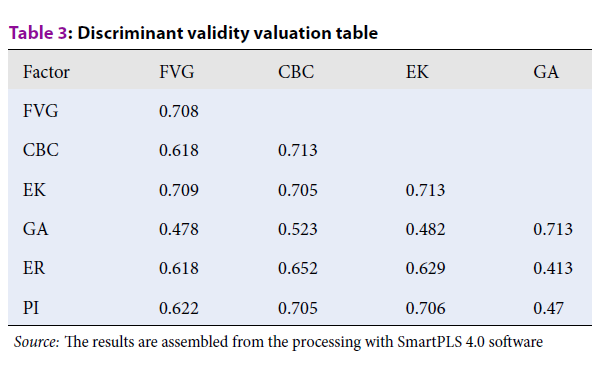
In addition, the discriminant validity (DV) is tested to measure the mentioned value in order to ensure that there is no correlation between the factors used to perform measurement44, calculated by squaring the total of the average variance extracted from AVE. According to Hair et al (2014)44, the load factor of these factors is larger than the load factor of other factors, showing the reliability of discriminant validity.
Discriminant validity valuation table
|
Factor |
FVG |
CBC |
EK |
GA |
ER |
PI |
|
FVG |
0.708 | |||||
|
CBC |
0.618 |
0.713 | ||||
|
EK |
0.709 |
0.705 |
0.713 | |||
|
GA |
0.478 |
0.523 |
0.482 |
0.713 | ||
|
ER |
0.618 |
0.652 |
0.629 |
0.413 |
0.759 | |
|
PI |
0.622 |
0.705 |
0.706 |
0.47 |
0.663 |
0.745 |
Table 3 shows that the scale met the criteria of discriminant, with the values (mid-diagonal, in bold) being greater than the correlation coefficients between factors shown outside the mid-diagonal. For example, the Environmental Responsibility (ER ) scale, with an AVE of 0.577 (Table 2), should reach 0.759 (Table 3). Thus, 0.759 surpasses all correlation values in its same row (0.618, 0.652, 0.629 and 0.413) and its same column (0.663).
The collinearity of the structural model needs to be solved before examining the relationship between the factors. The estimation of the path coefficient is based on the regression of each dependent variable and predictor variable 44. If multicollinearity occurs in the independent variables, the path coefficients cannot be guaranteed. The variance inflation factor (VIF) was tested for multilinearity. The VIF coefficient lower than 5 is accepted as not violating multicollinearity44. The results of this study show that the VIF coefficient value fell between 1,295 and 1,849, much lower than 5, so the analysis is continued.
Structural model evaluation
In the PLS-SEM analysis, the R coefficient of the dependent variable represents whether the test model is appropriate. According to Hair et al. (2014) the value of the R coefficient around 0.67 is considered significant, around 0.33 is considered moderate, and around 0.19 and below are considered weak. The analysis results show that the R value in this green furniture purchase intention research model is 0.685, showing that the model is well-explained. On top of that, independent factors have explained 68.5% of the directional variation in green furniture purchase intention, and the remaining 31.5% have not been mentioned or clarified due to the lack of additional factors that have not been mentioned in the research model. In addition, the Q index is considered to evaluate the predictive relevance of the path model to dependent concepts. Moreover, according to Hair et al. (2014)44, Q reaching values of 0.02, 0.15 and 0.35, respectively, correspond to the small, medium, or large predictive relevance of the exogenous variable to one particular endogenous variable. With the Blindfolding method, the Q value is 0.570, reflecting that the mentioned dependent variable has a relatively high predictive relevance. At the same time, the SRMR index of the study results was 0.069, smaller than 0.08.
The bootstrapping technique is used to check if there are any big differences between the path coefficient and zero. To ensure the testing requirements when building a linear structural model, this technique is applied with n = 241 samples, repeated 5,000 times.
Results of testing hypotheses of the study
|
Hypotheses |
Original sample |
Standard deviation |
t-value |
2.5% |
97.5% |
Conclude |
|
FVG -> PI |
0.144 |
0.071 |
2.039** |
0.044 |
0.200 |
Accept |
|
CBC -> PI EK -> PI GA -> PI ER -> PI |
0.451 0.219 0.022 0.183 |
0.073 0.076 0.053 0.078 |
6.200** 2.884** 0.428 2.356** |
0.291 0.800 -0.069 0.023 |
0.580 0.374 0.138 0.324 |
Accept Accept Rejected Accept |
Based on Table 4 when the bootstrapping analysis is performed, the weights reach the 95% confidence interval, so the model estimations are reliable. The results of the structural model testing process show that, with the significance level of 0.01, H5 was not supported, H1, H2, H3, H4, were support at a significance level of 95%. That is, Functional Value of Green Furniture (FVG), Environmental Knowledge (EK), Cognitive Behavioral Control (CBC) and Environmental Responsibility (ER) positively affect Green Furniture Purchase Intention (PI), while Green Attitude (GA) may still be strange for young people in HCM City so it has no significant impact. The model is adjusted as Figure 2:

Structural model evaluation
Discussion and Conclusions
Discussion
Through the process of examination and data analysis, the research has discovered various factors that have an impact on the green interior decoration items purchasing behavior of the younger generation from 18 to 35 years old in Ho Chi Minh City, which can show that the youth of Ho Chi Minh City have an attentiveness to the environment, are willing to contribute to environmental protection, and are conscious about looking for items that reduce environmental pollution while doing the shopping. The research model tested with the PLS-SEM method has shown some aspects of awareness, attitude, environmental knowledge, environmental responsibility, and purchase intention toward green items as well as green furniture in recent time.
This study shows that, when there is a need to use and buy furniture, young people are interested in the functional value of furniture, which is consistent with the study of Mohd Suki (2016) (30). Besides, young people in Ho Chi Minh City with environmental knowledge, which can positively impact their intention to purchase green furniture, are making decisions about investing in environment-friendly furniture. This effect has also been verified in previous studies, some of which were carried out by Kautish and Sharma in 20204 and Moslehpour et al. in 202247, along with various others. This also shows that young people in Ho Chi Minh City have pro-environmental behavior and are environmentally conscious, which forms a positive belief in environmental protection and contributes to environmental pollution level reduction. Moreover, they are more actively taking part in green product purchases that contribute to not only environmental protection but also green market development, which has exceptional potential.
The results show that green attitude does not affect purchase intention, cognitive behavioral control has a relative effect on purchase intention, and the environmental responsibility and environmental knowledge of young people in Ho Chi Minh City can impact their consciousness about environmental issues and socio-ecological benefits, positively impacting their purchase intention towards green furniture and green products. This is corroborated by previous studies by Uddin and Khan in 201642, Lavuri and Susandy in 202016, also Zaremohzzabieh et al. in 202148, and so forth. The results of the mentioned studies revealed that environment-friendly consumers who have an ecologically beneficial attitude also have a positive viewpoint towards buying green products. The youth of Ho Chi Minh City care about the current state of the environment and what causes pollution and harms the environment. They also desire to contribute to better environmental preservation, which means voluntarily making choices towards green products and interior green furniture instead of buying furniture made from materials that cause environmental damage.
This study proves that young people are occupied with environmental knowledge and have an environment-friendly standpoint, which encourages them to invest in green products, which is also necessary information for manufacturers and businesses to go green and produce environment-friendly goods in order to lend a hand to solve environmental problems and contribute to creating a sustainable green market.
Conclusions and suggestions
Along with the prospect of environmental pollution and degradation all around the world, Vietnam also suffered a similar condition. At the same time, it witnessed and experienced climate change through weather phenomena together and news from the media. Particularly, consumers in general and young people in Ho Chi Minh City already have, to some extent, a certain awareness and consciousness about taking care of their living environment. In order to play a part in reducing environmental pollution and protecting the living environment, combined with the presented research results, the author recommends some solutions as follows:
(1) For the factor Cognitive Behavior Control (CBC) with a coefficient of 0.458, the average value is 4.78; in which the highest scale is: I understand green furniture is a consumption trend that contributes to environmental protection for the future; lowest scale: Buying green furniture contributes to reducing environmental pollution. Consumers haven’t gained much awareness about the use of green products that will contribute to reducing environmental pollution. The proposed solution is to have measures to propagate information to consumers more.
(2) For the factor Environmental Knowledge (EK) with a coefficient of 0.221, the average value is 4.63; in which the highest scale is: Green color is characteristic of green interiors, conservation of the ecosystem; lowest scale: Green items can be biodegradable. The proposed solution is that green production enterprises need to have many commercial advertising campaigns and information so that consumers know about green products and the benefits of using green products. The issue of how to decompose or recycle green products compared to conventional products is for consumers to know.
(3) For the factor Environmental Responsibility (ER) with a coefficient of 0.184, the average value is 4.49, in which the highest scale is: Advocating for contributing to a sustainable environment; lowest scale: desire to contribute to the protection of the living environment. Consumers have not yet realized that their use of green products really contributes to protecting their own living environment. The solution is to have measures to propagate information to consumers more and help them realize that when many people make a small contribution to protecting the environment, the environment will be much better.
(4) For the factor Functional Value of Green Furniture (FVG), with a coefficient of 0.069, the average value is 4.14, in which the highest scale is: Green furniture has more ecological value than non-green furniture; lowest scale: Green furniture is made from environmentally friendly materials. Consumers are also skeptical about green product materials. The problem is that organizations need to make consumers have faith through the act of manufacturing qualified green products to serve their needs. Therefore, green product manufacturers should be candid and accurate about the information about their products. The product characteristics, specifications, and material sources should be clearly provided in order to convince consumers to purchase their products. In addition, it is necessary to have a certificate of green products produced in accordance with the process from the state management agency.
The study investigated and explored the impact of a number of factors on the green furniture purchasing intention of young people from 18 to 35 years old in Ho Chi Minh City. The quantitative results show that out of the total of 05 hypotheses, there are 04 hypotheses that satisfy the statistical conditions and are able to be taken into further examination. Thereby, the issue of awareness and environmental protection, as well as the use of environment-friendly products of young people in Ho Chi Minh City, has been reflected, which the author then used to make recommendations and solutions to raise consumers' awareness about environmental issues, environmental protection, and environmental damage reduction.
Limitations and directions for further research
The study was carried out with 241 samples in Ho Chi Minh City, which can be seen as small-scale and geographically limited samples. The green furniture purchase intention-affected factors suggested in the study might be insufficient and not thoroughly cover the situation. The research concentrated on a specific product, which is green furniture, even though there are many other types of green products that need to be researched. Last but not least, the research subjects are mainly young people and have not yet considered the diversity of demographics regionally and nationally.
ABBREVIATIONS
PLS-SEM: Partial least squares structural equation modeling
MCMD: Multi- Criteria Decision Making
TRA: Theory of Reasonable Action
TPB: Theory of Planned Behavior
CA: Cronbach’s Alpha coefficient
CR: Composite reliability
COMPETING INTERESTS
The authors hereby declare that there is no conflict of interest in the publication of the article.
AUTHOR'S CONTRIBUTIONS
Author 1: Tran Thi Huong is responsible for surveying and writing the article
Author 2: Bao Trung is responsible for developing the outline, providing comments, and editing the article
Tran Thi Huong and Bao Trung wrote the draft of the article and edited it according to the comments of the reviewers.