


Impact of endogenous and exogenous factors on catches: A case study of Vietnam’s offshore fisheries
- Faculty of Economics, Nha Trang University, Viet Nam
Abstract
The performance of fishing vessels is influenced by both endogenous and exogenous factors. This study aims to investigate the impact of these factors on the catch quantity of offshore gillnet vessels in Khanh Hoa, Vietnam, by estimating the harvest function using survey data from three fishing seasons (2008, 2013, and 2018). The study has revealed that endogenous factors, such as engine capacity, the number of nets, the number of fishing days, and variable costs, exhibit a positive impact on catches at the 1% level of significance. Among these factors, the number of nets has the highest effect on catches. Nevertheless, the effect coefficients are generally smaller compared to those observed in previous studies within the same area or on the same fishing grounds. Conversely, the coefficient estimate for the age of the vessel owner is negative, though statistically insignificant. Exogenous factors manifest varying effects on the quantity of catches. The research result found no discernible effect of fuel cost support, while the stock proxy exhibited a minor impact coefficient, and climate change awareness had a noteworthy impact on catch quantities at the 1% level of significance. The findings imply that offshore resources could be experiencing a growing scarcity. Additionally, as fishermen's awareness of climate change increases, they might be more inclined to adjust and manage its impacts. Moreover, it raises concerns about the long-term sustainability of open-access fisheries that rely on subsidies. The study suggests that fishing policies should focus on regulating offshore vessels' input factors to prevent the overuse of offshore resources. In addition, policies should support fishermen in adopting appropriate coping strategies when faced with climate change. Furthermore, subsidy policies that do not harm offshore resources should be promoted.
Introduction
Numerous studies have been conducted worldwide to estimate fisheries production functions, which are referred to as the harvest or catch function in fisheries. Schaefer's 1 study is considered the first to address the harvest function and has been widely cited in subsequent literature. Schaefer posited that the production function in fishing depends on three primary factors: catchability coefficient, fishing effort, and fish biomass1. The catchability coefficient is determined by the characteristics of the fishing gear used to catch fish, while the fishing effort is a set of input factors that fishermen can control and influence. In contrast, the fish is viewed as a variable that impacts the harvest function, but each fisherman cannot control and manage it. As a result, the fishing effort comprises endogenous variables 2, 3, 4, 5. It is optimized by adjusting the input factors of the vessel2, 6. It differs from input factors in that it is not a final product that is consumed, but rather an intermediate product used to generate the harvest quantity. Fishermen can actively manipulate the quantity of various input factors based on the scale and nature of their operations2. The fish stock is an important variable in the catch function, but it is not actually a production input factor for the vessel. The fish stock can be considered as an exogenous factor affecting catch output. However, if fishermen use excessive fishing effort, that may cause fish stocks to decrease, leading to a decrease in their catch output6, 7. Other exogenous factors, such as fishery management policies, fishing incentive mechanisms, climate change, etc., have potential impact on the catch output of the vessel8, 9, 10, 11, 12, 13.
An important question in fisheries economics is to what extent fishing effort and other factors affect catch quantity14. Understanding the harvest function of fisheries is crucial in revealing the important factors that impact fishermen's output, and the extent of their impact, and the potential for fishers to alter their targeting behavior14, 15. Pascoe et al.16 studied Danish gillnet vessels and estimated production functions using physical input factors, namely vessel weight, engine power, fuel consumption, fishing days, and fish stock index. They measured these factors in both monetary and physical values and used three different harvest functions modeled as Cobb-Douglas functions in translog form. The authors found that no variable measurement was better than the others, and recommended researchers choose the appropriate form of measurement depending on the research purpose. Meanwhile, Squires et al.17 estimated a production function for Malaysian trawl fisheries to assess the efficiency of input use. They used a translog function with multiple variables in the model and found that vessel weight, fishing gear, crew members, and fishing trips per month were significant variables. The study revealed that the degree of influence of these factors varied across regions and the level of development in each area. Fishing fleets on the less developed east coast of Malaysia had more significant influencing variables than those on the west coast.
Tingley et al.18 estimated input efficiency for the UK fishing industry using harvest function estimation techniques. They incorporated various input factors such as vessels, equipment, fishing gear, engine capacity, fishing technology, skipper skills, fishing time, and crew members. Their findings indicated that vessel characteristics and skipper skills significantly impacted the production function and played a vital role in input efficiency. Felthoven et al.19 used a variant production function model to estimate the productivity of Bering Sea and Aleutian Islands fisheries in the US. The model included variables such as vessel HP, length, crew size, days fished, stock index, and climate change. The study found that exogenous factors like stock biomass and climate change significantly impacted catch and productivity over time. Changes in management policies and fishermen's harvesting strategies also played a significant role in production outcomes.
Squires and Vestergaard20 added a technological change variable to Schaefer's (1957) harvest function to show the impact of technological advancements on the fisheries industry in the US and Canada. The study suggested that technological change had a significant effect on current and future catch and resource stocks, while fishing subsidies may have accelerated investment and technological advancements. On the other hand, Reimer et al.21 recommended accurately assessing the impact of policy interventions and providing a comprehensive description of the fishing process and regime when estimating the harvest function. Other studies constructed production functions for different fisheries worldwide, including Norwegian bottom trawl fisheries14, Solomon Islands' handline fishery22, and pelagic fish stocks in the Atlantic Ocean23, 24. Gordon 25 provided insights into the endogeneity issues in estimating econometric models for fisheries, including harvest functions.
In Vietnam, Tuan et al. 26, Tuan et al.27 used a production function to examine the factors influencing the revenue generated by gillnet vessels in Nha Trang, Khanh Hoa. The study proposed two regression models with independent variables including vessel length, vessel engine capacity, fishing gear, investment value of equipment, and vessel age. The primary difference between the two models was that the fishing gear variable was measured in terms of the number of nets and the value of the nets. The study developed a third-order polynomial multiple linear regression equation to explain the variables. The findings indicated that all the variables were statistically significant. However, some third-order variable coefficients were not statistically significant, suggesting that choosing an appropriate function form is one of the limitations of this study. Some factors had a high correlation, such as vessel length and engine capacity, so including them in the same model could result in multicollinearity, making the estimated outcomes unreliable. Furthermore, using revenue as the dependent variable in the study might lead to the biased estimates because revenue depends on prices. On the other hand, Duy et al.28 applied a production function model to estimate fishing effort for the gillnet fishery in Nha Trang in 2008. The study employed a Cobb-Douglas model with the main factors, including engine capacity, number of nets, and number of fishing days at sea. The results indicated that all factors were statistically significant, and the output elasticity coefficients with fixed factors were less than 1. However, a limitation of this study is that the estimation model used revenue as the output variable, which is considered problematic since revenue from fishing is dependent on fish prices. Although the study assumed that the price of fish was the same across fishermen, the use of revenue as the dependent variable still might cause biased estimation.
Duy and Flaaten29 employed random catch production frontiers to estimate the efficiency of input use for offshore gillnet vessels in Khanh Hoa province. The results indicated that the factors in the three estimated models were statistically significant. The study suggested that catch per unit of effort (CPUE) could serve as an appropriate indicator for stock biomass if the fishery lacks information on fish stocks. However, the limitation of the study is that it assumed fishing technology remained constant over time. Truong et al. 30 used a random production frontier to estimate the efficiency of input use in offshore gillnet fisheries in Da Nang, Vietnam. The production frontier model included vessel engine power, variable costs of fishing trips, number of crew members, and number of nets. The study found that the influential variables were statistically significant, but had almost no interaction effects. On the other hand, Pham et al.31 developed a production function of offshore fishing nets in Da Nang that included two fixed variables (vessel weight and capacity) and four variable inputs (number of days fishing at sea, number of nets, fuel costs, and number of crew members). The results showed that the offshore fishing industry in Da Nang was not operating at full capacity, and that many vessel capabilities were underutilized. Since the study used non-parametric estimation techniques, the degree of influence of the input variables could not be quantified.
Several studies have estimated production functions in various fishing industries in Vietnam. Long et al.32 used the translog production function to estimate factors affecting revenue and income in offshore longline fisheries in Khanh Hoa. Other studies estimated production functions for trawl fisheries in Khanh Hoa33, 34, Ben Tre and Quang Ninh35. However, these studies did not consider exogenous variables such as resource stocks, institutional frameworks, fisheries management policies, and climate change.
In this paper, the harvest function has been designed and estimated. The empirical focus is an offshore fishery in Khanh Hoa province, Vietnam. In recent years, the offshore fishing industry in Khanh Hoa province has faced a number of challenges, particularly the offshore gillnet fishery. The fishing productivity of offshore gillnet vessels has fluctuated significantly and has shown an overall decreasing trend in recent years29. The increase in the number of fishing vessels has contributed to the decline in catch productivity, which is likely due to changes in the offshore fishing incentive mechanism over the years. As a result, vessel owners are increasingly investing in modernization and intensifying fishing efforts, potentially leading to a decline in offshore resources, which could negatively impact catch productivity 29. Essential questions that need to be addressed for policymakers are: why has the catch productivity of the gillnet fishery decreased? What motivates fishermen to increase their fishing effort? And how do endogenous and exogenous factors impact catch quantities? To properly address these inquiries, it is crucial to understand the intricate nature of the interactions among the variables involved in fishing operations by estimating the harvest function.
The following sections will provide the theoretical background and methods, followed by the research results. The discussion will then be presented, and the main conclusions and policy implications will be summarized.
Theory and methods
Theory of production function in fisheries
The Schaefer harvest function, proposed by Schaefer1, is commonly used in bioeconomic studies. It assumes a linear relationship between fishing effort (E) and stock biomass (S), with the resulting catch quantity (H) given by the formula:
where q is the catchability coefficient, which is a gear and stock specific constant.
The function (1) is expanded and represented as a Cobb-Douglas production function as follows:
where H is the catch of the vessel in year t, E is the fishing effort of the vessel in year t, S is the fish stock biomass in year t, α is the elasticity coefficient of the catch with respect to effort, and β is the elasticity coefficient of the catch with respect to stock. This function (2) has been widely applied to fisheries economics2, 3, 4, 5, 14, 36, 37
As mentioned, fishing effort E is formed by a vector set of input production factors (X) such as capital, labor, and other factors, E = E(X). Therefore, the function (2) can be rewritten as:
where X is the vector of input factors of the vessel in year t and α is the vector of elasticity coefficients of the catch with respect to input factors.
Fishing vessels may be influenced by external factors. In this case, the harvest function can be rewritten as:
where Z is the vector of factors related to fishing policy mechanisms (such as subsidies) or climate variability (such as climate change, weather), or other external factors (such as demographic characteristics of fishing households).
Model specification
The selection of variables for the production function in fisheries varies across fishing gears. Several studies, including Felthoven et al.19, Grafton et al. 38, Herrero39, Khanh Ngoc et al.33, Kompas et al.40, Pascoe and Coglan41, Pascoe et al.42, Squires et al.17, and Tingley et al.18 have employed fixed input factors, such as vessel size (e.g., weight, length, and width) and/or engine power, as variables to represent the level of capital invested in fishing. Pascoe and Coglan41 found that about one-third of the variation in catch output of the trawl fishery can be explained by the technical characteristics of the vessel. In addition, variable input factors, including the number of fishing days, the number of fishing trips per year, and the number of crew members, have often been considered to affect catch output in a year43. Sharma and Leung44 estimated the harvest function for the longline fishery in Hawaii using only variable factors such as the number of crew members, number of fishing days/trips, and variable costs. Similarly, Kirkley et al. 23, Kirkley et al.24 employed the number of crew members, number of fishing days, and size of gear in the harvest function of the dredge fishery in the Atlantic Ocean. In contrast, Pascoe and Coglan41 combined vessel size variables, engine power, and number of fishing hours in the production function of the trawl vessel in the English Channel. Long et al.32 used the vessel length, the total number of months of operation in a year, the number of crew members, and the number of fishing trips in the production function of the offshore longline fishery in Khanh Hoa. Some other studies have indicated that the experience and fishing skills of the skipper affect catch output when estimating the production function, such as Squires and Kirkley45.
In gillnet fisheries, Pascoe et al. 16 incorporated measurements of fixed inputs, such as vessel weight and engine power, along with the amount of fuel used and the number of fishing days, into the production function of gillnet vessels in Denmark. Similarly, Squires et al. 17 identified vessel weight, number of nets, number of crew members, and number of trips as statistically significant variables in the production function of gillnet fisheries in Malaysia. Truong et al. 30 found vessel engine power, variable cost, number of crew members, and number of nets to be significant factors in the production function of offshore gillnetters in Da Nang. Pham et al. 31 included vessel weight, engine power, number of fishing days, number of nets, fuel cost, and crew size in the production function of offshore fisheries in Da Nang. In a similar vein, Duy et al.28 and Duy and Flaaten29 utilized three variables, namely engine power, number of nets, and number of fishing days, in the production function of gillnet vessels in Nha Trang, Khanh Hoa.
In this study, the engine power of the vessel was selected as a fixed input factor to measure the fishing effort of the vessel. The engine power had been widely used in previous studies16, 28, 29, 30, 31. The variable input factors were determined as the average number of gillnets used, number of fishing days, and variable fishing cost, which have been identified as significant variables in previous studies17, 28, 29, 30, 31. These variables are considered endogenous variables to the vessel.
The stock of resources is an essential variable in harvest functions. However, due to the lack of information on the stock of resources for the fishing industry in Vietnam, this study uses CPUE as a proxy for the stock variable. CPUE is a commonly used proxy for resource stock in the production functions of various fisheries worldwide, such as Comitini and Huang46, Greenville et al.47, Kirkley et al. 23, Kirkley et al.46, 24, Eggert 48, and Pascoe and Coglan41. In Vietnam, a recent study by Duy and Flaaten29 on the gillnet fishery found that CPUE could be a suitable proxy measure for the variation of fish stock in information-limited fisheries.
In this study, the production function included several variables, such as the age of vessel owners, fuel cost subsidies, and climate change, in addition to the traditional inputs of gillnet fishing. The age of vessel owners is considered an important variable, as it reflects the experience of the owners and may impact the catch yield. Several studies have supported this relationship, including Kirkley et al.24, Squires and Kirkley45, and Nguyen et al. 35.
Fuel cost subsidies, which have been implemented in Vietnam since 2008, represent a policy mechanism variable that can impact the behavior of fishermen and their fishing outcomes. The effectiveness of these subsidies has been studied by several researchers, including OECD8, Sumaila9, Duy et al.49, and Duy and Flaaten50.
Finally, climate change is an important variable in the production function of fisheries, as it can impact stock and fishing productivity. A number of authors, including Daw et al. 10, Grafton11, Sumaila et al. 12, and Cheung et al.13, have demonstrated the relationship between climate change and fisheries. While data on climate change is often difficult to measure, it can be approximated by the perceptions of fishermen regarding changes in climate, weather, ocean currents, and sea temperature, as demonstrated by Schwarz et al. 51 and Hasan and Nursey-Bray52.
Duy et al. 28 utilized a Cobb-Douglas production function to estimate fishing effort in the offshore gillnet fishery of Nha Trang city, Khanh Hoa province. Duy and Flaaten29 also confirmed the suitability of the Cobb-Douglas form for estimating the random frontier production function of the gillnet fishery in Khanh Hoa. Truong et al. 30 employed a translog model for the gillnet fishery in Da Nang, but the coefficients of the interaction terms among variables were statistically insignificant. Therefore, this study uses a Cobb-Douglas production function with the following form:
lnY = β + βlnHP + βlnGEAR + βlnDAY + βlnCPUE + βlnVAR_COST + βAGE + βSUBSIDY + βPER_CC + βYEAR2018 + ε (5)
where the variables defined in Table 1 and ε represent the error term for vessel i in year t.
The perception of vessel owners (or captains) on climate change compared to five years ago (the PER_CC variable) is measured in this study through a survey that evaluates the frequency of climate/weather events affecting fishing activities. Four climate/weather events are evaluated: (i) storms and floods, (ii) increasing temperatures at sea, (iii) rising sea levels, and (iv) changes in ocean currents. Vessel owners or captains were asked about their perception regarding each climate/weather event based on five-point scales: 1 = not occurring, 2 = occurring less than before, 3 = occurring at an average level, similar to five years ago, 4 = occurring slightly more, and 5 = occurring much more.
The definition of variables used in the model
|
Variables |
Definitions |
|
Yit |
Catch quantity of vessel i in year t (tons) |
|
HPit |
Engine capacity (HP) of vessel i in year t |
|
GEARit |
Number of nets used in each trip of vessel i in year t (nets) |
|
DAYit |
Number of fishing days of vessel i in year t (days) |
|
VAR_COSTit |
Variable costs of vessel i in year t (million VND) |
|
CPUEt |
Proxy for fish stock in year t (kg/day) |
|
AGEit |
Age of owner of vessel i in year t (years) |
|
SUBSIDYit |
Level of fuel cost subsidy for vessel i in year t (million VND) |
|
PER_CCit |
Perception of owner (or captain) of vessel i on climate change compared to 5 years ago (5-point Likert scale) |
|
YEAR2018 |
Dummy variable: YEAR2018 = 1 if the fishing season is 2018/2019; otherwise, YEAR2018 = 0. |
Data
The empirical analysis focuses on the offshore gillnet fishery in Khanh Hoa province, Vietnam. Khanh Hoa is a coastal province n the south-central Coast of Vietnam. As of 2019, the province had over 9,500 vessels, with nearly 800 vessels having an engine capacity of over 90 HP, accounting for 8.4% of all vessels, mainly operating in offshore areas53. These vessels are typically over 15 meters long. The offshore fishing fleet consists primarily of gillnet, trawl, handline, and purse seine vessels. Gillnet vessels make up approximately 25% of the offshore fleet in the province, with an average capacity of over 300 HP per vessel. The number of offshore gillnetters with a capacity of over 400 HP increased during the period from 2009 to 2019, while vessels with a capacity of 90 to under 400 HP decreased.
The offshore fishing season extends throughout the year, from October to September of the following year, and is divided into two seasons: the northeast monsoon (from October to March) and the southwest monsoon (from April to September). During August to September or September to October, offshore gillnet vessels usually remain onshore for maintenance and repairs. The primary target species of gillnetters are migratory pelagic species, such as tuna. Striped tuna (Sarda orientalis), skipjack tuna (Katsuwonus pelamis), and mackerel species like the Indo-Pacific king mackerel (Scomberomorus guttatus), wahoo (Acanthocybium solandri), and narrow-barred Spanish mackerel (Scomberomorus commerson) are the main target species. Additionally, other species are occasionally caught as incidental bycatch. Gillnets are comprised of numerous individual net walls that are linked together to form a large net wall that hangs vertically in the water. Floats are attached to the top of the net, while weights are attached to the bottom. When fish swim into the net, they may become gilled, entangled, or enmeshed by their gills.
The study collected representative random samples from three fishing year-seasons: 2008/2009, 2013/2014, and 2018/2019, which are denoted as the 2008, 2013, and 2018 seasons, respectively. The samples comprised 58, 57, and 49 vessels, respectively, accounting for 25.8%, 22.1%, and 23.3% of the gillnet population in each season. Identical questionnaires were used to collect data covering various aspects of the gillnet fishery, such as technical and operational characteristics of vessels, costs and earnings data, catch information, demographic data, and crewmembers' income. The data was collected through direct face-to-face interviews with either the vessel owner or captain.
The data comprises a combination of cross-sectional and time-series data, which cannot be considered a panel. Specifically, the data pertains to individual vessels from a population over a period of three years, but there are differences in the vessels included in each year. Consequently, data from different individuals is pooled or aggregated without accounting for potential individual differences that could affect the estimated coefficients. The study employs the ordinary least squares (OLS) method to estimate the model, followed by testing the assumptions of the multiple regression model, as outlined by Hill et al. 54. If heteroscedasticity is detected, the study will employ the generalized least squares (GLS) and heteroscedastic-consistent covariance matrix estimators proposed by White55. Furthermore, to ensure accuracy, the values of variable costs and fuel cost subsidies in 2008 and 2013 are adjusted for inflation using the price index to reflect 2018 during the model estimation process.
Table 2 presents descriptive statistics for the variables in the research model. Overall, the values of the variables increased over the three years, except for the DAY and PER_CC variables, which decreased in 2018 compared to 2013. The dataset exhibits a wide range of variability in the variables, for example, the average engine capacity is 320.1 HP, but the standard deviation is 135.9 HP.
Descriptive statistics of the variables in the model
|
Variables |
Unit |
2008 (N=58) |
2013 (N=57) |
2018 (N=49) |
Total (N=164) | ||||
|
Mean |
S.D. |
Mean |
S.D. |
Mean |
S.D. |
Mean |
S.D. | ||
|
Catch quantity (Y) |
Ton |
74.6 |
24.4 |
98.2 |
28.0 |
98.5 |
27.5 |
89.9 |
28.8 |
|
Engine power (HP) |
HP |
249.6 |
149.3 |
311.9 |
117.7 |
413.2 |
71.3 |
320.1 |
135.9 |
|
Number of nets (GEAR) |
Net |
267.7 |
63.6 |
278.1 |
52.9 |
319.7 |
37.5 |
286.9 |
57.2 |
|
Number of fishing days (DAY) |
Day |
231.2 |
28.6 |
237.9 |
35.5 |
233.7 |
30.3 |
234.3 |
31.6 |
|
Variable costs (VAR_COST) |
Million VND |
604.4 |
174.5 |
1148.2 |
350.2 |
1446.3 |
405.6 |
1045.0 |
471.6 |
|
CPUE index |
Kg/day |
306.5 |
0 |
399.9 |
0 |
405.1 |
0 |
368.4 |
46.0 |
|
Age of vessel owner (AGE) |
Year |
45.7 |
10.6 |
50.9 |
11.3 |
55.6 |
11.7 |
50.5 |
11.8 |
|
Fuel cost subsidy (SUBSIDY) |
Million VND |
29.2 |
1.6 |
123.1 |
93.4 |
282.0 |
33.7 |
137.4 |
117.7 |
|
Perception of fishermen on climate change (PER_CC) |
5-point Likert scale |
2.7 |
0.8 |
3.7 |
0.5 |
3.4 |
0.7 |
3.3 |
0.8 |
Result
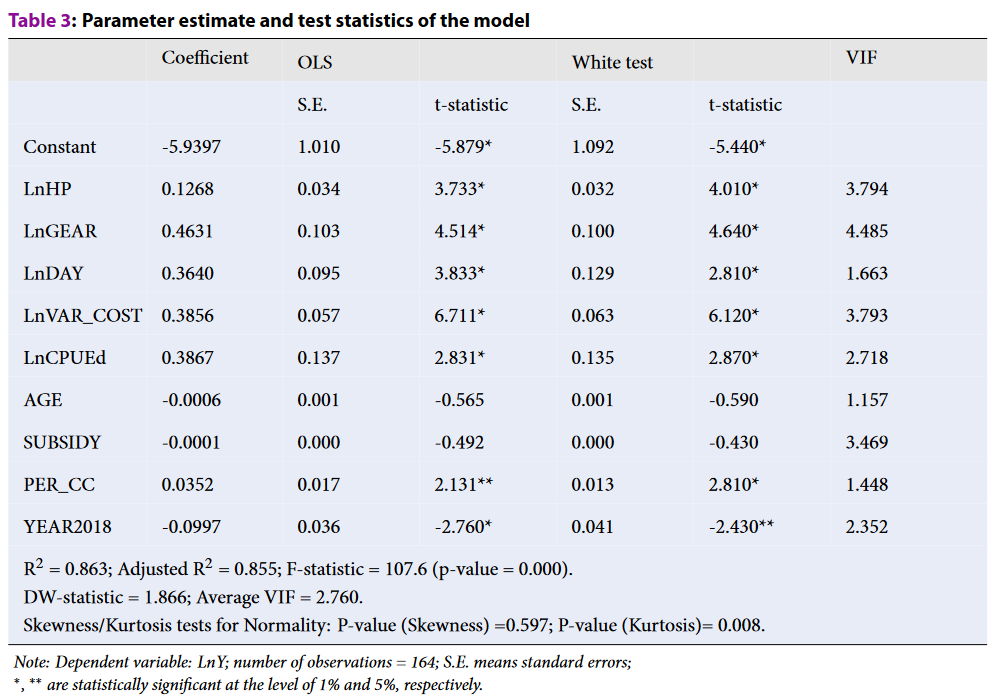
Table 3 shows the estimation results and test statistics for the harvest function model. The adjusted R-squared value of 0.855 suggests that the model explains 85.5% of the variation in catch quantity. The F-statistic of 107.6 is statistically significant at the 1% level, indicating that the estimated relationship is significant. The model specification is tested using Pregibon's test, which regresses the dependent variable LnY on its prediction and the prediction squared. The result shows that the prediction squared has no explanatory power, as its coefficient is not statistically significant (p-value of 0.699). This suggests that the Cobb-Douglas function is the appropriate form for the model.
Parameter estimate and test statistics of the model
|
Coefficient |
OLS |
White test |
VIF | |||
|
S.E. |
t-statistic |
S.E. |
t-statistic | |||
|
Constant |
-5.9397 |
1.010 |
-5.879* |
1.092 |
-5.440* | |
|
LnHP |
0.1268 |
0.034 |
3.733* |
0.032 |
4.010* |
3.794 |
|
LnGEAR |
0.4631 |
0.103 |
4.514* |
0.100 |
4.640* |
4.485 |
|
LnDAY |
0.3640 |
0.095 |
3.833* |
0.129 |
2.810* |
1.663 |
|
LnVAR_COST |
0.3856 |
0.057 |
6.711* |
0.063 |
6.120* |
3.793 |
|
LnCPUEd |
0.3867 |
0.137 |
2.831* |
0.135 |
2.870* |
2.718 |
|
AGE |
-0.0006 |
0.001 |
-0.565 |
0.001 |
-0.590 |
1.157 |
|
SUBSIDY |
-0.0001 |
0.000 |
-0.492 |
0.000 |
-0.430 |
3.469 |
|
PER_CC |
0.0352 |
0.017 |
2.131** |
0.013 |
2.810* |
1.448 |
|
YEAR2018 |
-0.0997 |
0.036 |
-2.760* |
0.041 |
-2.430** |
2.352 |
|
R2 = 0.863; Adjusted R2 = 0.855; F-statistic = 107.6 (p-value = 0.000). DW-statistic = 1.866; Average VIF = 2.760. Skewness/Kurtosis tests for Normality: P-value (Skewness) =0.597; P-value (Kurtosis)= 0.008. | ||||||
Assumptions of multiple linear regression were tested. First, the linearity assumption was examined using scatterplots, which suggested a linear relationship between the independent and dependent variables.
The last assumption of the regression model is homoscedasticity, which means that the variance of the error terms should be constant across all levels of the independent variables. The Breusch-Pagan test reports a Chi-squared (χ) value of 1.47 and a p-value of 0.2261 (>0.05), indicating that there is no evidence of heteroskedasticity in the regression model. On the other hand, the White test reports a χ2 value of 86.67 with a significant level of 5%, concluding that heteroscedasticity is present in the data. Breusch-Pagan test also reports that the explanatory variables, including LnCPUEd, SUBSIDY, and PER_CC, exhibit variance heterogeneity at a 5% level of significance. This implies that the assumption of homoscedasticity is not entirely met, and further investigation is required to determine the source of heteroscedasticity and address it appropriately.
When heteroscedasticity is present, the standard errors of OLS shown in Table 3 become unreliable, and the least squares estimators are no longer optimal. Two methods can be used to address this issue. The first method involves using robust standard errors to obtain a more accurate measure of the true standard errors of the regression coefficients. In this study, White's 55 heteroscedasticity-consistent covariance matrix estimators are used to re-calculate the test values for robust standard errors. The second method involves using weighted regression by applying the generalized least squares (GLS) method. After estimating the model using these two methods, the AIC (Akaike's information criterion) and BIC (Bayesian information criterion) are calculated. The model estimated using robust covariance matrix estimation is selected as it has better AIC and BIC criteria.
The results presented in Table 3 reveal that the estimated coefficients of endogenous variables, including LnHP, LnGEAR, LnDAY, and LnVAR_COST, are all positive and statistically significant at the 1% level of significance, suggesting that these variables have a positive impact on catch quantity. On the other hand, the coefficient estimate for AGE is negative, but statistically insignificant.
Regarding exogenous variables, the coefficient estimate for SUBSIDY is statistically insignificant, while the CPUEd variable has a positive and statistically significant effect on catch quantity at the 1% level of significance. Moreover, the coefficient estimate for PER_CC is positive and statistically significant at the 1% level of significance, indicating that a more positive perception of climate change is associated with a higher catch quantity.
Furthermore, the coefficient estimate for YEAR2018 is negative and statistically significant at the 5% level of significance. This suggests that, after controlling for the effects of other variables, fishing in the 2018 season is associated with lower catch quantitiescompared to the 2013 and 2008 seasons.
Overall, the results suggest that vessel characteristics, such as engine capacity, number of nets used, and variable costs, as well as the number of fishing days and fish stock proxy, are significant determinants of the catch quantity of offshore gillnet vessels. Additionally, owner or captain perceptions of climate change have a positive association with catch quantity, while subsidies and vessel owner age do not have a significant effect on catch quantity. Finally, the negative coefficient of YEAR2018 indicates a decrease in catch quantity during the 2018 season compared to previous seasons after the effects of the remaining variables are taken into account.
Discussion
The research findings suggest that a 1% increase in the power capacity leads to a 0.1268% increase in the annual catch of offshore gillnet vessels in Khanh Hoa province, holding other factors constant. This impact is lower than the results reported by Duy and Flaaten29, ranging from 0.269% to 0.280%, and Duy et al.28, which reported a variation of 0.251%. However, this is due to several reasons. Firstly, offshore fishing activities rely increasingly on fishing equipment, fish detection technology, and other support devices. Secondly, when the percentage increase in vessel power is much higher than the percentage increase in catch in the three seasons, it may suggest that offshore resources are becoming scarcer. Moreover, countries in the East Sea are increasingly tightening their control over their own sea areas, so fishermen are reluctant to move to offshore areas that overlap with other countries. Thirdly, gillnets are a type of static gear, so vessel power may not be the most important factor affecting catch production compared to active gear such as trawl17, 30.
The regression results suggest that a 1% increase in the number of fishing nets results in an average increase of 0.4631% in catch output, holding other factors constant. Although this impact is lower than the findings of Duy and Flaaten's 29 study, it is similar to the results of Duy et al.28. These results highlight the importance of the number of nets used in the production function of offshore gillnetters in Khanh Hoa province. The study by Squires et al.17 also demonstrated that fishing gear was a key factor in the production function of gillnet fisheries in Malaysia. This finding could explain the observed increase in the average number of nets used in the 2018 season by 15% compared to the 2013 season and nearly 20% compared to the 2008 season (see Table 2).
The number of fishing days is considered an important endogenous factor that reflects fishing effort and has a significant statistical effect. The elasticity coefficient of the DAY variable is 0.3640, while the theory of the fishery production function expects this coefficient to be equal to one. However, from a practical perspective, a smaller elasticity coefficient of the catch with respect to the number of fishing days may be reasonable because this variable includes not only the actual days fished at sea but also the time spent traveling from the port to the fishing grounds and back. A smaller coefficient may be due to the actual fishing days at sea being fewer, as it may take more time to travel to the fishing grounds or the fishery resources may be increasingly scarce, requiring more time for fishermen to search for the target species. This observation is further supported by the fact that the coefficient of lnDAY is slightly smaller than the estimated results of Duy et al.28 and Duy and Flaaten 29.
The variable cost has a positive impact on catch quantity, as expected. Variable costs include the costs of fuel, lubricants, ice, and food used for fishing trips at sea, and they are considered a proxy variable for other input factors, such as the number of crew members. A vessel with more crew members is likely to have higher food costs. If a vessel with high variable costs also has more crew members, operates for longer days, has a larger engine capacity, and carries more fishing nets, multicollinearity may occur due to the correlation among variables, as discussed earlier. However, the test results show that multicollinearity is not a significant issue, and the model built with the current variables is appropriate. The elasticity of output to variable costs in this study is only half of the results of Truong et al. 30 for gillnet fishing in Da Nang (0.720). This difference may be due to the measurement of the output variable as revenue in Truong et al. 30, while production function theory measures the output variable as catch quantity1, 14.
The test results do not reject the null hypothesis that the total elasticities of the HP, GEAR, and DAY variables are equal to one, as well as the hypothesis that the total elasticities of the HP, GEAR, and VAR_COST variables are equal to one. However, the total elasticities of the endogenous factors, including HP, GEAR, DAY, and VAR_COST, are significantly greater than one at the 5% level. This suggests that offshore gillnet vessels in Khanh Hoa operate with increasing returns to scale. In practice, a low degree of scale efficiency may be more significant than a high degree. Many previous studies, such as Fousekis and Klonaris58, Greenville et al.47, Kirkley et al. 23, Kirkley et al.24, Pascoe et al.42, Sharma and Leung44, and Squires and Kirkley45, have also found scale efficiency in fisheries worldwide.
Economic theory suggests that the productivity of all inputs is maximized when efficiency does not change with scale. Firms operating with a variable return to scale will create scale inefficiencies, resulting in lower levels of productivity59. However, an increasing return to scale does not necessarily imply that offshore vessels in Khanh Hoa increase productivity when increasing fishing capacity (i.e., input factors). This is because the fish stocks in offshore waters of Vietnam are considered to have been overfished 60, and seasonal variations in harvesting productivity and costs, including risks to vessels, fishing gear, and crew members during rainy and stormy seasons may hinder productivity growth.
Duy and Flaaten29 have suggested that the CPUE index can be a good representative measure of stock variability when fish stock information is limited. Theoretically, this coefficient should have unitary elasticity, but in practice, it is often less than one in many fisheries around the world 14, 41, 46, 47. This is particularly relevant in open-access fisheries like those found in Vietnam, where a large number of vessels engage in diverse and competitive offshore fishing activities within the region. Furthermore, as mentioned above, the number of fishing days is not only the actual number of days fished at sea, so an elasticity for the CPUE variable less than 1 is not contrary to theory. However, the CPUE coefficient of 0.3867 is significantly low compared to 1, which may imply that the stock is becoming increasingly scarce.
Among the exogenous variables, the PER_CC variable has a statistically significant impact on catch volume in the year. Survey results indicate that fishermen believe that extreme weather events are becoming more frequent and are affecting their fishing activities. A positive coefficient for the PER_CC variable is not surprising. If fishermen have a better understanding of climate change, they are more likely to adopt appropriate adaptation and coping strategies. When there are extreme weather events such as storms or floods, vessel owners adapt by either avoiding fishing or moving to fishing grounds with favorable weather conditions. Most offshore vessels are equipped with long- and short-range communication devices, compasses, and radio systems to receive natural disaster warnings. Thanks to vessel owners' awareness and proactive risk management, many vessels have minimized losses of human lives, vessels, and property on board, as well as other expenses, resulting in higher productivity for the year. Recent studies also emphasize that when fishing communities are aware of the impact of risk events or incidents caused by climate change, they can develop successful adaptation and coping strategies themselves11, 51, 61.
Kirkley et al.24, Squires and Kirkley45, and Nguyen et al.35 have argued that the age of vessel owners may reflect their fishing experience and therefore may have an impact on catch quantity. However, the AGE variable did not have a statistically significant impact on catch quantity, which may be due to the increasing role of scientific and technological factors in the offshore gillnet industry in Khanh Hoa. Vessels are now equipped with modern GPS receivers, radars, and monitoring systems, which help to observe fishing grounds. This is particularly important for target fish species caught in offshore fishing, such as tuna30. Furthermore, some vessel owners do not participate in fishing activities themselves, and instead, their children or relatives are hired as captains. This characteristic is quite common in the fishing industry in Khanh Hoa62, 28, 32.
Surprisingly, the variable of fuel subsidy (SUBSIDY) did not have a statistically significant effect on the catch output. Theoretically, government subsidies would encourage increased fishing effort in open access conditions, potentially leading to increased catch. However, long-term increased catch would decrease the resource stock, and excessive depletion of the stock would negatively affect the catch of vessels8, 9, 49, 50. Over the 3-year survey period, government fuel subsidy policies may have increased fishing effort, such as vessel engine capacity, number of nets, and variable costs, resulting in increased catch quantity on average (Table 2). The regression results showed that the average catch quantity in the 2018 season was lower than that of the two previous seasons, after the effects of other remaining variables were taken into account. Therefore, the non-effect of fuel subsidies on output may be due to the long-term impact of subsidies through economic benefits49. It is possible that the 2018 season catch was largely affected by the fuel subsidy policies of previous years.
Concluding remarks
The study has shown that endogenous variables such as engine capacity, number of nets, number of fishing days, and variable costs have a statistically significant positive impact on catches. Notably, the coefficient of elasticity of catch to the number of nets is the largest. However, the regression coefficients are generally smaller than those in previous studies in the same area or on the same fishing grounds, indicating that offshore resources may be becoming increasingly scarce.
Regarding exogenous variables, the study found that the small coefficient of the stock proxy variable suggests that offshore resources are becoming scarcer. The government's fuel cost support was found to have no effect on catches, while fishermen's perceptions of climate change had a statistically significant effect. The results imply that as fishermen become more aware of climate change, they may be more likely to adapt and cope with its effects, and that open-access fisheries with subsidies may not be sustainable in the long run.
The study emphasizes the importance of implementing measures to protect, regenerate, and develop offshore resources to prevent their depletion. Endogenous factors such as the number of nets, variable costs, and number of fishing days have the most significant impact on catches. Therefore, policymakers and fishery managers should develop policies to manage the use of offshore vessels' input factors. To prevent the overuse of offshore resources, policymakers should also consider setting a maximum limit for vessel engine power or vessel length, in addition to the current minimum requirements. Furthermore, the study suggests that policymakers may consider reducing total fishing efforts to lessen fishing pressure on offshore fisheries resources. To this end, providing alternative livelihoods for fishermen such as, aquaculture or coastal tourism, could be feasible solutions. As the study found that fishermen's awareness of climate change affects fishing catches, the government should implement action plans, awareness campaigns, and education programs to improve their understanding of the threats posed by climate change. Additionally, the government should support fishermen in adopting appropriate coping strategies when faced with extreme weather events. The study found that fuel cost subsidies did not significantly influence catch rates. While subsidies increased the economic indicators of offshore gillnet vessels, they negatively impacted the sustainable development of offshore fisheries50. Therefore, policymakers should review and evaluate the current subsidy program to determine its consequences on economic, resource, and social aspects, and to assess its trade-offs and effectiveness in management. The government should promote and encourage supportive policies without harming offshore resources or sustainable development.
ABBREVIATIONS
AIC: Akaike's information criterion
BIC: Bayesian information criterion
CPUE: Catch per unit of effort
GLS: Generalized Least Squares
HP: Horsepower
OECD: The Organization for Economic Co-operation and Development
UK: United Kingdom
US: United States
CONFLICT OF INTEREST
The author declares that there are no conflicts of interest in the publication of this article.
AUTHOR CONTRIBUTIONS
The author takes responsibility for the entirety of the content in this article.
ACKNOWLEDGEMENT
This research is funded by the Vietnam National Foundation for Science and Technology Development (NAFOSTED) under grant number 502.01-2021.13.