


Work stress increasing intention to quit healthcare workforce during coronavirus epidemic: Evidence from Hanoi’s public hospital, Vietnam
- East Asia University of Technology
- Independent researcher
Abstract
The research aims to analyze the affecting work stress caused by the coronavirus pandemic on a commitment to the organization, job satisfaction, and intention to quit the healthcare workforce at public hospitals in Hanoi. Snowball sampling method was used to obtain research data from 339 healthcare workers at Hanoi’s public hospitals through an inquiry form. The collected data was analyzed using descriptive statistics, reliability test, Exploratory Factor Analysis, Confirmatory Factor Analysis, and Structural Equation Modeling. The study reveals that work stress due to the COVID-19 pandemic has an inverse influence on a commitment to the organization and satisfaction of the healthcare workforce during the coronavirus epidemic, but it increased their intention to quit of them. Furthermore, commitment to the organization is a considerable influence on satisfaction at the job. Moreover, commitment and satisfaction have a negative impact on the intention to quit of the healthcare workforce. This study systematically looked at literature on stress at the job, commitment to the organization, satisfaction at the job to intention to quit the job. The above findings allow managers of Hanoi’s public hospitals to better acknowledge the importance of commitment to the organization, satisfaction at the job, as well as the terrible impact of work stress during the COVID-19 pandemic, thereby they can find appropriate implications to overcome future difficulties towards sustainable development. Besides, this study contributes greatly to building knowledge in the HRM sector as well as identifies the relationship of 3 factors that influence the intention to quit of the healthcare workforce at Hanoi’s public hospitals. More importantly, the research results suggested some crucial implications for public hospitals to enhance organizational commitment and job satisfaction as well as reduce the intention to quit of employees working at public hospitals in Hanoi in the future.
Introduction
The health workforce is one of the six most essential and important components of the health system and is always immutable. A prerequisite for a well-functioning health system is a highly motivated healthcare workforce. Hence, reducing the intention to quit of the healthcare workforce is critical to ensuring that health services work well and improve the health of the community 1. Ye et al. found that job satisfaction is the most essential premise factor in predicting the intention to quit the job of workers 2.
In recent years, the rapid development of urban areas in Hanoi along with the mushrooming of non-public health systems has brought different conditions in terms of working environment and income for healthcare workforce between public and non-public medical facilities. Therefore, this trend has led to an increase in the number of healthcare workers leaving and shifting jobs to non-public medical facilities. In addition, during the coronavirus epidemic, recent data from the Ministry of Public Health has shown that, within 18 months (from January 1, 2021 to June 30, 2022), there were 1,032 healthcare workers of public hospitals in Hanoi who quit their jobs and changed jobs due to the heavy workload from work. It makes the shortage of healthcare workforce at Hanoi’s public hospitals serious, especially in the suburban and rural areas, affecting the development of quality medical services in the localities of the nation’s capital.
Domestic studies have focused on analyzing the factors that influence employees’ intention to quit3, 4. However, their commonality does not come from the public health sector. In addition, the study by Wen et al. found the influence of work dimensions on the intention of grassroots doctors to quit their jobs in Chongqing province, China5. Thus, it cannot be denied that there have been no studies investigating the experiments in Hanoi’s public hospitals while the working environment and cultural background are significantly different. In addition, the above studies also have drawbacks in research methods, and application methods create various assessments and conclusions about the degree of influence of elements on the intention to quit the job of the healthcare workforce at public hospitals. Therefore, this study contributes methodologically and practically when proposing to use snowball sampling in combination with SEM to answer the question of whether the factors of stress at the job due to the coronavirus pandemic, job satisfaction as well as commitment of the healthcare workforce really help Hanoi’s public hospitals in reducing their intention to quit. Thereby, it proposes governance implications to reduce the intention to quit more clearly for Hanoi’s public hospitals.
Underpinning theory and study framework
Underpinning theory
Stress at the job because of the coronavirus pandemic
Stress is the mental or physical exhaustion caused by life circumstances and leads to reducing people’s life quality rapidly. Stress depends on socioeconomic circumstances, habitat, genetics or innate psychology6.
In fact, work stress is a big problem that businesses and organizations face in developed countries7. Nelson and Burke defined work stress is the emotional reaction of employees to the working environment at the organization due to the overload of work, pressures from the working environment, incorrect work assignments, etc 8. In addition, work stress will appear if employees are affected by a dangerous situation in the work process, threatening them and forcing them to find ways to adapt and respond to get rid of those negative emotions9. Petchsawang and Duchon affirmed that there are three main factors that lead to stress at work: environmental factors, organizational factors and employees themselves 10.
In the current complicated coronavirus epidemic, stress at the job due to the coronavirus has directly affected the attitudes and behaviors of employees in an organization. In other words, it is the attitude of stress caused by the pandemic factor. According to Hobfoll et al., war, terrorism, natural disasters and epidemics threaten human life, leading to anxiety, insecurity, and severe stress in life and work 11. The heavy consequence of the coronavirus epidemic has attracted domestic as well as foreign scholars to study work stress12, 13.
Satisfaction at the job
Satisfaction at the job is a workers’ positive or negative emotional status based on their work experiences 14. If employees’ job expectations are met, they will be satisfied.
Friday and Friday argued that employee satisfaction can be approached and assessed in two ways: general satisfaction and satisfaction with job dimensions 15. Each approach has its different advantages. However, in this study, job satisfaction was approached in a overall manner, and job satisfaction was studied based on the emotional or perceived of employees towards the job.
Commitment to the organization
Mowday and partners indicated commitment to the organization as a worker’s behavior or attitude toward an organization. Specifically, employees with a positive attitude are more likely to make them put in more effort, be willing to contribute to the organization, promote the implementation of the organization’s common goals and turn thoughts and words into actions to achieve the highest work efficiency. They also emphasized that organizational commitment made up of three aspects: identification, involvement and loyalty16.
Based on the study of Mowday and partners, Tran defined commitment to the organization as the strength of employee acceptance as well as involvement in one. Additionally, commitment to the organization is also constituted through 3 aspects: effort, loyalty and pride 17.
Like job satisfaction, organizational commitment is also approached in two directions. However, this study only looked at the overall organizational commitment based on the loyalty and trust towards the organization.
Intention to quit the job
Intention to quit the job describes an employee’s consideration of leaving the job at the organization 18, or it is the surest prediction of the employee’s impending actions based on the theory of planned behavior (TPB) of Ajzen19.
Barry et al. emphasized that the intention to quit is the proactive will of the employee after careful consideration of leaving the current organization20. The intention to quit is scattered in two directions: involuntary and voluntary21. However, this study only looked at the voluntary aspect of employees, which is the negative psychological state that makes employees appear willing to leave their jobs or organizations.
Hypothesis development and research model
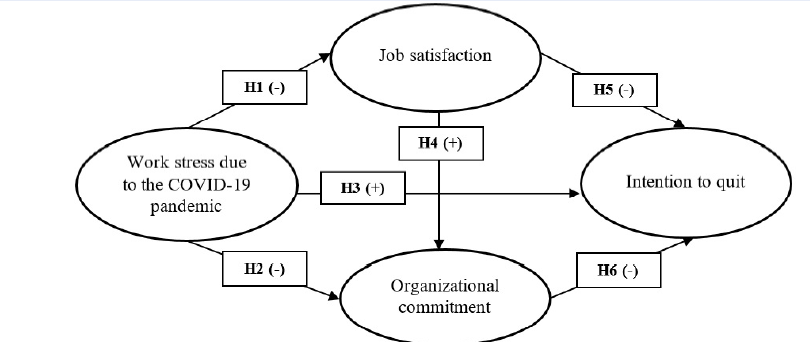
Satisfaction at the job is inversely influenced by work stress22. Kang and Singh highlighted that work stress as a direct determinant of job satisfaction23. The more work stress increases, the more satisfaction decreases and vice versa. More importantly, the stress related to the medical workforce’s health and lives due to the coronavirus epidemic has become even more severe24. Due to the work characteristics of the healthcare workforce that must be in direct contact with coronavirus patients, the high risk of disease transmission build up work stress and lead to job dissatisfaction. Hence, the first hypothesis is recommended as follows:
H1: Work stress due to the COVID-19 pandemic will be negatively associated with satisfaction at the job.
Chan et al. found that job stress has an inverse impact on commitment to the organization25. Workers are more committed to the organization if they feel comfortable in their job or if the work stress is reduced to a minimum. Conversely, increased work stress signals that employees have less commitment with the organization26. Along with the rapid expansion of the coronavirus pandemic, it severely influences the psychology of the healthcare workforce, leading to depression, fatigue, and exhaustion, making work stress more apparent and reducing organizational commitment13. Thus, the second hypothesis is recommended as follows:
H2: Work stress due to the COVID-19 pandemic will be negatively associated with organizational commitment.
Liu et al. argued work stress is positively associated with the intention to quit the job 27. More specifically, employees are more likely to quit if the level of work stress increases. In fact, healthcare workers who intend to quit or get a new job because of the psychological sequelae created by the coronavirus epidemic. The work of Aguiar-Quintana et al. affirmed that work stress because of the coronavirus epidemic is a core reason why workers intend to quit28. So, the third hypothesis is is proposed as follows:
H3: Stress at the job because of the coronavirus pandemic will be positively associated to quit.
Job satisfaction is a prerequisite for organizational commitment29. Tran agreed with the above opinion and confirmed that organizational commitment is positively affected by employee satisfaction17. More recently, Nguyen and Uong have found similar findings to the aforementioned studies30. Hence, the fourth hypothesis is recommended as follows:
H4: Satisfaction at the job will be positively associated with commitment to the organization.
The study by Curivan indicated employees tend to intend to quit if they are unable to obtain job satisfaction or dissatisfied with their current job31. Thus, job satisfaction is one of the crucial factors that directly affects the intention to quit, but negatively. This finding is unraveled in the works of Vu and Nguyen4 as well as Nguyen and Uong32. So, the fifth hypothesis is recommended as follows:
H5: Satisfaction at the job will be inversely associated to quit.
Martin and Roodt affirmed in their research that organizational commitment and intention to quit have a negative nexus29. In other words, at that time, employees did not want to continue working in the organization because they felt that they themselves don’t fit in and involuntarily and actively participated in the affairs of the organization anymore. Following the above results, Nguyen and Uong explored the intention to quit is directly affected by organizational commitment, but negatively32. The sixth hypothesis is recommended as follows:
H6: Organizational commitment will be inversely associated to quit.
Based on the assumptions, we build a study pattern as follow (see Figure 1):

Research model (Adopted from: Proposed by the authors)
Research Method
Constructs development
The first table present the propose scales inherited from diverse studies (see Table 1).
The preliminary scale
|
No. |
Scale |
Source |
Number of item |
|
1 |
Work stress due to the COVID-19 pandemic |
Aguiar-Quintana et al. |
6 |
|
2 |
Job satisfaction |
Lusch and Serpkenci |
6 |
|
3 |
Commitment to the organization |
Mowday et al. |
6 |
|
4 |
Intention to quit |
Lee |
4 |
In order for the preliminary scale in the proposed research model to meet practical requirements in the healthcare sector in Vietnam, the authors conducted a group discussion with 20 healthcare workforce and 10 managers at public hospitals in Hanoi. Additionally, the authors carried out in-depth interviews with 05 human resource management experts to adjust the variables observed in the preliminary scale, considering the connection among research constructs in the proposed study pattern and solving problems during group discussions. The discussions and interviews took place online on Microsoft Teams platform in August 2022.
The qualitative study results showed that participants agreed with the constructs and relationships in the proposed research model. On the one hand, the “job satisfaction” and “organizational commitment” scales are similar to the original scales.
Furthermore, the scale of “work stress due to COVID-19 pandemic” suggests that an observational variable should be added to be consistent with the work practices faced by healthcare workforce in the duration of the coronavirus epidemic. Furthermore, the scale of “intention to quit” has an inverse observation variable. Therefore, experts believe that it is necessary to reverse it to avoid causing complexity in the survey process.
In addition, the authors calibrated some words to make the scale easier to understand and more suitable for the cultural background of Vietnamese people. The official scale is presented in Table 2.
Sampling and Data collection
The official scale uses a 5-point Likert scale with questions scaled from “strongly disagree” to “strongly agree”. A preliminary survey of the official scale involving 30 healthcare workforce working at Hanoi’s public hospitals was conducted. The survey outcomes revealed the scales reached reliability, as Cronbach’s Alpha exceeded 0.637.
To meet the reliability in the Exploratory Factor Analysis (EFA), we chose 345 survey forms and obtained 339 valuable survey forms, which ensured that the analyzed sample size is more than the minimum sample size (minimum sample size: 24 * 10 = 240), which is typically 5 or 10 times the number of manifest variables38.
We used a snowball sampling method to obtain data of the healthcare workforce at Hanoi’s public hospitals. The surveys are directly sent to healthcare workforce from October to November, 2022.
The research data were analysed through Cronbach’s Alpha, EFA, CFA and SEM to check the good-fit of the study pattern.
The characteristics of healthcare workforce at Hanoi’s public hospitals participating in the survey were 67.7% male. Among them, 87.5% of the healthcare workers were over the threshold of thirty five (middle-aged), 100% had higher education and 86.3% got married.
Findings and discussion
Reliability, convergent and discriminant validity
The factor loadings exceeded the threshold of 0.5 39. Therefore, the observed variables are reliable (see Table 2).
Table 2 reveals that Cronbach’s α values exceeded 0.6, so the scales achieved homogeneity reliability40. In addition, Table 2 also provided evidence they had convergent validity since the average variance extracted index exceeded 0.5, and the composite reliability index exceeded 0.7 39. Hence, the scales were suitable for further analysis.
The results of reliability test
|
Scale |
Sign |
Items |
Loadings |
AVE |
Cronbach’s Alpha |
CR |
|
Work stress due to COVID-19 pandemic (WS) |
WS1 |
I am worried because of the negative news due to COVID-19. |
0.894 |
0.589 |
0.847 |
0.783 |
|
WS2 |
I am worried because I have to work during the coronavirus epidemic. |
0.890 | ||||
|
WS3 |
I stress while working. |
0.887 | ||||
|
WS4 |
I am dismayed because I have to work during the coronavirus epidemic. |
0.880 | ||||
|
WS5 |
I am bored and desperate at work due to COVID-19 pandemic. |
0.876 | ||||
|
WS6 |
I am exhausted from work in the context of COVID-19 pandemic. |
0.869 | ||||
|
Job satisfaction (JS) |
JS2 |
I earned respect at the hospital. |
0.893 |
0.632 |
0.803 |
0.803 |
|
JS6 |
My abilities have been shown at work. |
0.885 | ||||
|
JS4 |
I improved my professional through work. |
0.872 | ||||
|
JS3 |
The hospital is my second home. |
0.868 | ||||
|
JS5 |
I am happy to work at the hospital. |
0.859 | ||||
|
JS1 |
My creativity has been boosted by my work. |
0.845 | ||||
|
Organizational commitment (OC) |
OC3 |
I am willing to contribute to the hospital’s success. |
0.889 |
0.621 |
0.840 |
0.764 |
|
OC1 |
I share good things about the hospital. |
0.871 | ||||
|
OC2 |
I am proud to work at the hospital. |
0.860 | ||||
|
OC4 |
The hospital is the best place for me to work. |
0.850 | ||||
|
OC5 |
I am interested in hospital issues. |
0.846 | ||||
|
OC6 |
I want to stay in the hospital until I retire. |
0.834 | ||||
|
Intention to quit (ITQ) |
ITQ2 |
I would leave the hospital if I found a better job. |
0.887 |
0.584 |
0.798 |
0.738 |
|
ITQ4 |
I often have the thought of giving up this job. |
0.858 | ||||
|
ITQ3 |
I will be looking for another job next year. |
0.833 | ||||
|
ITQ5 |
I was thinking of leaving the hospital. |
0.799 | ||||
|
ITQ1 |
I do not want to continue working at the hospital |
0.784 | ||||
|
ITQ6 |
I have no intention of developing a career at this hospital. |
0.776 |
In addition, the study found that the HTMT ratio did not exceed the threshold of 0.8541. Thus, the scales reached discriminant validity (Table 3). It proves that the results support the existence of discriminant validity for all tested constructs.
HTMT ratio
|
Construct |
WS |
JS |
OC |
ITQ |
|
WS | ||||
|
JS |
0.821 | |||
|
OC |
0.673 |
0.674 | ||
|
ITQ |
0.783 |
0.721 |
0.673 |
Structural Equation Model
The model fit statistics for CFA (Figure 2) was χ/df = 2.352; p = 0.000; TLI = 0.909; GFI = 0.903; CFI = 0.917; and RMSEA = 0.057. The revision index is notably low, and thus there is no scope for further improvement. The index χ/df ratio is below the threshold of 3.0. Our TLI, GFI, and CFI, which have the values of 0.909, 0.903, and 0.917 are the best since it has to be over threshold 0.9 and RMSEA is below the threshold 0.08 for the model to be assessed as a good fit 39.

The result of the CFA (Source: analysis by the authors)
The model fit statistics for SEM were χ/df = 2.563; p = 0.000; TLI = 0.913; GFI = 0.906; CFI = 0.920; and RMSEA = 0.063. The revision index reveals no scope of improvement. The index χ/df ratio is below the threshold 3.0. Our TLI, GFI, and CFI, which have the values of 0.913, 0.906, and 0.920 are the best since it has to be over threshold 0.9. RMSEA is below the threshold of 0.08, indicating that the model is a good fit 39.

The results of standardized SEM (Source: Authors analysis)
Futhermore, the p-value of the correlation between the constructs does not exceed 0.05, indicating that the SEM has statistical significance 39. Table 4 summarizes the hypothesis test outcomes.
Hypotheses test
|
Hypotheses |
Impact direction |
β |
Standard error |
Critical ratio |
p-value |
Results |
|
H1: WS → JS |
- |
-0.55 |
0.116 |
3.035 |
0.000 |
Supported |
|
H2: WS → OC |
- |
-0.34 |
0.121 |
1.942 |
0.000 |
Supported |
|
H3: WS → ITQ |
+ |
0.07 |
0.094 |
1.834 |
0.000 |
Supported |
|
H4: JS → OC |
+ |
0.46 |
0.088 |
2.467 |
0.000 |
Supported |
|
H5: JS → ITQ |
- |
-0.07 |
0.120 |
1.916 |
0.000 |
Supported |
|
H6: OC → ITQ |
- |
-0.63 |
0.090 |
2.314 |
0.000 |
Supported |
Discussion
The analysis results presented in Figure 3 and Table 4 showed that “work stress due to the COVID-19 pandemic” has a negative impact on organizational commitment and job satisfaction of the healthcare workforce at Hanoi’s public hospitals (β = -0.55 and β = -0.34) while it has a positive association with the intention to quit with β = 0.07. In addition, employee satisfaction also plays a crucial role in the organizational commitment of the healthcare workforce (β = 0.46). Moreover, commitment to the organization and satisfaction at the job have a negative effect on the intention to quit of the healthcare workforce (β = -0.07 and β = -0.63). If they have commitment and satisfaction, they are less likely to quit. Thus, the hypotheses H1 to H6 are accepted. These findings are consistent with the results of the study of Saleem et al. 24, Truong et al. 12, Aguiar-Quintana et al. 28, Nguyen & Uong30, Nguyen & Uong32. However, the extent of the influence of the factors was not the same when studying with healthcare workforce at Hanoi’s public hospitals.
To specifically identify each factor of the impact model for the intention to quit of healthcare workforce at Hanoi’s public hospital, we present 6 important results as follows:
Firstly, H1 hypothesis states that work stress due to the COVID-19 pandemic has a negative impact on job satisfaction (β = -0.55, p < 0.05). This result is consistent with research by Saleem et al. 24. This means that in the context of the COVID-19 pandemic, if the healthcare workforce has a lot of work stress, job satisfaction tends to decrease significantly.
Next, to investigate H2 hypothesis, it was identified that work stress due to the COVID-19 pandemic has a negative impact on organizational commitment (β = -0.34, p < 0.05). This finding is consistent with the conclusions of Truong et al. 13. Nevertheless, this result is inconsistent with Bhatti et al. (2016), who argued that work stress due to the COVID-19 pandemic has a higher impact (β = -0.223, p < 0.05) on the organizational commitment of the employee.
Regarding the H3 hypothesis, work stress due to the COVID-19 pandemic is likely to increase but not significantly affect the intention to quit of healthcare workforce (β = 0.07, p < 0.05). This is consistent with research by Aguiar-Quintana et al.28) that work stress due to the COVID-19 pandemic will become a crucial contributing factor to increased intention to quit the healthcare workforce. This result also indicates that if Hanoi’s public hospitals want to reduce the employee turnover, they must give them less pressure in work. Nevertheless, this result contradicts Liu et al. 27 that work stress has a higher impact on intentions to quit (β = 0.0944, p < 0.05) of the healthcare workforce.
Related to the H4 hypothesis, job satisfaction has a positive impact on organizational commitment (β = 0.46, p < 0.05). This result supports Nguyen & Uong’s study30. If the healthcare workforce has high satisfaction, they are more likely to be committed to the hospital.
Continuing with the H5 hypothesis, job satisfaction is likely to significantly reduce intentions to quit of healthcare workforce (β = -0.07, p< 0.05). This assertion is supported by Nguyen & Uong32. That means the higher the employee satisfaction, the lower the intention to quit.
Finally, the H6 hypothesis suggests that organizational commitment is also likely to reduce the intention to quit of healthcare workforce at Hanoi’s public hospitals but with a lower impact than job satisfaction (β = -0.63, p < 0.05). This finding has similarities to Nguyen & Uong32.
In conclusion, our research differs in the study context as well as the location compared to Nguyen and Nguyen3, Vu and Nguyen4, and Wen et al. 5 since it is studied in the context of Hanoi’s public hospitals of Vietnam.
Moreover, the highlight of this study is the research methodology used. The snowball sampling method and structural equation modeling have made important contributions to the unique emphasis on research methodology compared to the previous studies. In which, The snowball sampling method correctly identified health care workers who showed signs of stress due to COVID-19, leading to the intention to quit at Hanoi’s public hospitals. Given the delicate nature of the research topic on the intention of healthcare workers to quit, the snowball sampling method is a goodfit in this context as colleagues can recommend and willing to share their thoughts.
Implications
This study contributes greatly to building knowledge in the HRM sector as well as identifies the relationship between the three factors that influence the intention to quit of the healthcare workforce at Hanoi’s public hospitals. In addition, this research will also contribute to the formation of approaches to successfully reduce the intention to quit of healthcare workes in Vietnam’s public hospitals, providing a theoretical basis and literature for further research development.
For the practical aspect, this study added a model that measures intention to quit based on factors comprising of: stress at the job due to the coronavirus pandemic, job satisfaction, and organizational commitment of the healthcare workforce. Besides, this study will have far-reaching implications for various stakeholders by providing literature on the identification of modern areas as well as new frameworks to promote further research on the topic of intention to quit in both the private and public sectors in the economy, especially at hospitals in general and at public hospitals in particular in Vietnam.
Our findings provide several theoretical and practical management implications for managers in Hanoi’s public hospitals to reduce the intention to quit of employees, as follows:
For the factor of work stress due to COVID-19 pandemic, work stress due to the coronavirus epidemic has the highest affected the healthcare workforce’s intention to quit ( = 4.32 and β = 0.07). The managers of hospitals need to understand the peculiarities of the medical profession, which carries a heavy workload and constantly put the healthcare workforce in a state of stress. The fear and stress caused by the coronavirus can further exacerbate employee stress levels. The outbreak of the coronavirus epidemic has been severely affecting the work and lives of healthcare workers, leading to an increase in anxiety, frustration, burnout, and intentions to quit. Therefore, to overcome these difficulties, managers should develop a workspace with no dangers and work full-time in the hospital.
For the factor of job satisfaction, job satisfaction plays a crucial influence on the intention to quit the healthcare workforce ( = 4.06 and β = -0.07). Using Maslow’s need theory, employees always want to feel valued and accepted by leaders and colleagues. They put in efforts and strive for recognition. If employees feel valued by the hospital, they will be very satisfied with their work and the hospital. Therefore, it is crucial that the managers of Hanoi’s public hospitals should promote internal information activities and internal emails so that employees can quickly and conveniently express their opinions and suggestions to the hospital, giving them equal opportunities to contribute ideas. By listening to and consulting with them, they are shown the respect the hospital has for them, thereby increasing satisfaction at the job, at the same time, reducing the intention to quit.
For the factor of organizational commitment, the intention to quit is also considerable impacted by organizational commitment of healthcare workforce at Hanoi’s public hospitals ( = 3.97 and β = -0.63). Therefore, to increase their commitment, hospitals need to show healthcare workforce that they are an important piece of the hospital success. Organize training and propaganda to build a sense of responsibility at work and show them pride in the medical profession – a profession of honor and responsibility to the community.
Conclusion and drawbacks
The study explored the impact of job stress due to the coronavirus pandemic, job satisfaction, as well as organizational commitment on the intention to quit of healthcare workforce at Hanoi’s public hospitals. The SEM analysis was performed to determine the relationship between the variables in the research model. Our findings revealed that stress on the job has an inverse affected on commitment to the organization and satisfaction of the healthcare workforce during the COVID-19 pandemic, while increasing their intention to quit. Additionally, commitment to the organization is a considerable influence on satisfaction at the job. Furthermore, commitment and satisfaction have an inverse impact on the intention to quit of the healthcare workforce.
Although the research objectives have been achieved, our study still has a limitation in terms of sample size because it was only conducted at public hospitals in Hanoi. Therefore, to overcome the above limitation, future studies could increase the sample size and expand the scope of research to include all public hospitals in the North, Central and South of Vietnam.
ABBREVIATIONS
CFA: Confirmatory Factor Analysis
CFI: Comparative Fix Index
df: degrees of freedom
EFA: Exploratory Factor Analysis
GFI: Goodness of Fix Index
HRM: Human resource management
RMSEA: Root Mean Square Errors of Approximation
SEM: Structural equation model
TLI: Tucker-Lewis Index
CONFLICT OF INTEREST STATEMENT
The authors declare that they have no conflicts of interest
AUTHOR CONTRIBUTIONS
Nguyen Danh Nam: research data collection.
Nguyen Danh Nam, Uong Thi Ngoc Lan: analysis and explanation.
Uong Thi Ngoc Lan: manuscript preparation.