


Impacts of Information and Communication Technologies infrastructure development on economic growth: An empirical study of Southeast Asian countries
- Foreign Trade University, Hanoi, Vietnam
Abstract
This article aims to systemize growth models and analyze the impacts of Information and Communication Technologies (ICT) infrastructure development on the economic growth of Southeast Asian countries. Accordingly, growth models are developed with ICT inputs, including mobile cellular subscriptions, fixed telephone subscriptions, fixed broadband subscriptions, and Internet users. Using data from World Bank, the author collected 220 observations of 10 ASEAN members during the 2000-2021 period. To evaluate how ICT infrastructure factors affect the economies, the author used various panel analysis and estimation methods: Panel unit-root test, panel cointegration test, and the Generalized Method of Moments (GMM) estimator. The results showed that all the variables were stationary and had cointegration relationships. Additionally, the Ramsey test results showed that there were no omitted variables in the models, which proved the fitness of the models. The study found that 3 ICT variables significantly improved economic growth: mobile cellular subscriptions, fixed broadband subscriptions, and Internet users; while fixed telephone has negative effects on the sample. The author also found that economic growth is significantly improved by labor force, gross fixed capital formation, and trade openness. Theoretically, this article built a growth equation with a vector of different ICT factors, including Mobile cellular subscriptions, fixed telephone subscriptions, fixed broadband subscriptions, and Internet users. Furthermore, when using the system GMM estimator which controls bias such as endogeneity, heteroskedasticity and auto correlation, effects of explanatory variables on economic growth were significant. Practically, the research results provided an overview of the contributions of ICT factors to Southeast Asian economies, which are consistent with the current situation of ICT development in the region. From these results, the article gave policy implications for Vietnam in developing ICT aspects as well as in applying ICT in socio-economic activities.
INTRODUCTION
In the era of digitalization, Information and Communication Technologies (ICT) are considered an important driving force of economies. By attracting higher investments and improving infrastructure, ICT has provided nations, especially developing economies, with opportunities to increase affordability to reach the population in developing countries that currently lives outside of ICT networks, to expand access to more advanced, affordable ICT services such as broadband for high-speed internet, to leverage the new ICT infrastructure to improve service delivery and build on it as a source of economic growth, and to develop and to align people skills relevant to the information technology-enabled services industry1. In the Southeast Asia region, ICT aspects have been considerably invested and developed since the 21st century and are expected to contribute to growth rates of the digital economy at 363 billion USD in 2025 and about 1000 trillion USD in 20302. These opportunities also raise the question whether ICT development has significant impacts on members of The Association of Southeast Asian Nations (ASEAN). However, not many researches have fully analyzed how ICT factors contribute to ASEAN members’ economic growth.
Since the 21st century, ICT development has been one of the most popular research topics, especially its contributions to economic aspects. In previous empirical studies, it is expected that ICT development significantly contributes to countries’ growth, and one of the most significant channels is ICT infrastructure. However, not many studies have fully and deeply analyzed how ICT affects developing economies, particularly in Southeast Asia countries. When it comes to developing countries, there have been controversial results of ICT infrastructure factors’ impacts on economic growth. For example, two ICT variables (fixed broadband and Internet) were found to significantly improve economies in Central Asia3, and economic growth in South Asian countries are positively affected by three ICT factors (fixed telephone, mobile cellular, and Internet)4. Meanwhile, when examining the effects of ICT development on African nations, studies found negative and/or insignificant impacts of ICT infrastructure variables on economic growth of the samples5, 6, 7. Even in some studies on the ASEAN, samples were only small parts of the region. For instance, Yong Jing and Ab-Rahim only used 5 ASEAN nations for their sample, which later showed that insignificant effects of fixed broadband on economic growth8, while Sapuan and Roly found significant contribution of ICT variables on 8 ASEAN countries9.
For the reasons above, the author acknowledges certain research gaps in previous studies. First, there have not been many studies on the effects of ICT development on ASEAN members, and previous studies have only covered small samples of the Southeast Asia region or other regions of the Asia. Second, results of ICT infrastructure factors’ effects on different economies are still controversial. Therefore, there needs to be further research on the impacts of ICT aspects on economic growth, especially in the region of ASEAN.
In acknowledgment of ICT’s importance in ASEAN economies, the author chooses the topic “Impacts of Information and Communication Technologies infrastructure development on economic growth: An empirical study of Southeast Asian countries”. This paper analyzes the impacts of ICT infrastructure development on economic growth in Southeast Asia so that policies can be suggested for Vietnam to apply ICT aspects in socio–economic activities. This paper is divided into 5 main parts, not including Abstract and References.
LITERATURE REVIEW
ICT infrastructure definition
ICT is defined as a diverse set of technological tools and resources used to transmit, store, create, share, and exchange information10. For example, computers, Internet devices, live and/or recorded broadcasting technologies, and telephony are technological tools of ICT infrastructure. More simply, ICT infrastructure covers all advanced resources, tools, and types of equipment that help to send information.
According to the latest UN E-Government Survey in 2022, ICT infrastructure has 4 components: mobile cellular telephone, Internet, fixed broadband, and active mobile-broadband11. To measure development levels of these components, the number of subscriptions or users in each component is calculated yearly.
Review of ICT infrastructure factors’ impacts on economic growth
Mobile cellular subscriptions
The International Telecommunication Union (ITU) defines mobile cellular subscriptions as subscriptions to a public mobile telephone service using cellular technology, which provide access to the public switched telephone network using cellular technology12. This includes postpaid and prepaid subscriptions and includes analogue and digital cellular systems. Yong Jing and Ab-Rahim claimed that the variable “Mobile Cellular Telephone Subscriptions” positively and significantly contributes to the economic growth of ASEAN-5 countries8. Meanwhile, Albiman and Sulong proved that mobile cellular subscriptions have negative effects on economic growth in the short run and positive effects in the long run7. Similarly, Hussain et al. found positive and significant long-term impacts of mobile cellular subscriptions on the GDP per capita of South Asian economies4. From these previous results, it is more likely that mobile cellular contributes to economic growth in the long run rather than the short run.
Fixed telephone subscriptions
Fixed telephone subscriptions refer to the sum of active number of analogue fixed telephone lines, voice-over-IP subscriptions, fixed wireless local loop subscriptions, Integrated Services Digital Network (ISDN) voice-channel equivalents, and fixed public payphones. Albiman and Sulong found insignificant and negative effects of this factor on Sub Sahara African countries’ economic growth, which was also proved when using the sum of fixed telephone lines and mobile phone subscriptions7. Similarly, examining the effects of ICT development on African nations but with a larger sample, Adeleye and Eboagu found positive but insignificant results of fixed telephone subscriptions5. However, Majeed and Ayub found positive and significant impacts of fixed telephone subscriptions on the sample of 149 countries13.
Fixed broadband subscriptions
ITU mentions fixed broadband subscriptions as subscriptions to high-speed access to the public Internet, including cable modems, digital subscriber lines, home fibers, other fixed (wired) broadband subscriptions, satellite broadband and terrestrial fixed wireless broadband12. Sapuan and Roly found that economic growth is positively and significantly improved by fixed broadband subscriptions9. However, Yong Jing and Ab-Rahim found insignificant coefficients of this variable on GDP of ASEAN-5 countries, which can be explained by differences in analyzing methods and data collection8. In addition, it was found that different income groups have different effects of fixed broadband subscriptions. Albiman and Sulong found that while fixed broadband subscriptions have positive and significant coefficients on upper-middle-income countries, this variable has no significant effects on lower-middle-income countries.
Internet users
Internet users are people who access the internet from any location. Sapuan and Roly found that GDP per capita in ASEAN-8 countries is positively affected by Internet users9. Similarly, results by Adeleye and Eboagu showed that Internet users have positive and significant impacts on the economic growth of 54 African countries5. Meanwhile, when analyzing the impacts of ICT factors on Sub-Saharan African countries, Albiman and Sulong found that Internet subscriptions have positive but insignificant effects on economic growth in the short run, but significantly contribute to GDP in the long run7.
RESEARCH METHODS
Model specification and hypotheses
Based on growth models with ICT inputs5, 13, the author proposes the growth function as follows:
GDP = AL KXICTe = f(A, L, K, ICT) (*)
Where GDP is the total GDP; A is the technological parameter; L is the total labor force; K is the gross fixed capital formation; X is the vector of control variables; ICT is the vector of ICT variables; u is the random disturbance.
By taking natural logarithms, the equation (*) is rewritten as follows:
lnGDP = β + βlnL + βlnK + βlnX + βlnICT + u (**)
Where lnGDP is the natural logarithm of total GDP; lnL is the natural logarithm of total labor force; lnK is the natural logarithm of gross fixed capital formation; lnX is the natural logarithm of control variables (in this case, the author chooses the trade openness, measured by total exports and imports as percentages of GDP); lnICT is the natural logarithm of ICT variables.
In this article, the author chooses 4 different components to measure the variable of ICT infrastructure, namely mobile cellular subscriptions, fixed telephone subscriptions, fixed broadband subscriptions, and Internet users. To avoid the error of multicollinearity, each ICT variable is included in different estimation equations. Therefore, growth equations with ICT factors are written as follows:
lnGDP = β + βlnL + βlnK + βlntrade + βlnmob + u (1)
lnGDP = β + βlnL + βlnK + βlntrade + βlnft + u (2)
lnGDP = β + βlnL + βlnK + βlntrade + βlnfbb + u (3)
lnGDP = β + βlnL + βlnK + βlntrade + βlninte + u (4)
Where: lnGDP is the natural logarithm of GDP; lnK is the natural logarithm of gross fixed capital formation; lnL is the natural logarithm of total labors; lntrade is the natural logarithm of trade openness; lnmob is the natural logarithm of Mobile Cellular subscriptions; lnfbb is the natural logarithm of Fixed Broadband subscriptions; lnft is the natural logarithm of Fixed Telephone subscriptions; lninte is the natural logarithm of Internet individual users.
Based on previous results of ICT infrastructure factors on economic growth5, 7, 9, the author suggests the following hypothesis:
H: Mobile cellular subscriptions have positive impacts on economic growth.
H: Fixed telephone subscriptions have positive impacts on economic growth.
H: Fixed broadband subscriptions have positive impacts on economic growth.
H: Internet individual users have positive impacts on economic growth.
Data collection
The author used secondary data from the World Bank14. The sample includes 10 ASEAN countries: Brunei, Cambodia, Indonesia, Laos, Malaysia, Myanmar, the Philippines, Singapore, Thailand and Vietnam, with the yearly time range from 2000 to 2021. Table 1 summarizes variables and data sources.
Summary of data sources
|
Variable |
Explain |
Unit |
Data sources |
|
GDPit |
Total GDP |
USD |
World Bank data |
|
Kit |
Gross fixed capital formation |
USD |
World Bank data |
|
Lit |
Total labor force |
People |
World Bank data |
|
tradeit |
Total export and import values |
USD |
World Bank data |
|
mobit |
Mobile cellular subscriptions |
Subscriptions |
World Bank data |
|
fbbit |
Fixed broadband subscriptions |
Subscriptions |
World Bank data |
|
ftit |
Fixed telephone subscriptions |
Subscriptions |
World Bank data |
|
inteit |
Internet individual users |
People |
World Bank data |
Unit-root test and cointegration test methods
The panel unit-root test is conducted to check whether the variables are stationary or non-stationary. In this research, the author used the Levin-Lin-Chu unit-root test, which assumes that all panel variables have identical first-order partial autocorrelation, while other parameters in the error process vary across individuals15.
The cointegration test aims to detect any false regression relationships between variables in all suggested models. In this research, the author used the Kao test, which is based on the residual of cointegrating regression16.
Estimation method
The author chose the system Generalized Method of Moments (sys-GMM) to evaluate the impact of ICT infrastructure variables on the dependent variable. This estimator is expected to control the bias of omitted variables, heteroscedasticity and autocorrelation, as well as to generate reliable results in the presence of endogeneity and heterogeneity. In addition, the GMM estimator is designed for short-panel analysis and assumes that the data-generating process can be dynamic.
According to Arellano and Bond17, the dynamic-panel equation for the GMM estimation is written as follows:
Where Y is the dependent variable; Y is the first-level lagged value of the dependent variable; X is a vector of lagged level and differenced predetermined and endogenous variables; Z is a vector of exogenous variables; and α, β, γ are parameters. Therefore, the suggested growth models can be rewritten as follows:
lnGDP = α + βlnGDP + βlnL + βlnK + βlntrade + βlnICT +
Where: lnGDP is the natural logarithm of GDP; lnGDP is the natural logarithm of GDP at the time t-1; lnK is the natural logarithm of gross fixed capital formation; lnL is the natural logarithm of total labors; lntrade is the natural logarithm of trade openness; lnICT is the natural logarithm of ICT variables (Mobile cellular subscriptions, fixed telephone subscriptions, fixed broadband subscriptions, Internet users).
RESULTS AND DISCUSSION
Sample descriptive statistics results
The results of sample summary are given in Table 2. Overall, after taking natural logarithms, standard errors of the variables are much lower than the mean values. Accordingly, the dependent variable has the mean value of 25.236 and the standard deviation of 1.530. Among the ICT infrastructure variables, fixed telephone subscriptions witness the lowest standard error at about 0.332. Other explanatory variables have standard errors ranging from 1.0 to 1.6.
Sample descriptive statistics
|
ln_gdp |
ln_l |
ln_k |
ln_trade |
ln_mob |
ln_ft |
ln_fbb |
ln_inte | |
|
Mean |
25.236 |
16.234 |
23.767 |
4.850 |
17.327 |
15.240 |
13.608 |
16.151 |
|
Median |
25.838 |
16.752 |
24.339 |
4.843 |
17.862 |
15.099 |
14.231 |
16.299 |
|
Maximum |
27.695 |
18.751 |
26.578 |
4.952 |
18.355 |
15.805 |
15.628 |
18.036 |
|
Minimum |
22.329 |
11.960 |
20.504 |
4.733 |
14.608 |
14.726 |
10.328 |
14.142 |
|
Std. Dev. |
1.530 |
1.782 |
1.622 |
0.055 |
1.139 |
0.332 |
1.683 |
1.049 |
|
Observations |
220 |
220 |
220 |
220 |
220 |
220 |
220 |
220 |
Unit-root test and cointegration test results
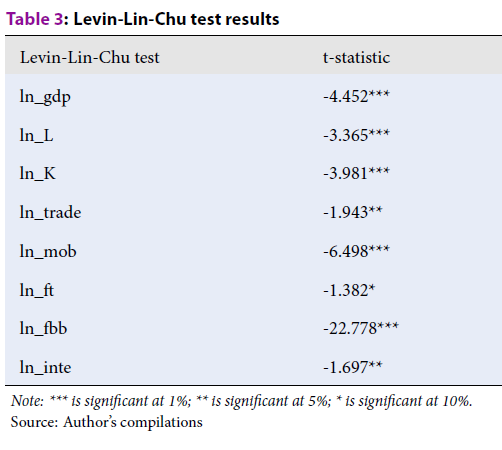
7 out of 8 variables are found to be stationary at level with statistical significance levels at 1%, 5% or 10% (Table 3). Meanwhile, the variable of Internet users (ln_inte) is the only to be stationary at the 2nd difference level.
Additionally, all ICT infrastructure variables have unit-root at level. Accordingly, mobile cellular subscriptions (ln_mob) and fixed broadband subscriptions (ln_fbb) are stationary with the 1% significance level. Fixed telephone subscriptions (ln_ft) and Internet users (ln_inte) are statistically significant at 10% and 5% respectively.
Levin-Lin-Chu test results
|
Levin-Lin-Chu test |
t-statistic |
Stationary level |
|
ln_gdp |
-4.452*** |
Level |
|
ln_L |
-3.365*** |
Level |
|
ln_K |
-3.981*** |
Level |
|
ln_trade |
-1.943** |
Level |
|
ln_mob |
-6.498*** |
Level |
|
ln_ft |
-1.382* |
Level |
|
ln_fbb |
-22.778*** |
Level |
|
ln_inte |
-1.697** |
2nd difference |
The results of the Kao test (Table 4) show that all 4 models are statistically significant at 1%. These prove that there are cointegration relationships between variables in each model. Also, residual variance and heteroskedasticity-and-autocorrelation-consistent (HAC) variance values are relatively low, at about 0.001-0.003.
Kao test for cointegration results
|
Model |
ADF-t |
Residual variance |
HAC variance |
|
(1) |
-3.410*** |
0.001 |
0.003 |
|
(2) |
-3.684*** |
0.002 |
0.003 |
|
(3) |
-3.352*** |
0.001 |
0.002 |
|
(4) |
-3.474*** |
0.001 |
0.002 |
GMM estimation results
Results of the GMM estimation (Table 5) show that all ICT variables have significant coefficients on the dependent variable (ln_gdp). Among the ICT infrastructure factors, there are 3 of 4 variables that significantly contribute to economic growth, which have positive and significant coefficients.
The variable ln_inte has the highest coefficient on ln_gdp (0.095) and has the 1% statistical significance level (t = 5.134). ln_fbb has positive effects on economic growth with the coefficient of 0.028 and also has the 1% statistical significance level (t=3.550). The coefficient of ln_mob is 0.020, but found to be significant at 5% (t=2.344). Meanwhile, ln_ft is the only ICT variable to have negative effects on economic growth, with the coefficient of -0.074.
GMM estimation results
|
Model |
(1) |
(2) |
(3) |
(4) |
|
Dependent variable: | ||||
|
lnGDPit-1 |
0.793*** (0.019) [42.37] |
0.785*** (0.019) [41.61] |
0.792*** (0.019) [42.50] |
0.784*** (0.020) [40.14] |
|
lnLit |
0.835*** (0.073) [11.436] |
0.980*** (0.069) [14.110] |
0.730*** (0.075) [9.757] |
0.499*** (0.069) [7.262] |
|
lnKit |
0.426*** (0.030) [13.989] |
0.455*** (0.026) [17.724] |
0.406*** (0.031) [13.004] |
0.367*** (0.033) [11.213] |
|
lntradeit |
0.099*** (0.018) [5.527] |
0.085** (0.047) [1.830] |
0.104*** (0.017) [6.242] |
0.117*** (0.018) [6.342] |
|
lnmobit |
0.020** (0.008) [2.344] | |||
|
lnftit |
-0.074*** (0.015) [-4.873] | |||
|
lnfbbit |
0.028*** (0.008) [3.550] | |||
|
lninteit |
0.095*** (0.019) [5.134] | |||
|
R-squared |
0.995 |
0.996 |
0.995 |
0.996 |
|
RMSE |
0.104 |
0.101 |
0.103 |
0.098 |
|
Hausman Chi-square |
0.000 |
0.000 |
0.000 |
0.000 |
|
Wald test F-statistic |
3166.871*** |
2690.450*** |
2765.049*** |
2736.392*** |
|
Ramsey test F-statistic |
0.73 |
1.83 |
3.00 |
1.79 |
Among other independent variables, labor force (ln_L) and gross fixed capital formation (ln_K) are found to significantly contribute to economic growth in all models. Noticeably, the coefficients of ln_L are higher than those of ln_K, which implies that labor forces still have stronger effects on GDP of the sample than gross fixed capital formation. All these effects are statistically significant at the 1% level. Meanwhile, although trade openness is found to have significant effects on the dependent variable, the coefficients are much lower than those of labor force and gross fixed capital formation.
The determination coefficients (R) of all 6 models are greater than 0.99, which means that in each model, more than 99% of the variation in the dependent variable are explained by chosen independent variables. These statistics also prove that the collected data well fits the chosen models. Also, the RMSE values of all models are relatively low at about 0.1, indicating a good fit between chosen models and datasets.
The Hausman chi-square values are close to 0, which proves that random effects are not significant and not appropriate for the chosen equations. Therefore, the model has the presence of endogeneity, which could be solved by using the GMM estimator. The GMM estimator also controls bias of heterogeneity, as mentioned in the Research methods. In addition, the author used the Wald test to prove the significance of explanatory variables, which had F-statistic values to be significant at 1%. Results of the Ramsey test show that the model has no omitted variables, which means that all chosen variables are important. These results also support the model’s stability.
In addition, the indicators of Variance Inflation Factors (VIF) are lower than 10, which means that the models have no phenomenon of multicollinearity. The results of VIF are presented in Table 6.
Variance Inflation Factors results
|
Model |
(1) |
(2) |
(3) |
(4) |
|
lnLit |
1.98 |
2.48 |
1.79 |
1.72 |
|
lnKit |
9.35 |
9.04 |
9.51 |
9.9 |
|
lntradeit |
6.17 |
6.69 |
6.21 |
6.16 |
|
lnmobit |
3.58 | |||
|
lnftit |
7.43 | |||
|
lnfbbit |
3.17 | |||
|
lninteit |
3.89 |
Discussion
As mentioned in the estimation results, mobile cellular subscriptions, fixed broadband subscriptions, and Internet users significantly improve ASEAN economies. These results are consistent with previous findings by Yong Jing and Ab-Rahim8, implying that ICT infrastructure investment would promote the ICT industry, then contribute to economic growth. Also, with ICT infrastructure advantages, nations can attract diverse investment sources, including those from international organizations and multinational companies. These opportunities are also expected to help ASEAN nations rapidly access to advanced digital technologies, promote the process of digital transformation as well as enhance economic aspects. Furthermore, if the study by Ahmed and Ridzuan only found contributions of ICT development to ASEAN economies through spending on ICT infrastructure,18 then the results of this study imply that nations need to focus on different aspects such as infrastructure development, penetration, and even quality of ICT human resources in the era of digital economy.
However, this study found insignificant contributions of fixed telephone subscriptions to economic growth. This finding is consistent with results by Albiman and Sulong, which suggested that the effects of fixed telephone lines on developing nations may be significant over a long period instead of in the short run7. Meanwhile, significant effects of other ICT factors, including mobile cellular subscriptions, fixed broadband subscriptions, and Internet users, imply that ASEAN economies can adapt to short-run development of these infrastructure components and quickly improve economic growth. Also, the lack of ICT policy formulation and unequal penetration may prevent developing countries from receiving the effectiveness of digital technologies in short periods. This assumption can be supported by the facts in the ASEAN region, where large gaps between countries in developing ICT infrastructure have remained. Therefore, it is vital for nations to make policies that support ICT infrastructure development both in the short and long terms.
CONCLUSION AND POLICY IMPLICATIONS
Conclusion
This research aims to build growth models and evaluate impacts of ICT infrastructure factors on ASEAN countries’ economic growth. Research results show that economic growth in ASEAN is significantly affected by infrastructure aspects of mobile cellular, fixed broadband, and the Internet. However, fixed telephone lines have no significant short-run effects on economic growth. Also, ASEAN members’ economic growth is found to be well improved with the presence of labor force, gross fixed domestic capital, and trade openness.
The research has theoretical contributions in developing growth models with ICT inputs. First, the author builds different growth models with different ICT variables, which are found to have significant effects on economic growth. Also, when employing the GMM estimator for the sample of ASEAN nations, ICT variables have positive coefficients on the dependent variable. These results are contrary to some studies on sub-samples of the region that show almost insignificant effects of ICT development when using traditional panel estimation techniques8, 18. This suggests that when controlling bias such as omitted variables, heteroskedasticity, endogeneity, and auto correlation, the effects of explanatory variables are statistically significant. From these results, it is possible to evaluate the general situation of ICT factors’ impacts on economic growth in Southeast Asia, then policy implications for nations are given.
Policy implications for Vietnam
First, besides opportunities to access to advanced ICT technologies and foreign sources, Vietnam will have to compete with different nations in inventing, producing, and selling ICT products. At present, although the revenue of the ICT industry reached more than 110 billion USD in 2022, only less than 30% of these are contributed by domestic ICT products19. Therefore, the nation needs to provide programs and strategies to develop domestic enterprises and domestic ICT products. Marketing campaigns and promotion of domestic ICT products or special offers and price discounts are ideal solutions to encourage people to choose “made in Vietnam” ICT products, leading to the expansion of the domestic ICT industry. Also, investments and supports from government, authorities, and organizations are essential, especially aids in infrastructure development and research activities.
Second, it is necessary to create favorable institutions and environments for ICT enterprises. For example, the Law on Digital Technology Industry will be added to the Law and Ordinance Development Program in 2023, which will overcome previous inadequacies in the development of the ICT industry. Also, there needs to be other supportive policies such as policies on digital technology industrial infrastructure, policies on promoting the development of new products and services, policies on forming a modern infrastructure system necessary for the development of the ICT industry, etc. In addition, authorities can deploy made-in-Vietnam ICT products and services development policies, which stipulate a number of priority and preferential policies, such as priority in procurement of state agencies; government support, ordering research and development, mastering core, key and dual-use products and technologies, as well as supporting the commercialization of research and development results of digital technology products and services.
Third, besides infrastructure aspects, Vietnam needs to develop ICT human resources that play a decisive role in the digital economy. To improve the quality of ICT human resources, the Government and authorities need to research and propose the National Digital Technology Skills Framework that is consistent with international standards, then create a practical training mechanism at enterprises and other organizations. In addition, to encourage ICT students to gain practical experiences, universities and educational systems can recognize results of internship, work, participation in digital products and services development projects at ICT firms as credits in training programs. Furthermore, it is necessary to have policies to attract excellent domestic and foreign digital human resources, especially in terms of salary, bonus, and remuneration. This will enable Vietnam to build a network of ICT specialists in the future. Therefore, these recommendations also imply further researches on different ICT aspects beside infrastructure development, such as ICT human capital or ICT skills.
ACKNOWLEDGEMENTS
This paper is the result of Foreign Trade University student’s scientific research activities.
LIST OF ABBREVIATIONS
ADF: Augmented Dickey-Fuller
ASEAN: Association of Southeast Asian Nations
GDP: Gross domestic products
GMM: Generalized Method of Moments
HAC: Heteroskedasticity - and - autocorrelation - consistent
ICT: Information and Communication Technologies
ITU: International Telecommunication Union
RMSE: Root-mean-square error
UN: United Nations
CONFLICT OF INTEREST
The author declares that there are no competing interests in the publication of this article.
AUTHORS’ CONTRIBUTION
The entire content of the article is written by the author only.