


The role of External Sources on Innovation Performance: Review from theory to empirical research
- University of Economics and Law, VNUHCM, Vietnam
Abstract
In recent years, firms' innovation activities have been encouraged in many countries, and the topic of innovation performance has been of interest to researchers. Previous studies have confirmed that internal sources have an impact on innovation performance, while external sources have gained increasing popularity and influence on firms' activities. Despite the growing interest in the impact of external sources on innovation performance, most studies have reached conflicting conclusions, with some showing positive effects and others negative effects. Therefore, the question remains as to whether external sources can affect innovation performance. This study aims to clarify the role of external sources on innovation performance by reviewing, analyzing, and synthesizing results from 56 empirical studies conducted worldwide. The findings highlight the theoretical frameworks used in previous studies and the types of external sources, such as external knowledge, R&D, information technology, and spillovers from foreign enterprises, that affect innovation performance. Finally, the study proposes suggestions for future research.
Introduction
Innovation performance plays a crucial role in the growth of firms 1. In recent years, researchers have shown interest in the topic of innovation performance and confirmed that it is affected by various factors such as innovation activities 1, 2, innovation capacity3, knowledge sources4, 5, 6, lean management 7, absorptive capacity8, 9, 10, 11, 12, internal control13, organizational ambidexterity14, organizational learning ambidexterity15, knowledge sharing behavior 16, and openness17. Greco et al. 18 reviewed the relationship between open innovation activities and corporate innovation performance in European countries using data from 61 articles published between 2003-2013. They found that research on the role of external open innovation activities is limited, but that process innovation benefits more from open innovation activities than from internal activities 18. Raja and Wei19 conducted a literature review of the relationship between quality practice and innovation performance based on 62 papers. They found a positive relationship between quality practice and corporate innovation performance, but also noted that other factors such as the uncertain business environment, firm size, financial sources, and corporate culture can modify this relationship. Zhao et al. 20 reviewed the impact of open innovation performance and risk management during open innovation activities, using data from 18 articles. Muller and Peres 21 explored the impact of social network structure on corporate innovation performance by reviewing 34 papers and found that the social network structure has a positive impact on innovation performance. Salim et al.22 examined the influence of internal factors on eco-innovation performance through a systematic literature review of 55 articles and found that corporate internal capacity is valuable for management and can enhance innovation performance.
Despite the growing interest in the impact of external sources on innovation performance, previous studies have reached conflicting conclusions, with some showing positive effects and others negative effects. Moreover, the relationship between external sources and innovation performance is U-shaped. Given this significant controversy, a literature review of the relationship between external sources and innovation performance is necessary.
The purpose of this study is threefold: (1) to summarize the research theories used to explain how external sources impacted the innovation performance in previous empirical studies; (2) to examine and classify the types of external sources that affect innovation performance; (3) to suggest areas for future research.
Research Method
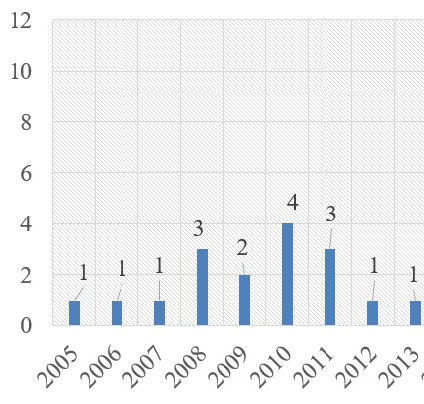
In this study, we reviewed 56 empirical studies from around the world to understand the role of external sources on innovation performance. The research used a combination of quantitative and qualitative methods, with 64% of the studies using quantitative research and 8.9% using qualitative research. The articles were published between 2005 and August 2022 and were sourced from prestigious journals such as Elsevier, Emerald, and Taylor & Francis. The studies were conducted in developing and emerging countries, with 36 articles being published in developing countries and 20 in emerging countries. Refer to Table 1 and Figure 1 for details.
Summary of studies reviewed
|
Year |
No. Articles |
Scope of research |
Research Method | |||
|
Developing country |
Emerging country |
Quantitative research |
Qualitative research |
Both quantitative research and qualitative research | ||
|
2005 |
1 |
1 |
1 | |||
|
2006 |
1 |
1 |
1 | |||
|
2007 |
1 |
1 |
1 | |||
|
2008 |
3 |
2 |
1 |
1 |
2 | |
|
2009 |
2 |
1 |
1 |
1 |
1 | |
|
2010 |
4 |
2 |
2 |
3 |
1 | |
|
2011 |
3 |
2 |
1 |
3 | ||
|
2012 |
1 |
1 |
1 | |||
|
2013 |
1 |
1 |
1 | |||
|
2014 |
5 |
4 |
1 |
4 |
1 | |
|
2015 |
4 |
4 |
2 |
2 | ||
|
2016 |
4 |
2 |
2 |
4 | ||
|
2017 |
5 |
5 |
2 |
3 | ||
|
2018 |
4 |
3 |
1 |
2 |
2 | |
|
2019 |
2 |
2 |
2 | |||
|
2020 |
10 |
4 |
6 |
8 |
2 | |
|
2021 |
3 |
3 |
2 |
1 | ||
|
2022 |
2 |
1 |
1 |
2 | ||
|
Total |
56 |
36 |
20 |
38 |
5 |
13 |

Number of published articles during 2005-2022 (Source: Authors’ analysis from review results, 2023).
Literature summary by theoretical framework
This section presents a compilation of reviewed studies based on the theoretical frameworks used. These theories are grouped as the knowledge-based theory, the resource-based theory, and other theories. Refer to Table 2 for details.
Resource-based theory
The resource-based theory was proposed by Barney23. This theory argues that enterprises are a combination of resources23, 24. However, this theory emphasizes that not all resources have the potential to bring out the competitive advantage of firms25. Penrose 26 is examined as a major contributor to the theoretical background of the resource-based theory27. According to the resource-based theory, most studies focus on strategic background, resource presentation, and ability required to reach sustainable competitive advantage and corporate performance18. In addition, enterprises with resources that are valuable, rare, inimitable, and non-substitutable can implement value-creating strategies that are not easily replicated by other enterprises 23. Resources in the context of the resource-based view include human, social, material, organizational, and financial resources28. A combination of resources, activities, and routines perform strategies and lead to new action , revenue, and business models for firms. Moreover, invisible resources are factors for successful firms23, 29. The resource-based theory has been applied in previous empirical studies to investigate the relationship between external sources and innovation performance5, 15, 30, 31.
Knowledge-based theory
Knowledge-based theory was built upon the resource-based theory. According to this theory, enterprises could achieve sustainable competitive advantage compared to their competitors23. The knowledge-based theory gained acceptance among researchers worldwide as a means to study firm behavior. However, this theory was commonly criticized for considering knowledge as a general resource rather than one with special properties32. Additionally, the knowledge-based theory of firms considers knowledge as a corporate strategic source 32.
One of the key contributions made by the knowledge-based theory is the exploration of two sources of knowledge for innovation: internal orientation and external orientation33. The knowledge-based theory posits that finding internal and external sources involves different selections. Thus, using internal orientation knowledge of firms does not necessarily prevent them from using external orientation knowledge34. Previous studies have highlighted the relationship between knowledge source and innovation performance based on internal and external orientation knowledge31, 33, 35, 36.
Other theories
Several other theoretical frameworks have been utilized to examine the impact of external sources on innovation performance in previous research, including the absorptive capacity theory, the behavioral theory of the firm, knowledge integration theory, the relational view, the theory of organizational learning, and the theory of economic development.
The absorptive capacity theory, proposed by Cohen & Levinthal37, define absorptive capacity as the ability of a firm to realize the value of new external information, assimilate it, and apply it to trading targets. This means continuous improvement in the internal knowledge base of a firm, which contributes to the increasing ability of a firm to transfer external information to new products, services, or processes.
The behavioral theory of the firm was proposed by Cyert & March38. This theory suggests that enterprises cannot process the amount of external redundant knowledge, which causes a condition of information overload and decreases the ability of enterprises to examine suitable knowledge. Therefore, external sources would be better at solving these problems and improving corporate innovation performance.
According to the knowledge integration theory, external knowledge integration was defined as an integrated mechanism including the stages of examining, receiving, and using knowledge39, 40. Integrating external knowledge plays an important role in taking external sources for innovation processes41.
The relational view, proposed by Dyer & Singh42, provides a framework for the internal determinants of corporate innovation performance. This theory suggests that important sources of enterprises operate along their frontier and network interaction in these activities42. Thus, sticking with the network relationships between staff would influence their behavior, development, and performance 43.
The theory of organizational learning provide background and content for creating and converting knowledge into innovation44, 45. Changes in market information collection were used to explain how extending the potential behavior of organizations, including corporate innovation performance46.
The theory of economic development, suggested by J. A. Schumpeter47, states that corporate innovation plays an important role in changing the environment through events such as introducing new products/services, processes, marketing, or organization. J. Schumpeter48 argued that the function of innovation is to destroy the obstructions to equilibrium by giving leaders the ability to increase profits.
Summary of studies following the theoretical framework
|
Theoretical framework |
Author(s) | |
|
Resource-based theory |
Barney | |
|
Knowledge-based theory |
Grant | |
|
Other theories |
The absorptive capacity theory |
Cohen & Levinthal |
|
The behavioral theory of the firm |
Cyert & March | |
|
Knowledge integration theory |
Kraaijenbrink et al. | |
|
The relational view |
Dyer & Singh | |
|
Theory of organizational learning |
Argyris & Schön | |
|
Theory of economic development |
J. A. Schumpeter | |
Literature summary by type of external sources
This section compiles the reviewed studies by type of external resources used. These external sources are grouped as external knowledge sources, socio-economic sources, and other sources.
External knowledge sources
External knowledge support enterprises in creating new ideas to add to their knowledge base, which enhances their performance49. With constrained financial and human resources for innovation activities, external knowledge could help these enterprises solve these problems50. On the other hand, internal knowledge development could be a waste of time, leading to a reduction in competitive advantage for firms51. In addition, external knowledge is readily available to enterprises and can be obtained with a minimum cost52.
External knowledge is a major source of potential innovation. External knowledge sources are clearly becoming essential for innovative activities by enterprises 53. External knowledge sources are positively associated with corporate innovation performance11, 17, 30, 31, 35, 36, 54, 55, 56, 57, 58, 59, 60, 61, 62, 63, 64, 65, 66, 67, 68, 69, 70, 71, 72, 73, 74, 75, 76, 77, 78, 79, 80. The relationship between external sources and corporate innovation performance was an inverted U-shaped relationship81, 82, 83, 84, 85, 86.
According to market-based information, knowledge is obtained from customers and suppliers, which is a type of external knowledge resource for innovation activities85. Duong et al.86 found that knowledge usage from customers and suppliers had a positive impact on innovation performance. Similarly, Love & Mansury87 confirmed that external linkages positively impact innovation performance.
External search depth and breadth are also types of external knowledge sources for corporate innovation performance. With access to a wide knowledge base, enterprises can easily collect new information and potential changes, which improve their ability to discover market opportunities or technology and expand knowledge for innovation activities53, 88. Therefore, distant enterprises could help them find new market opportunities to join strategic sectors and access new customers57. Flor et al.10 found that the impact of external search breadth and depth on innovation performance can be moderated by potential absorptive capacity. Gölgeci et al.89 posit that external search depth and breadth have a positive impact on innovation performance.
Table 3 provides a summary of studies using external knowledge as an external source.
Summary of studies using external knowledge as an external source.
|
Type of external knowledge |
Studies using external knowledge as an external source |
External sources affect corporate innovation performance |
|
External knowledge |
Alvarez & Iske |
Positive |
|
Berchicci |
an inverted U-shape | |
|
Knowledge usage from customers and suppliers |
Duong et al. |
Positive |
|
External search depth and breadth |
Flor et al. |
Positive |
External socio-economic sources
The role of national knowledge resources has been widely discussed in literature reviews relative to national innovation systems90. Government and public policies are among types of external sources for innovation activities91. Choi & Lim92 found that external government and public policies positively impact the innovation performance of 212 manufacturing SMEs in Korea. Zeng et al.93 reported that the linkage with government agencies has an impact on the innovation performance of 137 SMEs in China.
External information technology capabilities are considered external sources for firms. Information technology capabilities support knowledge integration by examining external knowledge, including exploration, finding, storage, and dissemination39. Gomes & Kruglianskas94 reported that technological information has a positive impact on innovation performance. Frishammar & Åke Hörte95 found that the management of external information has a positive effect on corporate innovation performance. S. Wu et al. 96 studied the effect of information technology capability on open innovation performance. S. M. Wu & Ding97 found that external information technology capability positively affects the open innovation performance of 232 SMEs.
Spillovers from foreign direct investment were also considered external sources. The viewpoint of spillovers suggests that local enterprises could benefit from foreign direct investment experiences to improve their innovation activities 98, 99. Jiang et al.100 showed that spillovers from foreign direct investment and external R&D had a positive impact on innovation performance.Refer to Table 4 for details.
Summary of studies using external socio-economic as an external source
|
Type of external socio-economic |
Studies using external knowledge as an external source |
External sources affect corporate innovation performance |
|
Government and public policies |
Choi & Lim |
Positive |
|
External information technology capabilities |
Gomes & Kruglianskas |
Positive |
|
Spillovers from foreign direct investment |
Jiang et al. |
Positive |
Other external sources
In addition to external knowledge and external socio-economic sources, several other external sources can determine corporate innovation performance, as discussed in some of the reviewed studies.
External R&D activities are an important external source for corporate innovation performance 101. Innovation performance can emerge from external knowledge sources, such as R&D activities, due to reduced cost and time102. Muñoz-Bullón et al.103 found that external R&D activities have a positive impact on innovation performance. Gkypali et al. 104 found that a diverse range of external collaborations negatively impacts innovation performance through its effect on internal R&D. Inauen & Schenker-Wicki105 investigated the impact of an outside-in approach to R&D management on innovation performance.
The benefits of using external network utilization for the corporate innovation process can be clearly understood in the context of the learning organization 106. Thus, external network utilization is also considered a type of external source for corporate innovation performance. Keil et al.107 found that external business development activities positively impact innovation performance of the 110 largest companies listed on US stock exchanges. Baker et al.106 reported on the role of external network utilization on innovation performance in 1978 US enterprises.
Another external source related to studies is the level of openness15. The level of openness can clearly reflect the awareness distance for innovation activities 108. Openness plays a crucial role in the combination of available knowledge and new knowledge109.
Refer to Table 5 for a summary of other external resources.
Summary of other external sources used as an external source
|
Other external sources |
Studies using external knowledge as an external source |
External sources affect corporate innovation performance |
|
External R&D activities |
Muñoz-Bullón et al. |
Positive |
|
Gkypali et al. |
Negative | |
|
External network utilization |
Keil et al. |
Positive |
|
Level of openness |
Dahlander & Gann |
Positive |
Conclusions and discussions
This study aims to review the literature on the relationship between external sources and innovation performance. The findings show that previous studies have utilized theoretical frameworks such as the knowledge-based theory, the resource-based theory, and other theories. Moreover, the results classify the types of external sources are grouped as external knowledge sources, socio-economic sources, and other sources.
Previous research has generally found that external sources have a positive impact on corporate innovation performance. This is due to a few reasons. Firstly, external sources can reduce the cost of searching for innovative activities 52. For example, external knowledge is easily accessible, helping companies quickly understand how to solve problems50. As a result, the external knowledge improves their competitiveness and innovation performance51. Secondly, external sources can increase a company's potential for growth. For instance, small enterprises may not have enough internal sources to perform R&D activities, so external R&D activities can help improve their services or products 102. Finally, external sources can have a strong impact on a firm's innovation performance through spillover effects100. For example, an increase in foreign direct investment and foreign enterprises can bring new technologies and processes into the domestic market, providing local firms with more opportunities to learn and innovate.
On the other hand, diversity in external collaborations can negatively impact corporate innovation performance through its effects on internal R&D104. This is due to three major reasons. Firstly, excessive dependence on external sources can increase costs and reduce profit and innovation performance. Secondly, relying on external sources can lead to communication and control risks. For instance, the use of external sales programs can expose a company's customer database to competitors. Lastly, diverting resources towards external sources can reduce internal innovation activities and demotivate employees, leading to negative long-term impacts on corporate innovation performance104.
Previous research argues that external sources can have both positive and negative impacts on corporate innovation performance, indicating a non-linear relationship between external sources and innovation performance. This is consistent with the findings of Berchicci 81, Laursen & Salter83, Ye et al. 84, who found a U-shaped relationship between external knowledge and corporate innovation performance, with optimal use of external sources leading to improved innovation performance.
Understanding these types of external sources is crucial in determining innovation performance in different contexts. The results of this study can be useful for managers when making decisions. The authors suggest that future research should focus on different types of external sources such as external information technology capability, spillover from foreign businesses, or a combination of them.
This study clearly examined the role of external sources on corporate innovation performance through a systematic literature review of 56 articles. But also there are three major limitations to this study. Firstly, the number of articles reviewed is relatively low (less than 70 articles), although other literature reviews on the same topic have also used a similar number of articles. Secondly, the study does not clarify different findings in various economic conditions and cultures. Finally, the role of moderating variables on corporate innovation performance is not addressed in this study.
Directions for Research future
In terms of theory, previous researchers have applied various theoretical frameworks to explain the impact of external sources on corporate innovation performance. Existing literature on the role of external innovation sources primarily views them as a supplement to corporate internal knowledge83, 110. However, studies that combine theories to investigate the support provided by external sources for internal sources and their impact on innovation performance are scarce. Thus, future studies can analyze this relationship and provide new interpretations of the theory.
In terms of research methods, future studies should employ a combination of quantitative and qualitative research to better understand the role of specific external sources on firms' innovation performance in different cultural contexts.
In the context of emerging countries, the information technology capability level is rapidly growing and affecting the business environment. Furthermore, firms' external information technology capability helps to reduce costs and support sales and technology. Previous empirical research has shown that information technology capability plays an important role in business growth, but studies exploring the relationship between information technology capability and corporate innovation performance are limited. Thus, future studies should aim to clarify the impact of external information technology capability on firms' innovation performance in emerging countries, such as Vietnam, where the Internet is widely used.
In terms of research subjects, previous empirical studies have focused on either SMEs or large enterprises. Hence, future studies should examine the influence of external sources on corporate innovation performance differently for small and large enterprises.
LIST OF ABBREVIATIONS
R&D: Research and Development
SMEs: Small and Medium Enterprises
CONFLICT OF INTEREST
The authors hereby declare that there is no conflict of interest in the publication of this article.
AUTHORS CONTRIBUTION
All authors contributed equally to the manuscript.