


Macroeconomic factors and firm performance – the case in the stock
- Thu Dau Mot University, Binh Duong
Abstract
Enterprises are an important entity in the economy and play a great role in creating jobs, carrying out production and business activities, contributing to the state budget, connecting foreign trade activities and creating development in each country. When businesses grow, it means that businesses contribute more to the national interest, therefore, countries need to create a favorable business environment to help businesses develop. Business operations are often affected by fluctuations in the macroeconomic environment in particular and government policies in general. Therefore, businesses always have to find ways to adapt to the impacts of macro factors, external shocks that may affect their business activities and from there, businesses can survive and develop. development, achieve financial benefits. The efficiency of a business is often measured by financial performance, it reflects the profit that a business can reap in business. One of the parameters that can reflect the efficiency of a business is the return on assets (ROA). The objective of the research is to evaluate the influence of macro factors on the financial performance of enterprises on the Vietnamese stock exchange in the period 2008 to 2020, using quantitative analysis method, analysis results analysis assert that: financial development has a positive effect on economic growth, which means that domestic credit poured into private enterprises often improves the financial performance. Moreover, the research results also suggest that enterprises choose to finance capital through equity, which is likely to increase the financial performance. In addition, in this research, we did not find the impact of economic growth, corporate liquidity on financial performance. It reflects that economic growth does not always bring practical effects to businesses, but economic growth needs to create qualitative changes and help businesses improve efficiency in a real way that contribute to the development of enterprises.
INTRODUCTION
Enterprises play an important role in economic development in every country. Enterprises play an important role in the economy such as to produce goods and services, to create output for the economy. In addition, businesses can create jobs, contribute to national budgets, and ultimately promote economic growth. It can be said that business plays a role in almost all economic activities in all countries.1, 2
In order to better represent their contribution to economic development in countries, businesses are often nurtured by the governments to help businesses grow. Enterprises should become more efficient when they have the ability to retain profits and businesses have more capital to expand production and business, thereby increasing firm value3. Similarly, efficient enterprises are often associated with high-dividend policy which generates high profits for shareholders, and therefore the stock price may increase. In general, improving business performance in order to maximize corporate value and shareholder’s benefits is the most important goal for any business4.
Firms operating in each country or multinational are often influenced by national policies, or broadly speaking, business performance is often affected by macroeconomic factors3, 4. For example, a business operates in a volatile macro environment, meaning that the business may face greater risks that can reduce the profitability of the business. However, countries have stable macroeconomics, businesses can feel secure to do business, expand investment and seek profits.
There have been a number of studies on the influence of macro factors on the financial performance. The studies all indicate that the fluctuations of macro factors often bring negative impacts on financial performance, in contrast, a few cases indicate that the macro factors have a positive impact on financial performance3, 4, 5. In addition, internal factors in enterprises, such as capital structure choice1, 6, firm size1, 2, 7, board characteristics8, 9, 10 or other factors that also affect corporate financial performance.
The objective of this research is to evaluate the macro factors affecting corporate financial performance in the case of Vietnam. In addition to the problem statement in part 1, the remainder of the research has four parts. Specifically, parts 2 and 3 present previous studies, data collection and research methodology. Next, the research discusses the results in part 4 and conclusions in part 5.
LITERATURE REVIEW
Research on the influence of macro factors on the financial performance has been carried out by a number of recent studies1, 2, 3. Research suggests that the stability of macro factors plays an important role in helping businesses feel secure in their business and thereby be able to generate stable profits for businesses while minimizing the negative risks3.
Ullah et al. (2020)1 studied at 90 textile enterprises in Pakistan during the period from 2008 to 2017. The authors believed that enterprises with expanding exports are more efficient. Meanwhile, Killins (2020)2 emphasized that industry concentration has a negative impact on financial performance. Furthermore, economic growth and market returns have an effect on financial performance in the case of life insurance businesses in Canada. In the business process, economic policy uncertainty (EPC) has an impact on business performance. Kong et al. (2022)3 argued that economic policy uncertainty discourages investment expansion and increases business risks, thereby limiting investment efficiency. However, economic policy uncertainty has a limited impact on R&D activities but encourages green investment by firms, and generally has a negative impact on corporate financial performance. Therefore, the authors recommended that governments of other countries should actively stabilize the macroeconomic environment to help businesses optimize the investment process and improve the risk prevention mechanism.
Macro factors are often influenced by government policies with a decisive role. Zhao et al. (2022)5 argued that encouraging technological innovation and a win-win goal between economic development and environment, and tax policy has an impact on technological innovation and promotes economic benefits for innovative enterprises, in which R&D support policy plays an important role in technological innovation and making business operations more efficient. Furthermore, there is always a positive relationship between waste generation and firm performance. In addition, this relationship is also affected by operating costs, industry characteristics and the global financial crisis11. Further, policies can come from creating incentives to improve corporate social responsibility, Tenuta & Cambrea (2022)4 researched at the Milan stock exchange between 2013 and 2019 argued that corporate social responsibility has a positive impact on financial performance, especially with the presence of many executive members on the boards of family companies, confirming the benefits of joint leadership in the board of directors. treat.
In addition, studies also suggest that internal factors in the business also affect the profitability of the business. Ullah et al. (2020)1 argued that debt to equity structure has a negative impact on corporate financial performance. Nassar (2016)6 in the Istanbul Stock Exchange (ISE) and suggested that there is a negative relationship between debt ratio, which represents capital structure and financial performance of firms. It is shown that enterprises should give priority to choosing financing with their own capital instead of capital from debt, which has a higher level of risk and dependency. Extending the study, Ullah et al. (2020)1 confirmed that revenue growth has a positive impact on financial performance. While, firm size has a negative effect on firm performance, that is, large firms are often less efficient than small firms. According to the authors, textile and garment enterprises often have large working capital, large-scale enterprises often have the ability to manage working capital effectively and have not yet promoted the benefits of economies of scale when compared to small businesses. Small businesses have the ability to operate flexibly in the marketplace, so they are easier to adapt in business reality. Further, factors such as firm size, liquidity, and risk also affect firm profitability2. Another study on Harc (2015)7 affirming that large enterprises have the ability to withstand risks in their operations, demonstrating the role of large enterprises in the market. However, firm size and short-term leverage have a positive effect but a negative effect for the relationship between firm size and long-term leverage. It shows that enterprises often prioritize long-term capital over short-term capital, because long-term capital has a higher level of safety and is often mobilized on the stock market, shareholders often have an investment commitment into the company in the long-term.
Board characteristics, Ooi & Hooy (2022)9 studied at public companies in Malaysia and found that Muslim CEO has a positive impact on financial performance and risk-taking of enterprises. However, the female Muslim CEO, postgraduate degree of education have a negative effect on the relationship between risk-taking and firm performance. Furthermore, in European enterprises, Rocca et al. (2022)10 argued that the political connection of managers and board members affect business performance, especially in the case of individuals with a large voice in decision-making such as executive seniors or CEOs.
Board size has a negative impact on corporate financial performance, as mentioned by Bennedsen et al. (2008)8. Research on large data of 7000 enterprises confirms a strong correlation between family size and board size, and this relationship is promoted by relatives' firms of the CEO serve on the board of directors. Therefore, there exists a negative relationship between board size and financial performance. Furthermore, board characteristics and corporate internal characteristics have an impact on financial performance12.
DATA AND METHODOLOGY
Data
In this research, we collect 50 companies listed on the Vietnam Stock Exchange during the period from 2008 to 2020. These are companies with long enough listing period and stable business operations. determined. The data are taken from the annual audited financial statements. All variables are treated for errors and errors, which are then used in the estimation model.
Methodology
Based on previous research by Ullah et al. (2020)1, we extend this study by adding some new variables, the regression equation is presented as follows:
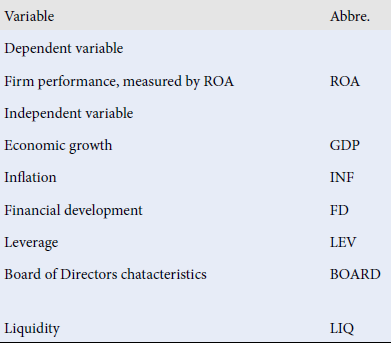
ROAit = β + βGDPit+ βINFit + βFDit + βLEVit + βBOARDit + βLIQit + μi + μ'it
In which, variables are explained in the Table 1; i and t proxy for year i and firm t, μ,μ' is the error term; β is intercept; β is the regression coefficient.
Description of variables used in the model
|
Variable |
Abbre. |
Previous studies |
|
Dependent variable | ||
|
Firm performance, measured by ROA |
ROA |
Nassar |
|
Independent variable | ||
|
Economic growth |
GDP |
Killins |
|
Inflation |
INF |
Hull & Alexander |
|
Financial development |
FD |
Fafchamps & Schündeln |
|
Leverage |
LEV |
Nassar |
|
Board of Directors chatacteristics |
BOARD |
Bennedsen et al. |
|
Liquidity |
LIQ |
Killins |
RESULTS AND DISCUSSIONS
Descriptive statistics
Descriptive statistics of research variables
|
Variable |
Obs |
Mean |
Std.Dev |
Min |
Max |
|
ROA |
650 |
3.078845 |
6.288456 |
-28.0502 |
83.9056 |
|
GDP |
650 |
6.097916 |
1.103095 |
2.94 |
7.2 |
|
INF |
650 |
7.220435 |
6.38286 |
0.6312009 |
23.11545 |
|
FD |
650 |
93.42904 |
13.15692 |
75.54869 |
116.6607 |
|
SIZE |
650 |
5.14 |
0.7813899 |
3 |
9 |
|
LEV |
650 |
0.660185 |
0.1681015 |
.1155198 |
1 |
|
LIQ |
650 |
1.072757 |
1.365805 |
.01 |
10.95165 |
Table 2 presents descriptive statistics of the variables in the regression model. For ROA measured for financial performance, it gets an average value of 3.07%, a maximum value of 83.90% and a minimum of -28.05, which indicates a huge difference in financial performance among enterprises in the survey sample. Economic growth, inflation and financial development achieved average values of 6.09%, 7.22% and 93.42%, respectively. The average size of the board of directors is 5.14 people/company, and ranges from 3 to 9 members. Capital structure that is financed by debt with 66% while the rest that is 34%, is financed by equity. In terms of liquidity, it reached an average of 1.07, showing that the average liquidity of listed companies is not high.
Correlation matrix
Correlation matrix between variables
|
ROA |
GDP |
INF |
FD |
BOARD |
LEV |
LIQ | |
|
ROA |
1.0000 | ||||||
|
GDP |
0.0241 (0.5401) |
1.0000 | |||||
|
INF |
0.0534 (0.1742) |
-0.1304* (0.0009) |
1.0000 | ||||
|
FD |
0.0355 (0.3943) |
-0.1387* (0.0004) |
-0.5204* (0.0000) |
1.0000 | |||
|
BOARD |
0.0697 (0.0759) |
0.0036 (0.9267) |
0.0335 (0.3944) |
-0.0638 (0.1040) |
1.0000 | ||
|
LEV |
-0.4248* (0.0000) |
0.0243 (0.5365) |
0.0000 (0.9996) |
-0.0468 (0.2333) |
-0.0738 (0.0599) |
1.0000 | |
|
LIQ |
0.1143* (0.0035) |
0.0246 (0.5321) |
-0.1047 (0.0075) |
0.0576 (0.1425) |
0.1899* (0.0000) |
-0.2956* (0.0000) |
1.0000 |
VIF analysis
|
Variable |
VIF |
1/VIF |
|
INF |
1.47 |
0.680749 |
|
FD |
1.47 |
0.681749 |
|
LIQ |
1.15 |
0.871767 |
|
LEV |
1.10 |
0.908187 |
|
GDP |
1.08 |
0.924075 |
|
SIZE |
1.04 |
0.957577 |
|
Mean VIF |
1.22 | |
Table 3 presents the correlation matrix, it found that the correlation coefficients between pairs of independent variables were less than 0.8, so there was no possibility of multicollinearity. In addition, Table 4 indicates that the mean VIF is 1.22 and less than 10, the component VIF indexes are also in the range of 1.04 and 1.47, and less than 10, so multicollinearity is unlikely to occur.
Regression results
Regression results – dependent variable ROA
|
Variable |
Regression coefficient | ||
|
Pooled OLS |
FEM |
REM | |
|
GDP |
0.3295 (0.118) |
0.3282* (0.089) |
0.3289* (0.087) |
|
INF |
0.0960** (0.024) |
0.0958** (0.014) |
0.0959** (0.013) |
|
FD |
0.0362* (0.078) |
0.0340* (0.072) |
0.0351* (0.062) |
|
BOARD |
0.3422 (0.241) |
-0.1281 (0.773) |
0.1051 (0.773) |
|
LEV |
-15.8537*** (0.000) |
-16.3314*** (0.000) |
-16.1429*** (0.000) |
|
LIQ |
-0.0672 (0.701) |
-0.0529 (0.838) |
-0.0563 (0.794) |
|
_Cons |
5.7653* (0.085) |
8.6976** (0.022) |
7.2746** (0.036) |
|
Test |
F(6, 643) = 25.21 Prob > F = 0.0000 |
F(6, 594) = 11.36 Prob > F = 0.0000 |
Wald chi2(5) = 98.09 Prob > F = 0.0000 |
|
F-test |
F(49, 594) = 3.56, and Prob > F = 0.0000 | ||
|
Hausman test |
Prob > chi2 = 0.9872 | ||
|
Wooldridge test for autocorrelation in panel data |
F(1, 49) = 0.012; Prob > F = 0.9130 | ||
|
Wald test for heteroskedasticity in fixed effect |
Chi2(50) = 44994.04; chibar2 = 0.0000 | ||
|
Breusch and Pagan multipliers test for random effects |
Chibar2(01) = 100.64; Prob > chibar2 = 0.0000 | ||
Regression results – robustness check
|
Variable |
Regression coefficient | |
|
FGLS |
Driscoll - Kraay | |
|
GDP |
0.3295 (0.115) |
0.3295 (0.141) |
|
INF |
0.0960** (0.023) |
0.0960*** (0.006) |
|
FD |
0.0362* (0.076) |
0.0362* (0.247) |
|
BOARD |
0.3422 (0.238) |
0.3422 (0.167) |
|
LEV |
-15.8537*** (0.000) |
-15.8537*** (0.000) |
|
LIQ |
-0.0672 (0.699) |
-0.0672 (0.382) |
|
_Cons |
5.7653* (0.083) |
5.7653 (0.164) |
|
Test |
F = 25.21 Prob > F = 0.0000 |
F = 24.98 Prob > F = 0.0000 |
Test for cross-sectional dependence
|
STT |
Variable |
CD test | |
|
t-statistic |
P-value | ||
|
1 |
ROA |
24.14 |
0.000 |
|
2 |
LEV |
-1.29 |
0.196 |
|
3 |
LIQ |
10.92 |
0.000 |
Table 7 shows that there is a dependent relationship between enterprises on the Vietnam stock exchange, especially through the test of ROA and LIQ coefficients, it shows that there is a large dependent relationship. Specifically, businesses have a dependent relationship on liquidity and profitability. Therefore, the study should be regressed according to the Driscoll - Kraay method to properly reflect this dependency.
Discussions
The regression results in Table 5 show that the regression according to the traditional method may have defects, so it is necessary to perform the regression according to FGLS. At the same time, because companies on the stock exchange have an interdependent relationship, the Driscoll - Kraay method should be performed regression as in the Table 6, the research results show that: inflation and development have a positive impact on financial performance while capital structure choice has a negative impact on the financial performance of the enterprise. There was no relationship between economic growth, liquidity and board size on corporate profitability.
Inflation has a positive effect on business performance, which can explain that because of the inflation factor, commodity prices often fluctuate in the direction of increasing prices, so businesses need to promote business to be able to do business in order to obtain greater benefits in the future. Moreover, high inflation is often consistent with doing the explanatory monetary policy in the context of Vietnam, and at the same time, businesses have easier access to capital and are the basis for businesses to open up or expand business in the short term. It is evident that the explanatory monetary policy have a positive impact on the financial performance of the business. In addition, enterprises should prioritize choosing equity sources to increase corporate efficiency, this is similar to the study of Ullah et al.1, Nassar6 once suggested that businesses should prioritize financing with their own capital instead of capital from debt with a higher level of risk and dependency.
CONCLUSIONS
Business enterprises are often affected by government policies, and in particular, are subject to fluctuations in macro factors. In a stable macro environment, it is to create stability in business and development for enterprises. The research assesses the impact of macro factors on business performance in enterprises listed on the Vietnam Stock Exchange in the period 2008 to 2020. The research results show that financial development has a positive impact on generating the profitability of the business. And at the same time, the choice of capital favoring debt has a negative effect or choosing a capital structure favoring equity has a positive effect on the business performance of the enterprise.
The research has several solutions. Firstly, the Government of Vietnam continues to implement solutions to stabilize the macro-economy in order to create a favorable investment environment and thereby encourage enterprises to produce and invest. Secondly, Vietnam continues to develop the financial market on the basis of improving the operation of the banking system and the stock market, thereby helping enterprises to be able to mobilize capital for production and business.
CONFLICTS OF INTEREST
We have no conflits of interest to disclose
CONTRIBUTIONS
The entire content of the article is made by the author only
ACKNOWLEDGEMENTS
We would like to thank the reviewers for their useful comments on our paper.