


Barriers to entrepreneurial intention among students of economics and management in Ho Chi Minh City
- University of Economics and Law, Vietnam National University - Ho Chi Minh City
Abstract
This study aims to investigate the effects of barriers on entrepreneurial intention among Economics and Management students in Ho Chi Minh City and then analyze and evaluate the impact of these barriers. The authors used 3 main models: Entrepreneurial Event Model – EEM, Model of Implementing Entrepreneurial Ideas, and Theory of Planned Behavior – TPB. The data were collected from 312 students at Economics and Management universities in Ho Chi Minh City. Next, the authors employed quantitative methods such as descriptive statistics, exploratory factor analysis (EFA), confirmatory factor analysis (CFA), HTMT test, structural equation modeling (SEM), Bootstrapping, and Kruskal - Wallis test using SPSS 20 and AMOS 24 softwares. The results showed that 4 independent variables had an effect on entrepreneurial intention, including Mental Barriers, Market Barriers, Educational Environment Barriers, and Knowledge Barriers. Particularly, Mental Barriers were seen as the most influential barriers to entrepreneurial intention. It was implied that the spirit, knowledge, and business environment were really a concern for students in the start-up stage, and educational background such as knowledge and encouragement of teachers also affected the entrepreneurial intention of Economics and Management students. Additionally, there were 5 groups with statistically significant differences in the students’ Entrepreneurial Intentions: (1) Gender, (2) School year, (3) University, (4) Major, and (5) Parents' careers. The study has filled a research gap by providing important insights into the barriers to entrepreneurial intention among Economics and Management students in Ho Chi Minh City. In practical terms, it helps students recognize obstacles and how to overcome them when making decisions while establishing a business. This study also provides educators and policymakers with solutions and governance implications for driving students' entrepreneurial intentions.
INTRODUCTION
Entrepreneurship is regarded as a new direction in solving socio-economic problems, for instance, reducing national unemployment 1. In Vietnam, to strengthen sustainable development and improve the current social situation, t he government has launched many startup-supporting policies, especially for supporting Resolution No. 35/NQ-CP in 2016. In the planning, the government stated that the whole country would have at least one million enterprises operating by 2020, in which 30 - 35% of Vietnamese enterprises would participate in innovation activities. In 2021 , the government continued to launch Resolution No. 02/NQ-CP on improving the business environment, whereby the resolution addresses the issue of ecosystem development and innovation promotion to improve national competitiveness. On another point, the government also enhanced the entrepreneurial intention among students through Decision No. 1655/QD-TTg in 2017 on the project "Supporting students in starting a business up to 2025".
Although entrepreneurial activities in Vietnam have many development opportunities, there are still many challenges that have not been fully resolved. In fact, some start-up activities may be slowed down by cultural issues, diminishing business returns due to scale changes, and risks in capital accumulation 2, 3, 4. Besides, the lack of knowledge and experience background also raises the bankruptcy rate of Vietnamese entrepreneurial businesses w hereby learning about these types of barriers will contribute to explaining the slowdown in innovation and entrepreneurship in Vietnam in general and in Ho Chi Minh City in particular.
Nevertheless, only a few studies were conducted on the entrepreneurial intention barriers of Economics and Management students in Vietnam in general and in Ho Chi Minh City (HCMC) in particular. Indeed, most of the previous studies were only studying the motivation factors for entrepreneurship. Therefore, this study will focus on solving the research questions : "What barriers affect the entrepreneurial intention of Economics and Management students in Ho Chi Minh City?", "How influential are those barriers?" and "What solutions to reduce the above barriers?". The study also aims to identify and evaluate the impact of barriers on the students' entrepreneurial intention; and thereby propose solutions to reduce those barriers.
MATERIALS - METHODS
THEORETICAL FRAMEWORK
Similar to previous studies, the authors will design the research on popular theoretical foundations. Firstly, we employed the Theory of Entrepreneurial Event Model (EEM), which was first developed by Shapero & Sokol5. Specifically, this model assumed that entrepreneurial intention stems from individual desire, feasibility, and ability to seize opportunities6. Secondly, the study would apply the Model of Implementing Entrepreneurial Ideas, which was developed by Bird 7. This model suggested that individuals tend to form intentions "based on a combination of both personal and contextual factors" 8. Finally, the Theory of Planned Behavior (TPB) would be applied. It is supposed that behavior came from three factors: attitudes toward the behavior, subjective norms, and perceived behavioral control 9.
LITERATURE REVIEW
Many studies have been conducted to find the factors that affect students’ Entrepreneurial Intentions. For instance, a study by Shahverdi & Qureshi is one of several international publications conducted on this topic in Malaysia10. The authors used CFA and SEM to find out factors affecting entrepreneurial intention, in which, lack of competency, lack of self-confidence, and lack of resources are considered direct barriers; meanwhile, lack of support and knowledge is only considered indirect factors. Similarly, Annuar et al. also proved that personal traits, entrepreneurial skills, and micro level are the factors creating barriers11. In addition, Amanamah et al. also used a survey sample consisting of 731 respondents to find out the factors that hinder start-ups in Ghana12. By multivariate regression, the authors believed that economic factors had the strongest effect on entrepreneurial intention, in contrast, the personal factor has a rather weak influence. Through the research in Bosnia and Herzegovina, Turulja et al 13 showed that the support of family and friends exerted a significant positive influence on entrepreneurial intentions. Fear of failure had a significant adverse impact on entrepreneurial intentions while entrepreneurial capacity enhanced it. The study at the University of Mongolia by Zanabazar & Jigjiddorj 14 aimed to explore various factors affecting the entrepreneur intention, including attitude of the students, subjective norms, entrepreneur education, and perceived behavior control. More than 500 university students were involved in the data sample, in which the valid respondent had to attend the entrepreneurship subject. The survey results demonstrated that personal attitude had an influence on entrepreneurial intention and the participants expressed their willingness to start their businesses by having an awareness of prospective challenges and opportunities.
In Vietnam, many studies on the same topic have been conducted. Thu et al. 15 and Trang16 used the SEM model to find out the factors affecting the entrepreneurial activities of students. In particular, the study of Thu et al. 15 clarified the role of cognitive factors, while Trang 16 focused on supporting factors and barriers. By other methods, Mai et al. 17 and Lien 18 combined EFA with multivariable regression to explore what factors and how they influenced entrepreneurial intention. Based on these two studies, the factors could be listed as mental support, capital, education, and personal characteristics of students17, 18. On the same topic, Thanh et al.19 used logistic regression, combined with correlation coefficient and EFA to catch on barriers affecting entrepreneurial intention. The results from this study showed that personal traits, cognitive conditions, and normative and regulative structures limited the desire to start a business in Vietnamese students, with the strongest impact being Personal traits specifically. Hien & Trang20 based on the theory of intended behavior of Ajzen9 combined with related studies to build a proposed research model. However, the author ' research had some limitations as the study only surveyed final-year students and ignored the others. Besides, the independent variables in the research model only explained 55.1% of the variation of the dependent variable. This meant that although the research model was suitable, 44.9% still belong to other factors not mentioned in the model. On the other hand, Van, Y, and Ha 21 collected primary data from 250 economics students at Tra Vinh University (TVU). Thanks to multivariable regression analysis, the study found six factors affecting the start-up intention of economic students including: start-up support; feasibility perception; educational environment; personality traits; attitudes towards start-up behavior; financial accessibility. Hiep et al. 22 collected data from 430 final-year economics students from 10 universities that had the highest rate of start-up students in Ho Chi Minh area. After applying the Multiple Linear Regression Analysis Model, the research results showed that the factors affecting the intention to start a business of economics students at universities in Ho Chi Minh City (arranged in order of importance from high to low) include: business education; subjective standards; startup environment; personality characteristics and perception of feasibility.
From the review process, it can once again be affirmed that the previous studies all have certain gaps. This gap can be easily seen through the lack of barriers affecting entrepreneurial intention, the lack in the case of Economics and Management students, and the lack in the case of universities in Ho Chi Minh City. Thereby, the research reinforces the research orientation on barriers to entrepreneurial intention among Economics and Management students in Ho Chi Minh City.
CONCEPTUAL FRAMEWORK
The model of this study focuses on clarifying the barriers affecting the entrepreneurial intention of Economics and Management students, w herein entrepreneurial intention is a process from thinking ( plann ing actions) to carrying out an entrepreneurial behavior 23.
Specifically, the study proposes six barriers affecting business intention as follows:
The first is knowledge barriers. Lack of knowledge and skills is considered a serious barrier to business intention24. Indeed, Miller25 identified a lack of knowledge and business skills as another potential barrier to entrepreneurship intentions. Therefore, the authors proposed that the knowledge barrier factor had a negative impact on entrepreneurial intention of students.
The second is cognitive barriers. According to Thu et al15, perception included desirability and feasibility. While desirability refered to the perceived value and attractiveness of the opportunity, feasibility included the possibility of implementation and the constraints of the opportunity 26. Taatila 27 also concluded that the lack of such awareness might adversely affect one's choice to start their own business. Therefore, the authors propose that cognitive barriers have a negative impact on students' entrepreneurial intentions.
The third is market barriers. A market is a place where buyers and sellers exchange goods and services. External market factors can have a positive or negative impact on an individual's thinking, so they also cause the entrepreneurial intention to change28. Therefore, the authors propose that market barriers positively or negatively affect students' entrepreneurial intentions.
The fourth is mental barriers. Many previous studies listed “mental barriers” as the negative factor affecting entrepreneurial intention, such as the study by Bich & Minh 29 and Herdjiono et al 30. Indeed, when individuals had no mental support, they tended to become self-deprecating when making startup decisions. In summary, mental barriers are proposed to negatively impact on the intention to start a business.
The fifth is the capital barriers. Capital is essential for the survival of the business in the early stages 31. The lack of capital is considered one of the critical factors hindering the intention to start a business. Therefore, the authors propose that the capital barriers negatively impact entrepreneurial intention.
Finally, there are barriers relevant to the educational environment. In the university environment, students have the freedom to be creative and come up with their entrepreneurial ideas32. According to Lüthje and Franke 33, training programs and university career-oriented activities could increase students' interest and perceptions of entrepreneurship in the future. In addition, some studies also consider education as a basic requirement when analyzing entrepreneurial intentions. In particular, Hiep et al. 22 affirmed that the Educational Environment is the most important factor affecting the entrepreneurial intention of economic students. Therefore, the authors propose that the educational environment barriers have a negative impact on entrepreneurial intention.
Generally, these factors are presented as the following observed variables (Table 1).
Constructing the entrepreneurial intention barriers
|
Variables |
Source |
|
Knowledge barriers | |
|
KT1 - I find myself lacking the specialized knowledge to start a business. |
Bich & Minh, 2021 |
|
KT2 - I find myself lacking in knowledge of business planning and raising capital. |
Ha et al., 2018 |
|
KT3 - I find myself lacking in knowledge of managing and operating the business model. | |
|
KT4 - I find myself lacking in knowledge of financial management and marketing. | |
|
KT5 - I find myself lacking in knowledge of legal regulations for businesses. | |
|
KT6 - I find that there are not many experienced advisors in state organizations to help students start a business. |
Trang, 2020 |
|
Cognitive barriers | |
|
NT1 - I do not think that I will be able to manage a business |
Thuy, 2015 |
|
NT2 - I do not think that I am going to be a successful businessman. |
Suggested by the author's group |
|
NT3 - I do not think that starting a business is easy. | |
|
NT4 - I do not think that business is attractive. | |
|
NT5 - I do not have my business idea yet. | |
|
Market barriers | |
|
MA1 - I realize that startups are facing intense competitive pressure. |
Bich & Minh, 2021 |
|
MA2 - I realize that startups have difficulty accessing business practices and consumption customs. |
Suggested by the author's group |
|
MA3 - I realize that the laws of Vietnam do not support doing business easily. | |
|
MA4 - I realize that the tax and quota procedures are too cumbersome and confusing. | |
|
MA5 - I realize that the conditions and procedures for producing and trading goods and services are too cumbersome and difficult to understand. | |
|
MA6 - I realize that it is difficult to implement and protect intellectual property rights. | |
|
Mental barriers | |
|
TT1 - My family does not support my decision to start a business. |
Bich & Minh, 2021 |
|
TT2 - My friends do not support my decision to start a business. | |
|
TT3 - Important people do not support my decision to start a business. |
Trang, 2020 |
|
TT4 - The school does not support my decision to start a business. |
Suggested by the author's group |
|
Capital barriers | |
|
NV1 - I cannot borrow money from friends and relatives to start a business. |
Bich & Minh, 2021 |
|
NV2 - I do not have enough personal savings to start a business. | |
|
NV3 - I cannot find investment funds to support a startup project. | |
|
NV4 - I cannot get a loan from start-up student loans. |
Dinh et al., 2021 |
|
NV5 - I cannot find people to contribute capital to establish the company. |
Thuong, 2014 |
|
Educational environment barriers | |
|
GD1 - I do not hear stories about business activities from experienced people at my university. |
Dinh et al., 2021 |
|
GD2 - I do not see my university encouraging the development of creative ideas so that I can start a business. | |
|
GD3 - I do not see my university encouraging students to participate in extracurricular activities about entrepreneurship. | |
|
GD4 - I do not see my university education providing me with the skills and knowledge needed to start a business. | |
|
GD5 - I did not have any discussions/exchanges about business activities during my studies. |
Hung & Pha, 2016 |
|
Entrepreneurial intentions | |
|
YDKN1 - I cannot start a business. |
Hung & Pha, 2016 |
|
YDKN2 - I cannot be self-employed in the future. | |
|
YDKN3 - I am not thinking about starting my own company. |
Haris et al., 2016 |
|
YDKN4 - I have no goal of becoming an entrepreneur. |
Bich & Minh, 2021 |
|
YDKN5 - I am not ready to learn how to start a business. |
On the other hand, to increase the significance of the topic, some demographic factors and personal characteristics were also included in the analysis17, 18. These demographic factors include (1) Gender, (2) Year of study, (3) School, (4) Field of study, and (5) Occupation of parents.
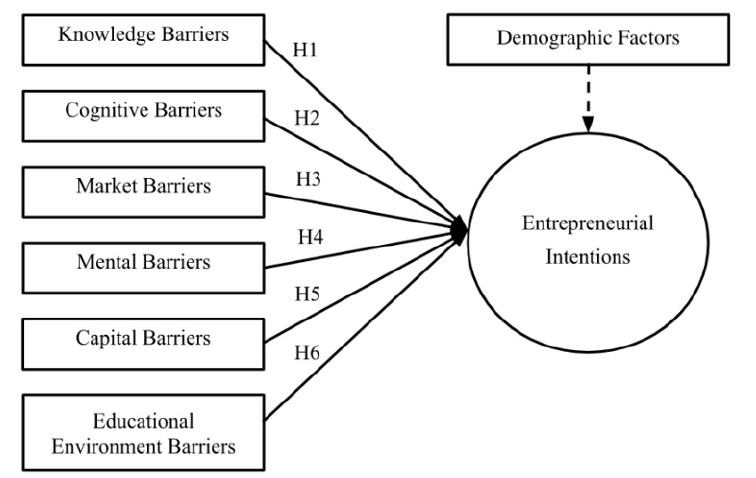
In sum, the conceptual framework could be illustrated in Figure 1, which was also the research model for this study.

Research framework (Source: Compiled by the authors)
H1: Entrepreneurial intentions are affected by knowledge barriers.
H2: Entrepreneurial intentions are affected by cognitive barriers.
H3: Entrepreneurial intentions are affected by market barriers.
H4: Entrepreneurial intentions are affected by mental barriers.
H5: Entrepreneurial intentions are affected by capital barriers.
H6: Entrepreneurial intentions are affected by educational environment barriers.
DATA
The study carried out primary data collection with 312 valid questionnaires, surveyed from February to March 2022 by convenience sampling technique in Ho Chi Minh City. This sampling method is appreciated for its efficiency, simplicity, and cost-saving 34. Additionally, to reduce the cost, the authors will only focus on some economics-teaching universities in HCMC, including UEL, UEH, UEF, and TDTU. These universities typically enroll a large number of economics-management students per year, which are expected to be representative of the students in the same major in HCMC35, 36, 37, 38.
T he surveyed demographic factors were (1) Gender: male and female; (2) School year: a maximum of 4 years; (3) Universities : UEL, UEF, UEH, and TDTU (4) Fields of study comprised of Real Estate business, Economics - Public Management, International Economics Relations, International Business, Business Administration, Economics, Marketing, Commerce and some other disciplines; and (5) Parents' occupation including non-business, business-related, public servants and self-employment.
In addition to demographic factors, the authors also built a questionnaire according to measurement variables representing barriers. In which, knowledge barriers (KT), and market barriers (MA) had 6 observed variables, cognitive barriers (NT), capital barriers (NV), educational environment barriers (GD) had 5 observed variables, and mental barriers (TT) had 4 observed variables. These observed variables were evaluated on a Likert scale from 1 to 5, with 1 being “Strongly Disagree” and 5 being “Strongly Agree”. Besides, the entrepreneurial intention was also built based on 5 observed variables including the questions: (1) I cannot start a business, (2) I cannot be self-employed in the future, (3) I am not thinking about starting my own company, (4) I have no goal of becoming an entrepreneur, and (5) I am not ready to learn how to start a business.
ANALYTICAL METHOD
From the collected data, the authors conducted data processing and analysis. Specifically, the study used SPSS 20 and AMOS 24.0 software to perform Cronbach's Alpha Test, Exploratory Factor Analysis (EFA), Confirming Factor Analysis (CFA), Structural Equation Modeling (SEM), and Kruskal – Wallis test for non-normally distributed data.
Moreover, to increase the relevance and reliability of the study, the authors also tested the dispersion and convergence for the CFA result through the CR, AVE, and Heterotrait-Monotrait Ratio of Correlations (HTMT) Indexes. Similarly, the authors also test Bootstrap (with 500 observations) for linear structural model SEM.
RESULT
CRONBACH’S ALPHA RESULT
The results of Cronbach's Alpha test (Table 2) showed that all scales had acceptable Cronbach's Alpha coefficients (greater than 0.6). Specifically, the lowest factors were the cognitive barriers and the capital barriers (with the same Cronbach's Alpha equal to 0.755), and the highest one was the mental barriers scale (with Cronbach's Alpha equal to 0.878). Moreover, the item-total correlation for all observed variables was greater than 0.3, therefore, they could be included in the EFA and CFA exploratory factor analysis.
Results of testing the reliability of the Cronbach's Alpha
|
Observation variables |
Scale Mean if Item Deleted |
Scale Variance if Item Deleted |
Corrected Item – Total Correlation |
Cronbach’s Alpha if Item Deleted |
|
Knowledge barriers |
Cronbach’s Alpha = 0.854 | |||
|
KT1 |
18.80 |
13.81 |
0.71 |
0.816 |
|
KT2 |
18.76 |
14.11 |
0.68 |
0.822 |
|
KT3 |
18.84 |
13.89 |
0.70 |
0.818 |
|
KT4 |
18.94 |
13.68 |
0.66 |
0.827 |
|
KT5 |
18.72 |
15.29 |
0.58 |
0.841 |
|
KT6 |
18.89 |
14.96 |
0.53 |
0.851 |
|
Cognitive barriers |
Cronbach’s Alpha = 0.755 | |||
|
NT1 |
13.92 |
8.74 |
0.67 |
0.658 |
|
NT2 |
13.93 |
8.71 |
0.62 |
0.673 |
|
NT3 |
13.65 |
11.17 |
0.29 |
0.782 |
|
NT4 |
14.37 |
9.17 |
0.52 |
0.714 |
|
NT5 |
13.90 |
9.43 |
0.53 |
0.710 |
|
Market barriers |
Cronbach’s Alpha = 0.834 | |||
|
MA1 |
18.78 |
13.16 |
0.55 |
0.819 |
|
MA2 |
19.03 |
12.58 |
0.62 |
0.805 |
|
MA3 |
19.20 |
12.56 |
0.57 |
0.816 |
|
MA4 |
19.09 |
11.74 |
0.67 |
0.793 |
|
MA5 |
19.08 |
11.78 |
0.68 |
0.791 |
|
MA6 |
19.06 |
12.58 |
0.56 |
0.818 |
|
Mental barriers |
Cronbach’s Alpha = 0.878 | |||
|
TT1 |
9.03 |
9.09 |
0.74 |
0.842 |
|
TT2 |
9.17 |
8.90 |
0.79 |
0.824 |
|
TT3 |
9.11 |
9.21 |
0.75 |
0.839 |
|
TT4 |
9.23 |
9.75 |
0.67 |
0.867 |
|
Capital barriers |
Cronbach’s Alpha = 0.755 | |||
|
NV1 |
14.64 |
8.10 |
0.58 |
0.690 |
|
NV2 |
14.44 |
9.01 |
0.42 |
0.749 |
|
NV3 |
14.54 |
8.50 |
0.57 |
0.695 |
|
NV4 |
14.62 |
8.61 |
0.54 |
0.705 |
|
NV5 |
14.46 |
8.57 |
0.51 |
0.717 |
|
Educational environment barriers |
Cronbach’s Alpha = 0.866 | |||
|
GD1 |
13.62 |
12.46 |
0.64 |
0.850 |
|
GD2 |
13.62 |
12.13 |
0.72 |
0.829 |
|
GD3 |
13.78 |
12.25 |
0.70 |
0.836 |
|
GD4 |
13.75 |
12.06 |
0.70 |
0.836 |
|
GD5 |
13.69 |
12.59 |
0.68 |
0.839 |
|
Entrepreneurial intentions |
Cronbach’s Alpha = 0.859 | |||
|
YDKN1 |
13.29 |
13.28 |
0.65 |
0.837 |
|
YDKN2 |
13.42 |
12.52 |
0.68 |
0.829 |
|
YDKN3 |
13.44 |
12.48 |
0.70 |
0.824 |
|
YDKN4 |
13.54 |
12.29 |
0.69 |
0.828 |
|
YDKN5 |
13.58 |
12.19 |
0.67 |
0.832 |
RESULT OF EXPLORATORY FACTOR ANALYSIS (EFA) AND CONFIRMATORY FACTOR ANALYSIS (CFA)
After 7 loops of performing Exploratory Factor Analysis (EFA), the number of remaining observed variables was 23 and the number of removed observed variables was 8 (its factor loading less than 0.35). In which, the KMO coefficient was 0.917 (greater than 0.5), the Bartlett Test was 0.0 (less than 0.05), and they were consistent with the above analytical assumptions. Moreover, all observed variables had a loading factor greater than 0.35, and the total variance extracted is 52.475% with the suitable eigenvalue.
After 3 loops of performing Confirmatory Factor Analysis (CFA), the number of remaining observed variables was 19 and divided into 4 factors. There was a new factor that differed from the original expectation, made up of observed variables TT1, TT3, NT1, TT2, and NT4 (Figure 2). Based on the content of the questions, this new variable could be defined as the “mental barriers” and the authors would use it for the next steps of analysis. The results of the CFA also showed appropriate indicators. Specifically, the index CMIN/df = 2,145; GFI = 0.905; CFI = 0.941; TLI = 0.931; RMSEA = 0.061; and PCLOSE = 0.03.
Besides, the authors also evaluated the dispersion and convergence of CFA. The results of Model Validity Measures represented that 4 factors KT, TT, GD, and MA had all CR values greater than 0.7 (acceptable for reliability) and all AVE values were greater than 0.5 (acceptable for convergence). Moreover, according to HTMT indexes, there was no correlation among factors, so the new barriers were guaranteed to be discriminant (Figure 2).

Barriers after analysis of EFA and CFA (Source: Calculated by the authors)
As a rule, these factors need to be calculated by Cronbach's Alpha again. Specifically, all new factors had Cronbach's Alpha values greater than 0.6, the smallest factor was the Market Barriers with a coefficient of 0.766 and the largest was the Educational Environment Barriers with a coefficient of 0.866.
In sum, after employing the EFA and CFA method , there were 4 constructed factors. Specifically, the EFA removed 8 observation variables, and the CFA removed the next 4 observation ones. Meanwhile, the rest were grouped as knowledge barriers, educational environment barriers, market barriers, and especially for mental barriers. And these variables would be used in the following steps.
RESULT OF STRUCTURAL EQUATION MODELING (SEM)
The SEM results (Figure 3) were consistent with the above expectations and suitable for the assumptions of the statistics. The following figure showed that CMIN/df = 2,290 < 3; CFI = 0.919; TLI = 0.908; RMSEA = 0.064; PCLOSE = 0.01, GFI=0.870 39, 40.

SEM Linear Structure Modeling Results (Source: Calculated by the authors)
Summary of SEM result
|
Normalized regression coefficient |
Standard Error (S.E) |
Bootstrap regression coefficient (n=500) | |
|
KT |
-0.183*** |
0.081 |
-0.177*** |
|
TT |
0.562*** |
0.071 |
0.569*** |
|
GD |
0.213*** |
0.081 |
0.203*** |
|
MA |
0.368*** |
0.96 |
0.368*** |
The estimated parameters (in Table 3) summarized that all factors were significant at 95%. In which, the factor mental barriers (TT) had the largest impact on entrepreneurial intentions (the coefficient was 0.562), then the market barriers (MA) (equal to 0.368), and the final one was education barriers (GD) (equal to 0.181). In contrast, the knowledge barriers (KT) had a negative effect on the intention (the coefficient was less than 0). Besides, the bootstrap coefficients with a 500-observation sample were significant at 95%, so the results of the SEM model were suitable for analysis.
RESULT OF KRUSKAL - WALLIS TEST
Entrepreneurial intention in this study was assumed to be a continuous variable and equal to the mean of the YDKN variables. Because this new variable did not follow a normal distribution, the authors decided to use Kruskal-Wallis Test to explore the association between demography and entrepreneurial intention.
Result of Kruskal - Wallis Test for demographic factors
|
Chi-Squared |
P-value | |
|
Gender |
15.477*** |
0.000 |
|
School year |
26.738*** |
0.000 |
|
University |
38.358*** |
0.000 |
|
Major |
34.775*** |
0.000 |
|
Parents' careers |
13.405*** |
0.000 |
Table 4 indicated that demographic factors influenced entrepreneurial intentions at a 95% significance level. Specifically, there were 5 groups with significant differences in the students’ entrepreneurial intention: (1) Gender, (2) Year of study, (3) School, (4) Field of study and (5) Occupation of parents. In sum, the above demographic factors had impacts on entrepreneurial intention, and provided scientific evidence for the last hypothesis.
DISCUSSION
The research results showed that the barriers played an important role in doing-business decisions for Economics and Management students in Ho Chi Minh City.
In particular , mental barriers were considered a critical factor limiting entrepreneurial intention11, 15, 19. Indeed, entrepreneurial individuals are strongly influenced by social opinions as well as their perceptions. Therefore, the lack of awareness and spiritual encouragement will cause individuals to falter and reduce business intentions. Especially, mental barriers in this study are approached by subjective (TT1, TT3, TT2) and objective aspects (NT1, NT4). Besides relatives and friends (objective aspect), individual cognitive (subjective aspect) also prevents them from starting their own business, including students majoring in Economics and Management. Therefore, it is essential for encouraging the entrepreneurial intention of students through both the social connection and their awareness.
Another point is that the entrepreneurial intentions of students were also affected by market barriers29, 41. When the students start their business, they need to know how customers react to their products, what key players are, and what policies they must follow. It will cost them a huge amount of time to adapt and create hesitation in Entrepreneurial Intentions. In sum, the market barriers represent the fierce competition in the market and legal risks. The reality also shows that the greater the competition, the less the desire for entrepreneurial activities.
The educational environment also played a significant role in shaping the desire to start a business for the students10, 15, 41. Today, many training programs in Vietnam are still strongly theoretical, with low practical applicability. Many businesses even have to retrain basic skills to help students complete their jobs well42. Therefore, they will be less confident when starting their own business, they will be scared of mistakes, communication, and criticism from others. The lack of start-up incubators, flexibility, and appropriate methods will restrict entrepreneurial ideas, therefore, limiting entrepreneurial intentions.
However, the research results showed that knowledge Barriers had a positive impact on the intention, the more the knowledge barriers, the more motivated students to start a business. This result is the opposite of the study of Masoumeh Shahverdi et al 10. The cause may be due to the scope and other demographic factors. The author's research is aimed at a group of students in the field of Economics - Management in Ho Chi Minh City, while Masoumeh Shahverdi et al10 was aimed at students in Malaysia. Besides, the reason can also come from the risk tolerance of individuals. Even though they have less business knowledge, they still want to start a business to learn from practical experiences. This result is considered a new point on the topic, thereby creating a premise for further research on the relationship between knowledge and entrepreneurial intention.
CONCLUSIONS
In conclusion, estimated results identified four barriers to entrepreneurial intention in descending order: mental barriers, market barriers, educational environment barriers, and knowledge barriers. Besides, the results of the Kruskal - Wallis Test showed that gender, school year, university, major, and parents' careers also influenced the intention.
The key findings in this study come from mental barriers and knowledge barriers. Differing from previous studies, the authors employed cognitive barriers as part of mental barriers11, 15, 19. Thus, any solutions that aim to reduce mental barriers need to focus on solving both subjective and objective issues, especially cognitive barriers. Meanwhile, the results showed that knowledge barriers had a positive impact on entrepreneurial intentions. It is expected as the new suggestions for further studies when exploring what promotes start-up behaviors, at the same time, researchers can test the risk tolerance theory when someone starts their own business.
From the research results, the authors propose some solutions to reduce the entrepreneurial intention barriers of Economics and Management students as follows:
Firstly, the mental support for students needs to improve. Families and friends should be willing to listen to the voice of students. Thereby, they can make recommendations for students when deciding to start a business. Family and friends can also encourage the student's project by sharing some knowledge and experiences related to the ongoing business project.
Secondly, credit institutions need to have specific policies to promote entrepreneurship in students. Almost all the students lack capital and knowledge of funding procedures. Therefore, credit institutions need to simplify the criteria for approving loan applications, loosening requirements on borrowers' financial situation, with the purpose of giving students more opportunities to access loan packages. However, financial institutions can take advantage of necessary records related to learners such as academic results and extracurricular activities to determine potential projects and avoid nonperforming loans.
Thirdly, individuals establishing their businesses should conduct market research before deploying. Self-employed individuals and collectives need to survey or outsource market research firms to assess the feasibility of the project. This will help the infant businesses learn from the experiences and practices of their predecessors (or competitors), as well as identify both demand consumption behaviors of the target customers.
Finally, educational institutions need to improve the environment and encourage student entrepreneurship. The authors suggest that educational institutions should establish "Communities” to support the entrepreneurship of students or "Forums” to connect students, which will be the potential places connecting schools and students or among students who have the same passion. In addition, the training program at the school should also be interspersed with more applications, helping students experience the practice and improve the spirit of entrepreneurship. The school can also link up with alumni who have started a business to develop a consulting service, oriented on startup ideas for students, and provide more core business knowledge.
However, the study has two main limitations that need to improve and conduct in further research. The first one is the convenience sampling technique. Although the authors try to collect answers from universities that have a large number of Economics – Management students (UEL, UEH, UEF, and TDTU) 35, 36, 37, 38, the sample is not perfectly representative of HCMC. Therefore, the result might be biased and lead to the wrong prediction. The second limitation is the methodology. Indeed, the result interpreted what factors influenced the entrepreneurial intention and its trend, except for the marginal effect. It will make the quantification of policies more difficult, making the assessment of policy effectiveness complicated and expensive.
List of abbreviations used
UEL: University of Economics and Law
UEF: University of Economics and Finance
UEH: University of Economics Ho Chi Minh City
TDTU: Ton Duc Thang University
EFA: Exploratory Factor Analysis
CFA: Confirmatory Factor Analysis
SEM: Structural Equation Modeling
HCMC: Ho Chi Minh City
CR: Composite Reliability
AVE: Average Variance Extracted
KMO: Kaiser-Meyer-Olkin
CMIN/df: Chi-squared/degree of freedom
CFI: Comparative Fit Index
GFI: Goodness of Fit Index
TLI: Tucker & Lewis Index
RMSEA: Root Mean Square Error of Approximation
YDNK: Entrepreneurial intention
Competing interests
The authors declare that they have no competing interests.
Authors’ contribution
Author Nguyen Vo Thy Thy is responsible for the content: Abstract, Introduction, Results, Discussion, and Conclusions.
Author Phan Ngoc Nhu is responsible for the content: Introduction, Materials – Methods, and Discussion.
Author Hoang Long is responsible for the content: Materials - Methods, Results, Discussion, and Conclusions.
Author Chau Hoang To Tran is responsible for the content: Introduction, Materials – Methods, and Discussion.
Author Pham Thi Lan Nhi is responsible for the content: Materials - Methods and Discussion.
Author Phung Thi Xoan is responsible for the content: Introduction and Discussion.