


The impact of business simulation games on Vietnamese students’ entrepreneurial intention
- School of International Business and Marketing, University of Economics Ho Chi Minh City - UEH, Viet Nam
Abstract
In Vietnam, business simulation games have been affirmed as a very effective business learning tool for entrepreneurship education. However, few educators have properly applied them to arouse students' desire to study entrepreneurship. This paper aims to explore the role of human-system interaction and subjective norms (extrinsic) with self-efficacy (intrinsic) in building students’ entrepreneurial intention using the theories of Self-Determination (SDT), and Stimulus-Organism-Response (SOR). The PLS-SEM was employed to analyze the data collected from 195 undergraduates from Vietnam’s southern business universities. The results showed that self-efficacy plays a full mediator between human-system interaction and entrepreneurial intention. Additionally, subjective norms strengthens the effect of human-systems interaction on self-efficacy, implying that subjective norms plays a moderating role in this connection. It is anticipated that the study's findings will provide practical applications for universities' boards of management, game designers, and future researchers to focus on developing entrepreneurship that accommodates students’ values.
INTRODUCTION
Entrepreneurship has been celebrated as a catalyst of revolution in the outlook of the new world economy 1. Therefore, research dealing with the concept of entrepreneurial intention has increased exponentially, creating a new field of research, especially in the education industry2. The Entrepreneurship syllabus in universities has changed from learning on paper-based books to e-books and business simulation games. It has been more than two decades that business simulation games - a tool as experiential training are being used for inculcating important managerial and decision-making skills in business graduates, forming their entrepreneurial intention3.
Extant literature has revealed a number of previous researches about the nexus between business simulation games and entrepreneurial intention4, 5. However, literature still does not clarify and provide empirical evidence about extrinsic and intrinsic motivations to prove the role of business simulation games in developing entrepreneurial intention in business graduates. The research of Fox (2018)5 had delivered a significant role of extrinsic motivation such as game design and flow (decision, choice, and action frameworks), therefore, concur with prior researchers who have concluded that serious games are an important and significant tool in the entrepreneurship education, from that build the entrepreneurial intention.
Despite the growth of the research on entrepreneurial intention, researchers suggested that the outcome of entrepreneurial intention research should be centered on social cognitive categories (person, context, cognition, and motivation)6. Previous studies focus on the impact of either intrinsic factors on EI as utilizing human perceptions, attitudes, and behaviors when using business simulation game3, 7 or extrinsic factors (fear of reprisal or social pressure, Mitchell et al., 2018). Specifically, Mitchell (2018)8 provides a basis for deeper understanding of how gamification works as the first to empirically examine the role of extrinsic motivation. However, it does contrast with findings in some contexts showing gamification does not facilitate competency needs satisfaction and intrinsic motivation9 or autonomy needs satisfaction10. Therefore, the effect of both and intrinsic factors on the entrepreneurial intention has rarely been explored. For this reason, this study examines both intrinsic and extrinsic motivations affecting the entrepreneurial intention of undergraduate students.
In this context, it is important extrinsic to explore the research model that examines the intermediate role through incorporating two theories, Self-Determination Theory (SDT) and Stimulus-Organism-Response Theory (SOR). Apart from familiar factors, to be more specific about intrinsic motivation, we substitute self-efficacy for the function of competence (a factor of SDT) and put it play an intermediate role in the SOR framework. Thus, based on these theories, four constructs of the research model variables include human-system interaction (simulation design), self-efficacy, subjective norms, and entrepreneurial intention are chosen with the aim to find deeper understandings about students’ intention to become entrepreneurs and to provide important implications for teaching innovation.
LITERATURE REVIEW
Business Simulation Games (BSG) and its benefits
BSG are tools that can duplicate decision-making in a real-world business context by using students' natural capacity for technology, according to the Academy of Management (AOM) and the Association for Business Simulation and Experiential Learning (ABSEL)11. BSGs are also digital environments with the aim of teaching or training through an experience that extends beyond entertainment and fun (without necessarily excluding such features), utilizing technological resources, and employing gamification techniques in daily business. Students' reactions to their simulation experiences show that they enjoyed the competitive team environment and acquired knowledge from it. In addition, frequent business decision-making may help participants make better strategic decisions12.
Previous research on “GLO-BUS” indicated that students get access to unique and rich contexts for the application of strategic management frameworks through an engaging and competitive simulation environment13. Decision-making, overviewing, target-based orientation, and a problem-solving focus are all characteristics of BSG14. Business games, in general, (1) allow students to engage with educational content in a more enjoyable and interactive way, as well as benefit from the simulation of scenarios with several factors that are difficult to represent with other methodologies; (2) allow students to gain management skills and competencies that are required in the business world15; and (3) assist participants in gaining experience without the risks and costs of putting their decisions on the line15.
Human-system interaction in the context of BSG
Regarding the systematization of research on the modeling of a game, the Taxonomy of Computer Simulations 16 and then adapted for the BSG17 considers the design elements of the user interface. Human-system interaction design, also known as interactive systems design, must take into account a number of factors, including attention and basic human capacity in task execution. In the design of interactive systems, the author emphasizes the need of working on resources that recognize recourse and devices such as assistants and automatic error checkers for probable attention aberrations. These tools are useful for simulating a student's reasoning in a certain field of knowledge, as well as receiving ideas and assistance from educators18. Given the high level of complexity and multiplicity of operational and project requirements presented, it is critical to consider the possibility of investigating new methodologies and devices to monitor and analyze the user experience of BSG. This can contribute with essential elements to guide its design and success as a learning tool.
Entrepreneurial Intention (EI)
In the literature on entrepreneurship, intention is defined as a state of mind that focuses someone's attention towards entrepreneurship, resulting in that individual prioritizing self-employment over organizational work19, 20, 21. Intentions have been proved to be a well-built predictor of planned behaviours in entrepreneurship research22, 23. Intentions define one's ability to become an entrepreneur and, more importantly, whether such ideas will be pursued effectively or not24. Thus, the Ndovela and Chinyamurindi Entrepreneurial careers: Circumstances Influencing Entrepreneurial Aspirations 149 lifespan of an entrepreneurial enterprise is influenced not just by environmental factors but also by the entrepreneur's intentions25. It has also been linked to entrepreneurship and has been seen as the heart of entrepreneurship relating to the establishment of a business. Entrepreneurial intentions have a positive effect on students’ entrepreneurial attitude, therefore posing a need for educators to reinforce this sentiment26.
Individuals, the environment, and their interactions are all involved in the phenomena of venture creation27. Previous researchers believe that entrepreneurial intentions are influenced largely by the happenings in the macro-environment 28. The influence of such environmental factors can be an interacting effect with individual actions29. Furthermore, developing an understanding between environment and behavior is essential for determining an intent towards when and how to take advantage of entrepreneurial opportunities 30, 31. By incorporating BSG into education, it is possible to modify students' intentions and build entrepreneurial aspirations in them32. After forming an entrepreneurial purpose, an individual begins to hunt for possibilities to start a new business, and if this is somewhat misleading and opportunities are not spotted or discovered, then the entrepreneurs have to imagine the future market value of their product or service33, 34. In management, BSG is seen as critical in the development of EIs among students5, 35.
Self-efficacy
Self-efficacy explains human behavior as “a product of the interplay of intrapersonal influences, the behavior individuals engage in, and the environmental forces that impinge upon them” 36. The interaction between these factors determines one's belief in one's capacity to effectively conduct a certain activity in a particular context, as well as one's expectations for the behavior's results37. Self-efficacy is the antecedent and consequence of an action choice, and it influences how people do their current task and plan for future task successes38. According to Bandura (2012)36, self-efficacy is the most influential component influencing behavior since it has an impact on other processes and factors such as goal setting, outcome expectations, and intention. The notion of self-efficacy has been applied in a variety of sectors, including entrepreneurship, due to its fundamental impact on human behavior.
Subjective Norms
Subjective norms is key indicators of intentions 39, 40. Subjective norms is influenced by perceived expectation levels from significant people, such as family, colleagues, and role models, according to Peng (2012)41. The importance of social connection in this environment, as the presence of others influences people's thoughts, feelings, and behaviors. Others, both worldwide (e.g., 42) and within the South African career research literature, agree with this viewpoint (e.g., 43). Furthermore, subjective norms can also play a role in determining entrepreneurship intent as a characteristic that influences experiences 44.
BSG on EI
There are limited researches derived from the previous scholars related to the process of interpreting entrepreneurial stimuli into response such as entrepreneurial intention. Therefore, we use the Stimulus-Organism-Response (SOR) model developed by Mehrabian & Russel (1974) 45, which is combined with the Self-Determination Theory (SDT) by Ryan & Deci (2000)46 for demonstrating the BSG effect on EI. In addition, SDT factors played an intermediate role to serve as a bridge between the SOR factors and BSG. Specifically, the model proposed in this research demonstrated the process among factors that influence EI with BSG. This study uses SOR to depict students' stimuli in their learning environment, including human-system interaction and subjective norms. As learners experience the distortion of time and enjoy the pleasures of interaction with the BSG system, it can affect their desire to adopt it as well as to continue using it47, 48. Moreover, we postulate that people may be influenced by the opinions of others (parents and peers), as regards subjective norms, which then leads to their intention antecedents, namely intention to use 49.
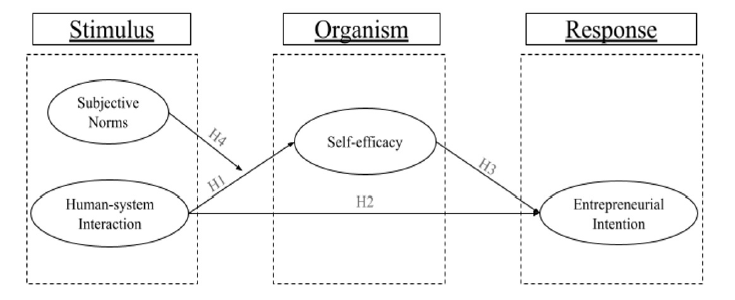
Self-efficacy would be supported by a positive interpersonal climate in which parents, peers, and the BSG system provide management skills, experiences, motivation…. Thus, this study will propose another extended S-O-R model by examining the relationship between human-system interaction, subjective norms (stimuli) and self-efficacy which adapted from the SDT 46 performing as organism and EI (responses). In addition, we investigated the direct effect of self-efficacy on EI. A highly efficacious student who perceives high entrepreneurial self-efficacy can be expected to intentionally start their own business and actually engage in the long run. Recent research in BSG and EI has provided support for some elements of our proposed model. We consider some of this work below, as Figure 1.
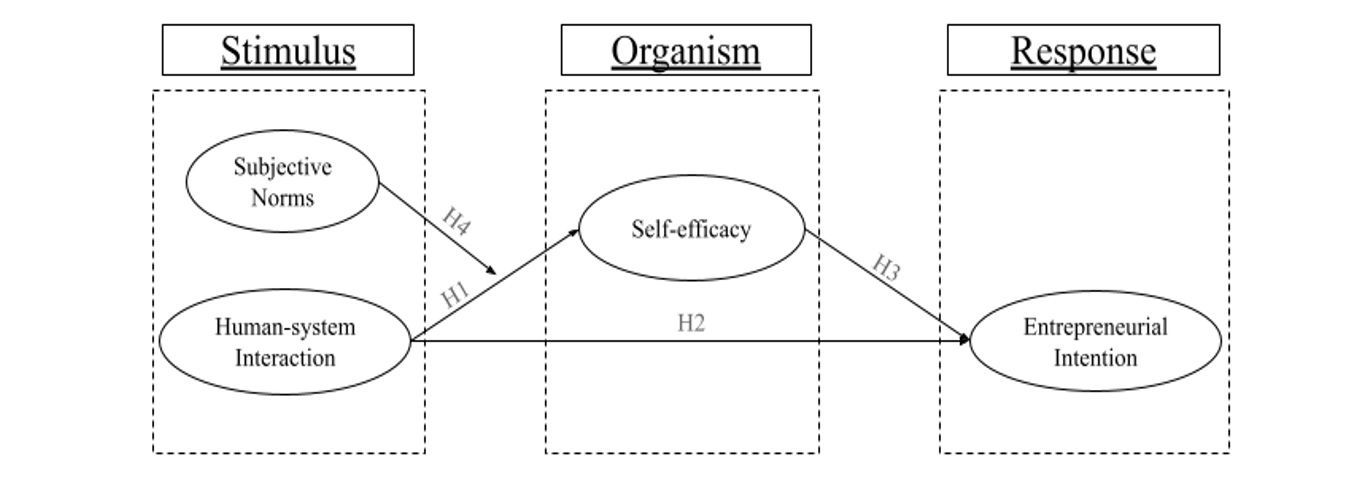
Research Model (Source: by authors, 2022)
The direct effect of Human-system interaction on Self-efficacy
Miller (2010) 50 noted that the simulation is the “kind of learning tool that can be very effective in moving students from the lower rungs of learning to the upper rungs where true critical analysis and understanding takes place” (p. 161). Indeed, BSG is considered a successful experience learning tool “in which the learner was directly in touch with the realities being studied” 51, 52. BSGs, which provide a more realistic view of the entrepreneurial experience than theoretical teachings and allow experiential learning with no real-world consequences53, 54. This approach can help students observe the relationship between decisions and their outcomes55. Furthermore, student's game performance is frequently linked to their grades, implying genuine repercussions and urging them to improve their behavior.
Studies highlight the combination of education in systems thinking and team skills training through game simulation, leading to more sustainable systems management. As a result, students' self-efficacy especially increases during their own game design phase. The training program for self-efficacy through gaming simulation demonstrates that the interactive design of simulation games supports change processes in educational organizations56. Accordingly, we hypothesize:
H1: Human-system interaction has a positive effect on Self-efficacy.
Human-system interaction and EI
Human-system interaction can be defined as “the degree to which learners believe that they can easily take and study the learning contents via interacting with the learning function of the e-learning platform” 57. Business game human-system interaction “can develop student’s entrepreneurial skills and encourage them to undertake entrepreneurial activities. The simulation experience allowed students to face challenges, overcome limitations, improve their analytical skills, and enhance their business knowledge58. Provided that learners find it interesting while interacting with BSG in some aspects (game design, game challenge...), they will go through high perceived playfulness59 and they will be more likely to experience flow 60, which straightforwardly lead to the learners' engagement in BSG. Buil (2019)61 hypothesized that engagement has a positive impact on skill development and perceived learning, which can not only meet the target of the courses but gradually form students' entrepreneurial intention as well.
In examining the relationship between EI and human-system interaction, a number of studies have yielded significant results focusing on two different aspects of human-system interaction (website quality). Students generally express a positive attitude toward BSG and the perceived learning from BSG. This positive feeling continues, as well, years after students have finished their simulation exercises and moved into the business world62. Accordingly, we hypothesize:
H2: Human-System Interaction has a positive effect on EI.
Self-efficacy and EI
Self-efficacy is instrumental in producing the intended or desired results of their efforts. Bandura 63, 64 explains self-efficacy as “one's belief in one's ability to succeed in particular situations or to accomplish a task "and is "the confidence in one’s own ability to achieve intended results”. Human performance is affected by external issues such as the nature of the task, the tools being used, and the situation. So, self-efficacy is the belief in one's ability to act resulting from those actions. Merhi65, 66 noted that self-efficacy is a personal assessment of one's ability to carry out a variety of tasks and actions. The higher the confidence level is, the higher their intention to choose entrepreneurship as their future career enhances. Several researches have shown that self-efficacy strongly influences individuals' ability to become entrepreneurs, their efforts to create a new business, their persistence in the face of change, their resilience facing challenges of creating new businesses, and their success in operating the business role 67, 68, 69. Accordingly, we hypothesize:
H3: Self-efficacy has a positive effect on EI.
The moderating variable on the relationship between Human-system interaction and Self-efficacy
In business simulation games, opinion of peers is very important for a number of reasons: (a) students interact with each other and share information and thoughts which strongly affect their positive intention; (b) Visser and Krosnick (1998)70 also found that young students learn more efficiently and effectively from the people who are close and important to them such as teachers and parents. Knowledge, information, and resources acquired through social and external networks can help students identify, realize opportunities and obtain external resources, advice, and information from their networks71. As a result, social support which is defined as subjective norms that students get from family and friends is crucial to translating business knowledge, skills, information of acquired to their confidence in abilities 72.
Additionally, it has also been suggested that entrepreneurial self-efficacy may be enhanced through appropriate training and education and, subsequently, by leveraging the rate of entrepreneurial activities73, 74. this study was designed to investigate the impact of BSG’s interactive system with students on entrepreneurial self-efficacy within the context of entrepreneurship education. The support obtained from the subjective norms is essential to change the BSGs interaction with students into a his/her belief in the ability to perform a number of tasks and to increase the motivation and desire to start a business72, 75. Taking into account the previous arguments, there are significant differences between individuals with different subjective norms regarding human-system interaction influence on self-efficacy, we propose our first hypothesis:
H4: Human-system Interaction has a positive effect on Self-efficacy and will be moderated by Subjective Norms.
METHODS
Data collection
The data was collected via a survey using Google Forms from business universities throughout Vietnam. Data collection in Vietnam can be difficult as there are a few business universities applying BSG in their courses. Therefore, we have to investigate the number of schools throughout Vietnam that use BSG as a teaching method to develop a list of potential respondents who show willingness for survey participation. The purpose of the study was explained to the students before they were asked to fill out the questionnaire. Students who participated in the study were majoring in Marketing, International Business, Commercial Business, etc. Five participants have had experience with the BSG in courses and have played it before in several courses. A total of 238 students were interviewed to take part in the survey. Of them, 43 surveys were removed from the sample because they indicated that they had no experience in business simulation games. In the end, a total of 195 valid surveys were used for data analysis, resulting in an 81.9% usable response rate.
Measurement
To establish a rigorous measurement of the manifest variables, the instrument development process followed the prescriptions recommended in the seminal articles focused on enhancing the validity of measurements in positivist studies 76. Measurement items were adapted from previous literature with little modifications of words and sentences in accordance with this study. The measures for subjective norms are adapted from Pender (1986)77. An example of the subjective norms is “The school you are studying creates many conditions to encourage you to pursue your EI”. The measures for human-system interaction are adapted from Ajzen (1991)78. An example of the simulation design is “The business simulation game offers full detailed instructions online”. Additionally, to measure intrinsic motivation, the well-known Situational Motivation Scale79 was employed. This includes statements such as “I am confident in my ability to start my own business” (self-efficacy). The measures for entrepreneurial intention are adapted from Albert Shapero (1982)80. An example of the EI is “I have very serious thoughts about starting a business, setting up a company”. In all cases, the 5-point Likert scale was used for almost all questions to measure the responses with 1 - indicating strongly disagree, and 5 - indicating strongly agree.
RESULTS
Contextual Qualitative Data
In terms of Human-System Interaction construct, beside the item that was collected from Cheng, Y. M. (2020)’s57 questionnaire, we added two more items based on comments of interviewees. For the opinion “The participant’s guide is very helpful not only in the game but appropriate for real-life economy as well”, we added “Business simulation games allow me to learn a lot of real business knowledge” and “The business simulation game offers complete online instructions” for this construct.
With regards to Subjective Norms construct, beside the items that were collected from Frarrukh et al (2019)’s81 questionnaire, we added three more items based on the viewpoints of our interviewees. For the comment “Family has a significant impact on student's self-efficacy because they are provided mental and physical advice to be an entrepreneur”, the item “Family influences my entrepreneurial intentions” was added. For the opinion “The comments of friends can affect his mindset that he has the ability to startup”, we added “If friends around me think I am good for doing business, then I would think I am appropriate for being an entrepreneur”. For the comment “The others’ advice makes me think of starting a business”, then the item “From the subjective effects of society, my business intentions are rekindled” was added for the construct.
Referring to Self-efficacy construct, beside the items that were collected from Yen, W. C. (2020)’s82 questionnaire, we just added one more item “I believe I can overcome my financial limitations to gain start-up opportunities” due to the opinion “The financial status is crucial when a person considers whether he/she should startup”.
Since there were no additional comments for the Entrepreneurial Intention, our items for this construct were all collected from Doanh, D. C. (2021)’s 83 questionnaire and no more items were added.
Measurement model assessment
Table 1 reveals that all the reflective constructs have high levels of internal reliability and consistency, as demonstrated by the above composite reliability values. All the constructs’ reliability coefficients ranged from 0.838 to 0.893, with all of them above 0.70, indicating that the items are reliable measures for their perspective constructs 84, 85. To test the reliability of EI, human-system interaction, self-efficacy, and subjective norms, Cronbach’s alpha coefficient was computed. The Cronbach’s alpha values varied from 0.718 to 0.82, which exceeded the minimum acceptable values and proved good internal consistency reliability for each latent construct. For exploratory studies, values 0.70 are considered acceptable 84.
To assess the convergent validity for each construct, the standardized factor loadings were used to determine the validity of the four latent constructs 86, 87. The findings indicated that each factor loading of the constructs ranged from 0.629 to 0.892 and exceeded the recommended level of 0.50. As each factor loading on each construct was greater than 0.50, the convergent validity for each construct was established, thereby providing evidence of construct validity for all the constructs in this study86.
Additionally, the AVE was calculated to assess the discriminant validity for the four constructs88 for which the AVE ranged from 0.510 to 0.735. All values of all constructs were likewise found to be higher than the threshold of 0.5, demonstrating adequate convergent validity89. The items utilized in this study also have strong convergent validity, since they loaded highly (more than 0.50) on their respective components, according to the results. Table 1 summarizes the findings.
Measurement Quality Indicators
|
Construct |
Item |
Outer Loading |
Cronbach’s Alpha |
Composite Reliability |
Average |
|
EI |
EI1 EI2 EI3 |
0.892 0.832 0.846 |
0.820 |
0.893 |
0.735 |
|
Self-efficacy |
SE1 SE2 SE3 |
0.878 0.847 0.790 |
0.789 |
0.877 |
0.704 |
|
Human-system interaction |
HSI1 HSI2 HSI3 |
0.878 0.720 0.786 |
0.718 |
0.838 |
0.635 |
|
Subjective norms |
SN1 SN3 SN4 SN5 SN6 |
0.629 0.771 0.706 0.695 0.762 |
0.764 |
0.838 |
0.510 |
Discriminant validity
|
EI |
Self-Efficacy |
Human-System Interaction |
Subjective Norms | |
|
EI |
0.857 | |||
|
Self-efficacy |
0.601 |
0.839 | ||
|
Human-system Interaction |
0.269 |
0.315 |
0,797 | |
|
Subjective norms |
0.553 |
0.605 |
0.444 |
0.714 |
The discriminant validity of the construct is shown in Table 2. Its discriminant validity is supported by the fact that the square root of the AVE between each pair of factors is greater than the estimated correlation between factors85, 88. Table 2 compares cross-loadings and indicates that an indicator's loadings are higher than other loadings in the same column and row for its own construct. Furthermore, the results indicate that there is discriminant validity between all the constructs based on the loadings and cross-loadings criterion depicted in Table 1.
Structural model assessment and hypotheses testing
We used bootstrapping technique to analyze the significance of indicators 90. The use of a bootstrapping technique to analyze the significance of the loadings obtained on the observed variables is based on the model's estimates and calculates the estimates of the parameters and their confidence intervals based on multiple estimated 91, 92. Table 3 presents the values of coefficients of the Structural Model – Between Constructs. The values were estimated by a bootstrapping technique. All T-values higher than 1.96 (significance level = 5%) and p-values lower than 0.05, except human-system interaction with EI90, 92.
Coefficients of the Structural Model
|
Indicators |
β |
Sample Mean (M) |
Standard Deviation |
T statistics |
P values |
|
HSI → EI |
0.087 |
0.090 |
0.066 |
1.315 |
0.189 |
|
HSI*SN → SE |
0.158 |
0.157 |
0.065 |
2.437 |
0.015 |
|
HSI → SE |
0.140 |
0.139 |
0.062 |
2.273 |
0.023 |
|
SE → EI |
0.576 |
0.577 |
0.062 |
9.298 |
0.000 |
|
Gender → SE |
0.165 |
0.163 |
0.053 |
3.088 |
0.002 |
|
SN → SE |
0.573 |
0.577 |
0.048 |
11.918 |
0.000 |
Thus, 2 hypotheses proposed by the authors are accepted. Specifically:
-
Self-efficacy has the strongest and positive impact on EI (H3) with the coefficients β= 0.576 and p= 0.000.
-
Human-system interaction has the lowest and positive impact on Self-efficacy (H1) with the coefficients β= 0.140 and p= 0.023.
Mediating Effect: Self-efficacy is a mediator between Human-system interaction and EI (H2b).
Specific Indirect Effects
|
Indicators |
Original Sample (O) |
Sample Mean (M) |
Standard Deviation |
T statistics |
P values |
|
HSI → SE → EI |
0.081 |
0.080 |
0.036 |
2.262 |
0.024 |
Total Indirect Effects
|
Indicators |
Original Sample (O) |
Sample Mean (M) |
Standard Deviation |
T statistics |
P values |
|
HSI → EI |
0.081 |
0.080 |
0.036 |
2.262 |
0.024 |
Table 4 and Table 5 presents an indirect effect. T-values higher than 1.96 (significance level = 5%) and P Value less than 0.05, so indirect effect is significant. Thus, there exists an indirect relationship from HSI to EI. It can be concluded that Self-efficacy plays a mediating role between Human-system interaction and EI, hypothesis H2 is accepted.
Moderating effect:Human-system interaction has a positive effect on Self-efficacy and will be moderated by Subjective norms (H4).
Path Coefficients of Mediator
|
Indicators |
Original Sample (O) |
Sample Mean (M) |
Standard Deviation |
T statistics |
P values |
|
SN*HSI → SE |
0.158 |
0.157 |
0.065 |
2.437 |
0.015 |
|
SN → SE |
0.573 |
0.577 |
0.048 |
11.918 |
0.000 |
|
HSI → SE |
0.140 |
0.139 |
0.062 |
2.273 |
0.023 |
From Table 6, the P-values of the relationship Subjective norm affects Self-efficacy is 0.000 < 0.05, showing that Subjective norm impacts on Self-efficacy. Regression coefficient Original Sample (O) = 0.573 > 0 shows that Subjective norm has a positive effect on Self-efficacy. The P-values of the relationship Human-system interaction affects Self-efficacy is 0.023 < 0.05, showing that Human-system interaction impacts on Self-efficacy. Regression coefficient Original Sample (O) = 0.140 > 0 shows that Human-system interaction has a positive effect on Self-efficacy. Moreover, P-values of the moderating relationship Subjective norms*Human-system interaction affects Self-efficacy is 0.015 < 0.05, showing that Subjective norm*Human-system interaction has an impact on Self-efficacy. Thus, the Subjective norm has the moderating role from Human-system interaction to Self-efficacy. Original Sample regression coefficient (O) = 0.158 > 0 shows that increasing Subjective norm will increase the impact of Human-system interaction on Self-efficacy. Therefore, hypothesis H4 is accepted.
The studies of Cohen (1988) and Faul et al., (2007) were used to evaluate the coefficient of determination (r²), determining that the f² values were equal to 0.02, 0.15, and 0.35 are considered small, medium, and large effects.
Effect size (f square)
|
EI |
HSI*SN |
SE |
HSI | |
|
EI | ||||
|
HSI*SN |
0.060 | |||
|
SE |
0.440 | |||
|
HSI |
0.010 |
0.025 | ||
|
0.443 |
Table 7 presents the effect levels of relationships:
-
Subjective norms on Self-efficacy (f2 = 0.443): has a large effect.
-
Self-efficacy on EI (f2 = 0.440): has a large effect.
-
Human-system interaction*Subjective norms on Self-efficacy (f2e = 0.060): has a small effect.
-
Human-system interaction on Self-efficacy (f2 = 0.025): has a small effect.
-
Human-system interaction on EI (f2 = 0.010): has a very small or no effect.
Result R square and R square Adjusted
|
R Square |
R Square Adjusted | |
|
EI |
0.369 |
0.359 |
|
SE |
0.430 |
0.418 |
According to the responses, Table 8, the construct Self-efficacy presented an R² of 0.430, the construct EI presented an R² of 0.369, both of which were accepted.
Figure 2 shows the model that was developed as a result of this research. The path coefficients and significance levels for each hypothesis are indicated by the numbers in the arrows. The standard error and f square generated by the bootstrapping procedure were used to determine the importance of the paths.
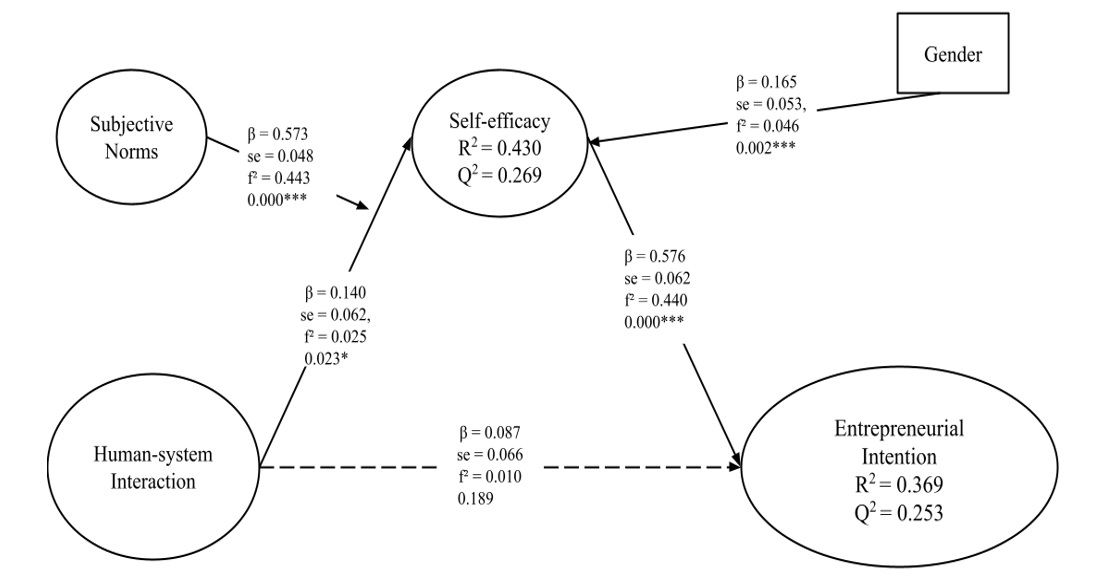
Structural Model
PLS Predict test results
|
RMSE |
MAE |
MAPE |
Q²_predict | |||||
|
PLS |
LM |
PLS |
LM |
PLS |
LM |
PLS |
LM | |
|
EI3 |
0.752 |
0.745 |
0.612 |
0.607 |
17.325 |
16.797 |
0.135 |
0.151 |
|
EI2 |
0.791 |
0.784 |
0.651 |
0.602 |
18.477 |
16.929 |
0.183 |
0.197 |
|
EI1 |
0.815 |
0.793 |
0.665 |
0.617 |
19.785 |
17.621 |
0.183 |
0.226 |
|
SE1 |
0.739 |
0.731 |
0.606 |
0.587 |
17.479 |
16.896 |
0.219 |
0.235 |
|
SE3 |
0.807 |
0.770 |
0.645 |
0.626 |
19.602 |
18.587 |
0.256 |
0.322 |
|
SE2 |
0.782 |
0.797 |
0.609 |
0.633 |
20.053 |
20.358 |
0.302 |
0.276 |
For the PLS-SEM and linear regression models, Table 9 compares the root mean squared error (RMSE), mean absolute error (MAE), mean absolute percentage error (MAPE), and Q Predict values (LM). For RMSE, MAE, and MAPE, the results demonstrate that PLS-SEM has higher error values than LM, indicating that PLS-SEM has low out-of-sample predictive power, with the exception of SE2. It was further confirmed in Table 9, where the Q Predict values for PLS-SEM and LM show that PLS-SEM values are slightly lower than LM values except for SE2, but those were positive and greater than zero. There are a few explanations for this. PLS Predict produces case-specific predictions on the composite model level 93. The PLS-SEM model of this study is complex as this includes both single-order and second-order formative constructs and used reflective indicators. Besides, the number of observations used (1950) was large in this study. Large sample size in PLS-SEM has the likelihood to detect some misspecifications94. Literature suggested that PLS-SEM offers a better solution with a small number of observations used with many constructs and many items95, and the PLS Predict approach is useful when the dataset is very small partitioning is problematic93.
Synthesis of the Study Hypotheses Tests
|
Hypothesis |
Description |
Result |
|
H1 |
Human-system interaction has a positive effect on Self-efficacy |
SUPPORTED |
|
H2 |
Human-system interaction has a positive effect on EI |
NOT SUPPORTED |
|
H3 |
Self-efficacy has a positive effect on EI. |
SUPPORTED |
|
H4 |
Human-system interaction has a positive effect on Self-efficacy and will be moderated by Subjective norms |
SUPPORTED |
DISCUSSIONS
Human-system interaction is associated with one’s successful experience of one’s ability to directly get in touch with the realities being studied51, 52. Willy C. Kriz (2003)96 and other studies document a positive relationship between human-system interaction and self-efficacy, Table 10. In the same manner, we postulated that human-system interaction increases the level of self-efficacy using BSG (H1). Our data failed to confirm this direct relationship but after further analysis, we found that human-system interaction indirectly impacts self-efficacy through subjective norms which is a full moderator.
We expected that a higher level of human-system interaction can develop students’ entrepreneurial skills and encourage them to undertake entrepreneurial activities. Mummalaneni (2005)97 found that website design elements, including layout organization, display, and signage, have a positive effect on users’ stimulation. In support of this notion, the data collected validate that human-system interaction has a positive effect on EI (H2). This finding also speaks to the publishers about the importance of improving the design of simulation games to develop students’ system interaction and their EIs.
The study’s findings among university students demonstrates that higher levels of confidence as a result of simulation games would boost learners' EI. Trevelyan (2011), Chen et al. (1998), and Boyd & Vozikis (1994)67, 68, 69 found that a high level of competence boosted their intention to pursue entrepreneurship as a future career. Self-efficacy has been demonstrated to have a significant impact on people's abilities to become entrepreneurs, their efforts to start a new business, their tenacity in the face of change, and their resilience in the face of change in the past, the difficulty of starting a new business and its success in fulfilling its job and mission. We found supporting evidence that self-efficacy has a positive effect on students’ EI (H3)
Finally, subjective norms is defined as perceived social pressure to perform or not to perform a particular behavior78. Subjective norm has been linked to evaluations of learners' usefulness in a good way98. In this paper, we argue that when using BSG, learners' self-efficacy is boosted by the subjective norms that comes with social pressure. Furthermore, students’ self-efficacy is not only influenced by the environment but also the features, or additive studying interactions with software. Thus, our data provide supporting evidence for our argument that the human-system interaction has a positive impact on self-efficacy which is supported by subjective norms within the context of BSG, not examined by previous studies (H4). This result indicates that positive motivational communications provided by the people surrounding students which combines with a great interactive system can increase students’ confidence in their own abilities to perform entrepreneurship.
CONCLUSIONS
Limitations and future research
Despite the fact that this paper has a number of significant contributions, the acknowledgment of its shortcomings must not be taken for granted. These limitations also suggest the directions for further research.
Firstly, due to the lack of universities in Vietnam applying BSG as a teaching method, the range of respondents who participate in the survey is exceedingly undiversified, with the majority from UEH University and Southern universities. Validating this model in other locations, such as extending to North and Central Vietnam, will augment the body of knowledge and enrich our understanding about elements of business-based gamification appreciably influencing students' EI. Consequently, future research may authenticate the model and hypotheses presented above in other locations.
Secondly, owing to the fact that the number of students who have been playing BSG before is scant, data analysis is conducted from a small size of the sample. Accordingly, future research could collect data in a larger size, especially respondents with entrepreneurial experiences.
Thirdly, this study only focuses on investigating the relationship between proficiency in BSG and EI which is based on one factor of SDT (namely, competence). Thus, future research might magnify the research model to comprise other factors of SDT such as autonomy or/and relatedness to completely understand the power of intrinsic motivation in the case of BSG and its functions to create EI. Furthermore, BSG mentioned in this study in general definition, means that the research does not thoroughly point out the name of the game that is being investigated and the related domain of business. Hence, future research could scrutinize the research model and hypotheses presented above with regard to more specific games which simulate the risk-free economy, remarkably in more exclusive fields and departments such as Logistics, Marketing, etc. to have deeper expertise about users’ EIs in terms of distinctive business-based gamification.
Finally, in this study, we have focused on only two types of external conditions (namely, subjective norms and simulation design). However, other types of conditions exist. Therefore, future research could focus on examining other types of exterior stipulation such as human-human interaction (peer-to-peer interaction, tutor-student interaction), reward, punishment... to fully comprehend the relationship between independent and dependent variables from all aspects.
ABBREVIATIONS
SDT: Self-Determination
BSG: Business Simulation Games
AOM: Academy of Management
ABSEL: Association for Business Simulation and Experiential Learning
SOR: Stimulus-Organism-Response
EI: Entrepreneurial Intention
AVE: Average
MAE: mean absolute error
PLS: partial least squares
LM: linear model
SEM: Structural Equation Modeling
HSI: Human-System Interaction
SN: Subjective norms
RMSE: Root mean squared error
MAPE: Mean absolute percentage error
SE: Self-efficacy
UEH: University of Economics Ho Chi Minh City
H1, H2, H3…: Hypothesis
CONFLICT OF INTEREST
The authors declare that they have no conflicts of interest.
AUTHORS’ CONTRIBUTION
- Author Hoang Cuu Long is responsible for the following components: Literature review, result intepretation and suggesting policy implications.
- Authors Vo Thi Hong Nhung, Nguyen Thi Nha Quynh, Bui Nhat Thien Thanh, Le Nguyen Yen Nhi are responsible for the following components: data analysis, suggesting policy implications, drafting and editing the manuscript.