

Using IPA model to evaluate management criteria for State-owned enterprises
- East Asia University of Technology
- VNU University of Economics and Business
Abstract
In modern society, State management plays an important role. Therein, State-owned enterprises in Vietnam played a pivotal role in post-war economic development. Therefore, the main objective of the study is to analyze the evaluation criteria of State management for SOEs. The article identifies criteria and analyzes SOE management based on the Importance - Performance Analysis model to measure the gap between the level of importance and level of performance of the criteria. This research uses both qualitative and quantitative data obtained from interviewing experts and surveying 425 managers. The Cronbach’s Alpha test, Exploratory Factor Analysis, Paired Samples T-Test, and IPA model are employed to analyze the data collected. The research results pointed out that the indicators of the evaluation criteria are scattered in four quadrants of the IPA model. Especially, the first quadrant has up to ten indicators that are evaluated at a low level of performance, focusing on efficiency and effectiveness criteria. It means the efficiency and effectiveness of State management have not been appreciated. The second quadrant which keeps up the good work has six indicators. The third quadrant (lower priority) has six indicators. And the fourth quadrant (possible overkill) has eleven indicators. The results brought practical implications for the managers of the State management agencies to understand the actual situation of State management for SOEs in recent years. From the analysis of the Importance and Performance in the IPA model, two criteria that need to be focused on improving are efficiency and effectiveness. The article also presents discussions and recommends solutions to improve the management of the State. In addition, matrix IPA is also being analyzed to provide a basis for managerial implications to improve the State management for SOEs in the future.
INTRODUCTION
In modern society, state management plays an important role. Thanks to good governance, a country or a locality can develop rapidly despite limited national resources. On the contrary, bad governance can make a country or a locality become business slack and backward. The role of State management in the context of the market economy has been increased. The larger the size of the economy is, the higher the economic growth rate becomes. The more complex the economic structure becomes, the greater the State’s management responsibility1is.
State-owned enterprises in Vietnam played a pivotal role in post-war economic development. However, their role has decreased due to the strong growth of the private sector in the socialist-oriented market economy. State-owned enterprises play an important role in state administration with the task of significant material force for the State to guide and regulate the economy, contributing to macroeconomic stability. Moreover, State-owned enterprises are the leading force in science and technology application, setting an example of productivity, quality, and socio-economic efficiency and complying with the law.
To effectively manage State-owned enterprises, the Government of Vietnam promulgated the Law on State-owned Enterprises Management in 2014 to overcome inefficiencies. It is a sign that the Government attaches great importance to the state economic sector management. In fact, mechanisms and policies for the State-owned enterprises have barriers in mobilizing and concentrating resources. As a result, the state economic sector has not shown its position with the part in leading, motivating, and promoting the development of other economic sectors. At the same time, the state economy lacks the promotion of value chain linkages and promotes advantages in carrying out its mission to the country.
Several domestic studies analyzed the State-owned enterprises2, 3. However, these studies only summarize the position and role of State-owned enterprises in the socialist-oriented market economy. But the criteria for evaluating the effectiveness of State management for one has not been analyzed. Moreover, there are very few studies applying the IPA model to evaluate the effectiveness of State management for State-owned enterprises. Accordingly, research on the evaluation criteria of State management for State-owned enterprises is a new field with many gaps in theoretical and practice research. Hence, coming from the above situation and the research gap, this study aims to use the IPA model to evaluate management criteria for State-owned enterprises. Moreover, the results of the IPA matrix can help the Government, policy-makers, and State-owned enterprises look for solutions to the stable and sustainable development of the national economy.
THEORETICAL BACKGROUND
State management for State-owned enterprises
There are many concepts of State-owned enterprises (SOEs), but there is no consensus because it changes over time and depends on conditions, circumstances, and the economy of countries. Schiavo-Campo & Sundaram showed that SOEs are enterprises in which the State holds more than half of their total assets4. In the OECD guidelines on corporate governance, SOEs are enterprises in which the State controls through full, majority, or significant minority ownership5. Based on economics theory, SOEs are organizations involved in goods and services products but not owned by any individual but belonging to society6.
In Vietnam, depending on the stage of economic development, the concept of SOEs has changed to be consistent with the actual requirements. According to Law on Enterprises 2020, “SOEs are enterprises in which the State holds more than 50 percent of the charter capital and has the right to vote as prescribed in Article 88 of this Law”. Thus, the research on SOEs is approached in the direction of ownership, not in the way of management.
The term “State management” was born at the same time as the formation and existence of the State, described as a specific management method of the State. The World Bank defined State management as the exercise of political powers by an organization to manage a country and manage socio-economic resources for the development of that country7.
In closing, State management is the use of management tools containing a system of policies, regulations, and legal documents to manage relationships in the socio-economic fields of the country. To maintain a stable situation and develop and achieve the highest operational efficiency in each specific environmental condition and period.
Based on the above views, State management for State-owned enterprises is the use of the jurisdiction by State management agencies to impact purposefully, systematically, and synchronously. To make the most effective use of resources for SOEs to develop in the right direction, meet the goals, and be consistent with each diverse period.
Evaluation criteria of State management for State-owned enterprises
There are many different methods to evaluate state management for research fields. However, the widely used method is based on evaluation criteria. Developing evaluation criteria plays an important role in the management of the State8. Evaluation is the systematic and objective assessment of an on-going or completed policy implementation and outcomes to determine the relevance and fulfillment of objectives, management efficiency, effectiveness, and sustainability8.
This study synthesized theories and summarized the studies of Schiavo-Campo & Sundaram4, Dao9, and Le10 and combined with the theory of “Good Governance”, the evaluation criteria of State management for State-owned enterprises comprise of effectiveness, efficiency, relevance, sustainability, and equity. The content of the evaluation criteria is explained as follows:
Effectiveness is the power and authority of the management subject to influence, control, or dominate the managed objects in the system through legal tools, policies, decisions and orders consistent with objective laws to achieve management goals and meet the practical needs of society. The effectiveness of State management for State-owned enterprises is a social category that shows the relationship between the State and SOEs or is based on the extent to which the State exercises power with the degree of law observance and obedience of the SOEs. The effectiveness of State management for SOEs is the ultimate goal of the State in the management process of SOEs. It is evaluated by comparing results obtained in performing management functions and duties to accomplish the requirements for SOEs.
Efficiency is the management subject to optimally use input resources so that the managed objects achieve maximum operational results with minimum costs. The efficiency of State management for SOEs is the degree of fulfillment of requirements in the state management process based on good management of input resources so that SOEs can get the best performance results at the lowest cost.
Moreover, the efficiency of State management for SOEs is different from that of ordinary enterprises. Not only are SEOs achieving profits, but they also perform public tasks such as creating jobs and incomes for citizens, supporting the private sector, leading the economy to develop, exploring new fields, creating a corporate culture or business morality, and ensuring national security. Hence, evaluating the efficiency of State management for SOEs needs to consider the completed results of both aspects above.
Relevance is the reasonable, feasible, and consistent level between the contents in management activities and the objectives and orientations of the management subject to the managed objects. The relevance of State management for SOEs contains (i) the relevance between the system of legal documents and the objectives, orientations, and strategies for the development of SOEs; (ii) the relevance between socio-economic development policies and the activities of SOEs; (iii) the relevance between activities of SOEs and international practices. In other words, the activities of SOEs must be compatible with legal regulations, meet State management requirements and receive consensus among stakeholders in the economy. Additionally, it is also relevant to the content, method, form, inspection, and supervision of the operation process of SOEs.
Sustainability is the level of stability and sustainability overtime of the management subject in directing, operating, and managing the activities of the managed objects. The sustainability of State management for SOEs is the long-term stability of the system of policies and strategies combined with a long-term vision in the development orientation of SOEs. It is also structural stability at state agencies to be flexible and adaptive in management to changes in the integrated economy. In addition, documents related to the operation of SOEs must be open and flexible to meet the requirements of SOEs over a long period of time in order to realize two goals to ensure the process of production and business combined with the performance of public duties assigned by the State.
Equity is the level of balance in the implementing management requirements of the management subject in the exercise of rights and obligations of the managed objects. The equity of State management for SOEs is to ensure that all requirements and contents in the management process are distributed equitably without discrimination in terms of size, form, and type of business among SOEs. The promulgation of management documents must ensure the balance of rights and obligations, combined with the performance of assigned public utility tasks to meet the State’s requirements in stabilizing the market and orienting the country’s socio-economic development.
METHOD
The IPA model
This study uses the Importance Performance Analysis model of Martilla & James based on the difference between the opinions of managers about the importance and performance of the evaluation criteria of State management for SOEs, forming a two-dimensional chart to simplify the interpretation of the collected data11. The IPA model is widely used in research on management and marketing11, hotel and tourism services12, 13, dentistry, health care14, 15, education16, 17and banking18.
When applying the IPA model, there are significant limitations. Hence, to overcome them , researchers have formed new methods such as IPA-IGA, integrated Kano - IPA, and IGA-PRCA19. With the methods using IGA (a more advanced version of IPA), the researchers believe that IGA does not have a strict theoretical basis and attributes of importance are a function of the performance attributes19. PRCA is applied to a limited number of elements or attributes of a product or service19.
Applying the IPA-Kano integration method to assess the importance and performance per criterion is the most appropriate and feasible. The integrated model allows for the measurement of management activities based on the difference between the managers’ views and management objects and researchers about the importance and performance of the fisheries public service management agencies in coastal regions and islands in Vietnam.
In the IPA model, if P – I 0, State management for SOEs is good. In contrast with, if P – I < 0 is badly (see Figure 1).

The IPA model (Source: Martilla and James
Quadrant I: The criteria in quadrant I are very important in the State management for SOEs, but the performance is low. Therefore, the State management agencies should promote the development of these criteria.
Quadrant II: The criteria in quadrant II are important in the State management for SOEs, and the State management agencies have performed well. Therefore, the State management agencies will maintain, preserve and promote those criteria.
Quadrant III: The criteria in quadrant III are not important as well as their performance is also low. And so, the State management agencies don’t need to concentrate resources to develop these criteria.
Quadrant IV: The criteria in quadrant IV are not important in the State management for SOEs, but performance is good. Therefore, the State management agencies don’t need to use additional resources to develop these criteria because it will create waste.
Scale design
The preliminary scale contains four criteria with 34 indicators; evaluation of State management for SOEs is synthesized from the theories from the studies of Dao9, Le10 combined with the empirical survey.
To be relevant to the field of study, the authors discussed with twenty managers working at the SOEs to carefully review the content related to criteria and adjust the indicators to meet the research objectives and the actual situation. In addition, in-depth interviews were conducted with five experts on economics management to unify the selection of evaluation criteria, better understand the content related to the research topic and solve problems arising during the discussion. The discussion and interview questions used are open-ended, exploratory questions to serve as a basis for supplementing and adjusting the indicators in the preliminary scale. Since the COVID-19 pandemic, group discussions and in-depth interviews were executed online on MS Teams in February 2022 and recorded in 60 minutes. The authors use Nvivo 11 software to store, encode and analyze qualitative data.
The results obtained through in-depth interviews and discussions showed that 100% of the participants agreed with five evaluation criteria of State management for SOEs and the content of the indicators. Moreover, the authors adjusted words to be consistent with the education level of survey participants. The survey items for all the criteria used in the study are presented in Table 1.
Data Source
Hoang and Chu stated that the minimum sample size to use exploratory factor analysis is 50, preferably 100 or more20. The ratio of observations on an analytic variable of 5:1 or 10:1 will provide the minimum sample size of the study to ensure reliability. In this study, the authors use the 10:1 rule. The study has 34 indicators, so the number of samples needed is 34*10 = 340. To limit the case of invalid answer sheets, the authors carried out a survey of 440 managers.
The study used a convenient sampling method for managers working at the Commission for the Management of State Capital at Enterprises (30 votes) and SOEs (410 votes) containing Vietnam Posts and Telecommunications Group (VNPT), Vietnam National Petroleum Group (Petrolimex), Vietnam Electricity (EVN), Vietnam National Coal and Mineral Industries Holding Corporation Limited, Vietnam National Chemical Group (Vinachem), Vietnam Aviation Corporation (AVIAVIETNAM), Vietnam National Shipping Lines (VINALINES), Vietnam Southern Food Corporation (JSC), Vietnam Railways (VNR), Vietnam Expressway Services Engineering Joint Stock Company (VECE).
The authors divided equally among 10 SOEs to show an objective and fair assessment among them. The survey forms were sent directly and through email to managers from March, 2022 to April, 2022.
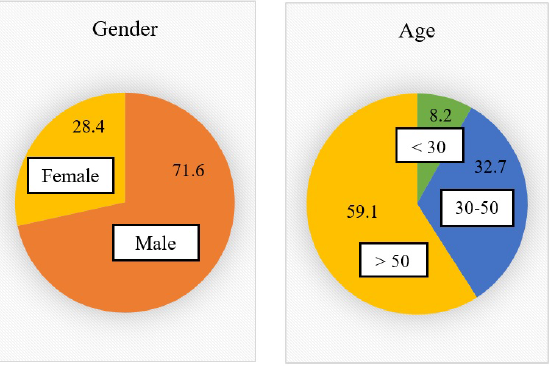
After cleaning the data, the study collected 425 valid answers (25 votes at the Commission for the Management of State Capital at Enterprises and 390 votes at the SOEs) with a return of 96.6 percent. Male respondents constituted 71.6% of the sample. 91.8% of respondents were middle-aged (above 35 years old). The respondents with an education level of a university bachelor (28.3%), Master’s degree (69.6%), and Doctor of Philosophy (2.1%). The characteristics of the survey sample are consistent with the situation at the SOEs in Vietnam. Figure 2 shows the results of sample characteristics.

Sample characteristics (Source: Authors analyze)
RESULTS ANALYSIS AND DISCUSSION
The results of Cronbach’s alpha of the evaluation criteria scale of State management for SOEs showed that the latent variable “Effectiveness” has the highest of 0.833, while the latent variable “Equity” has the lowest Cronbach’s Alpha value of 0.779. Compared with the standard 0.6, all observed items of the scale are internally consistent. The corrected item-total correlation coefficient is higher than 0.3. All scales achieve two reliability and discriminant validity. Hence, the scale is good and meets the reliable requirement for exploratory factor analysis21. The EFA obtained results with the coefficient KMO = 0.803, Bartlett Test is statistically significant with Sig. = 0.000 (< 0.05), and five evaluation criteria were extracted with Eigenvalue = 1.213; Sums of Squared Loadings = 80.31% (higher than 50%). And the above five evaluation criteria can explain about 80.31% of the data variation and 19.69% of the observed variables can not explain the data22. According to survey data, five evaluation criteria in the research model with 34 indicators were extracted to meet the requirement of convergent validity and discriminant validity23 (see Table 1).
The results of assessing the importance and performance of 5 criteria with 34 indicators in Table 1 showed the indicators’ importance has an average value from 3.55 to 4.25. It proves that they are important. For performance level, the average value is from 3.23 to 4.11. The results of Paired Sample T-Test of the evaluation criteria with Sig. = 0.000 lower than 0.05. It confirmed a difference between the assessment of the managers on the importance and the level of performance in State management for SOEs. Most of the differences have a negative sign expressing that the performance level is lower than the degree of importance assessed by the managers.
Survey items, reliability of measures, the importance and performance levels of the evaluation criteria
|
Criteria |
Abbr. |
Items |
Cronbach’s Alpha |
Items loading |
Importance |
Performance |
P-I |
Sig. |
|
Effectiveness |
Effe1 |
The policies and strategies for SOEs belong to the country’s socio-economic development policy. |
0.835 |
0.898 |
4.24 |
3.98 |
-0.26 |
0.000 |
|
Effe2 |
The orientations, legal documents and regulations for SOEs are promulgated quickly, timely and fully. |
0.895 |
4.17 |
3.70 |
-0.47 |
0.000 | ||
|
Effe3 |
The mechanism to deal with administrative procedures in management is favorable and creates conditions for SOEs to develop. |
0.888 |
4.20 |
4.00 |
-0.20 |
0.000 | ||
|
Effe4 |
The degree of well-balanced and close coordination between State agencies in the management of SOEs. |
0.883 |
4.15 |
3.81 |
-0.34 |
0.000 | ||
|
Effe5 |
State management agencies have policies to support and encourage SOEs to promote their strengths and potential to develop the economy. |
0.876 |
4.07 |
4.00 |
-0.07 |
0.000 | ||
|
Effe6 |
The SOEs seriously implement plans and tasks assigned by tate management agencies. |
0.861 |
4.19 |
3.78 |
-0.41 |
0.000 | ||
|
Effe7 |
The management, monitoring, and evaluation process of State management agencies for SOEs are transparent. |
0.858 |
4.10 |
3.61 |
-0.49 |
0.000 | ||
|
Effe8 |
The legal remedy is enough of a deterrent if there is an error in the State management of SOEs. |
0.838 |
4.18 |
3.57 |
-0.61 |
0.000 | ||
|
Efficiency |
Effi1 |
The policies and strategies for SOEs meet the requirements of state management objectives. |
0.821 |
0.896 |
4.22 |
3.89 |
-0.33 |
0.000 |
|
Effi2 |
The SOEs support and motivate other economic sectors to develop. |
0.889 |
4.14 |
4.03 |
-0.11 |
0.000 | ||
|
Effi3 |
The SOEs increase the State budget, create resources in society, and grow the economy. |
0.886 |
4.20 |
3.50 |
-0.70 |
0.000 | ||
|
Effi4 |
The SOEs use all state resources to accomplish their goals. |
0.870 |
4.23 |
3.55 |
-0.68 |
0.000 | ||
|
Effi5 |
The SOEs use the State budget to a minimum but achieve maximum operational efficiency. |
0.863 |
4.25 |
3.23 |
-1.02 |
0.000 | ||
|
Effi6 |
The SOEs help the economy out of the recession phase and maintain stability. |
0.857 |
4.19 |
4.01 |
-0.18 |
0.000 | ||
|
Effi7 |
The SOEs create jobs and income for citizens and ensure social security. |
0.850 |
4.21 |
3.91 |
-0.30 |
0.000 | ||
|
Effi8 |
The SOEs carry out production and business activities and public-utility tasks assigned by the State. |
0.840 |
4.14 |
4.08 |
-0.06 |
0.000 | ||
|
Relevance |
Rel1 |
The policies and strategies for SOEs are relevant to the country’s socio-economic conditions and situations. |
0.837 |
0.894 |
4.12 |
3.78 |
-0.34 |
0.000 |
|
Rel2 |
The objectives set in the state management process are consistent with the actual situation of SOEs. |
0.882 |
4.00 |
4.00 |
0.00 |
0.000 | ||
|
Rel3 |
The plans, regulatory documents, and laws promulgated in the state management process of SOEs are highly feasible. |
0.873 |
4.05 |
4.11 |
0.06 |
0.000 | ||
|
Rel4 |
The business activities of SOEs are consistent with the development of the international integration economy. |
0.855 |
3.99 |
3.87 |
-0.12 |
0.000 | ||
|
Rel5 |
The business activities of SOEs are consistent with the requirements of the objects of the economy. |
0.848 |
3.85 |
3.85 |
0.00 |
0.000 | ||
|
Rel6 |
The business activities of SOEs are consistent with international requirements, practices, and regulations. |
0.831 |
4.01 |
4.01 |
0.00 |
0.000 | ||
|
Rel7 |
The state management process is consistent with the business activities of SOEs. |
0.828 |
4.00 |
3.99 |
-0.01 |
0.000 | ||
|
Sustainability |
Sus1 |
The policies and strategies for SOEs have a long-term vision and meet the requirements of future socio-economic development. |
0.800 |
0.883 |
4.08 |
3.95 |
-0.13 |
0.000 |
|
Sus2 |
The plans, regulations, and laws have the flexibility to adapt to future economic fluctuations. |
0.866 |
4.03 |
4.05 |
0.02 |
0.000 | ||
|
Sus3 |
The business activities of SOEs create a healthy competitive environment among different economic sectors. |
0.852 |
3.90 |
3.90 |
0.00 |
0.000 | ||
|
Sus4 |
The business activities of SOEs focus on developing the country’s economy and aim to serve long-term benefits for the citizens. |
0.848 |
3.96 |
3.88 |
-0.08 |
0.000 | ||
|
Sus5 |
The objectives set in the state management ensure that there is no conflict with the future development orientation of SOEs. |
0.844 |
4.07 |
4.00 |
-0.07 |
0.000 | ||
|
Sus6 |
State management of SOEs ensures stability, consistency, and equality. |
0.837 |
4.04 |
4.01 |
-0.03 |
0.000 | ||
|
Equity |
Equ1 |
The policies and strategies for SOEs ensure the harmony of the common interests of the economy. |
0.817 |
0.877 |
4.10 |
3.90 |
-0.20 |
0.000 |
|
Equ2 |
The resources are scattered proportionate to the development potential of SOEs. |
0.866 |
4.08 |
3.80 |
-0.28 |
0.000 | ||
|
Equ3 |
The SOEs keep a balance between business activities and performing public duties. |
0.853 |
3.98 |
3.98 |
0.00 |
0.000 | ||
|
Equ4 |
The SOEs maintain a balance in business activities, creating conditions for other economic sectors to develop together. |
0.847 |
3.87 |
3.70 |
-0.17 |
0.000 | ||
|
Equ5 |
State management of SOEs creates a balance with other economic sectors. |
0.833 |
3.55 |
3.55 |
0.00 |
0.000 |
The analysis results on the IPA model in Figure 3 showed:
Quadrant I – Concentrate here: There are ten indicators consisting of Effi1, Effi3, Effe4, Effi5, Effe2, Effe4, Effe6, Effe7, Effe8, Rel1. The indicators scattered in this quadrant are rated as important in the State management for SOEs. In which, importance is higher than the median value (4.1), but performance is lower than one (3.9). Based on this result, State management agencies need to increase investment and develop and improve the above indicators.
Quadrant II – Keep up the good work: There are six indicators with Effi2, Effi6, Effi7, Effi8, Effe1, Effe3. These indicators are rated as highly important, and they are conducted with good performance. Consequently, State management agencies need to maintain and promote these strengths.
Quadrant III – Lower priority: There are also six indicators with Rel4, Rel5, Sus4, Equ2, Equ4, Equ5. This indicator has both importance and performance is lower than the median value. It means, State management agencies do not need to invest excessive resources in the development of these indicators.
Quadrant IV – Possible overkill: There are eleven indicators with Effe5, Rel2, Rel3, Rel6, Rel7, Sus2, Sus6, Equ3. These indicators are of low importance, but the performance of State management agencies is good. And so, State management agencies should limit investment in these indicators. However, they are also current stable indicators that need to be maintained.

The IPA model (Source: Authors analyze)
The results of the scatterplot analysis showed that the indicators are scattered in 4 parts I, II, III, IV of the scatter plot simple. Especially, up to 10 indicators scattered in the quadrant I of the IPA model focus on effectiveness and efficiency criteria. It pointed out the inefficiency and ineffectiveness of State management agencies for SOEs. This result has reflected the situation of State agencies.
The highlight of this study that makes it different from study of Ngo2, Tran & Nguyen3 by applying the method of measuring the evaluation criteria of State management for SOEs is done from the perspective of managers through the IPA model, which is more detailed and realistic than the previous research models. On the other hand, this study carried out evaluation criteria of State management for SOEs in a specific type of enterprise. Therefore, compared with the research of Tran & Nguyen3, this study has different scientific and practical significance. The results of the IPA model analysis have given the Government, the leader of State management agencies for SOEs, a more direct view of their management in the past. Thus, this study can create a model for future studies on the evaluation criteria of State management for SOEs.
MANAGERIAL IMPLICATIONS
The results of this study bring some managerial implications for both theoretical and practice. For theoretical implication, by analyzing the evaluation criteria of State management for SOEs, this research contributes to the body of State management criteria literature.
For practice implication, this is the first study exploring the evaluation criteria of State management for SOEs based on the IPA model analysis. Therefore, this study contributes to providing some useful information for the Government and State agencies to improve the State management for SOEs as follows:
To begin with effectiveness criteria, the Government needs to step up propaganda and raise awareness at all levels (from central to localities) to realize the importance of State management for SOEs. Therefore, it can enhance awareness of law enforcement. Moreover, the Government needs to develop a specific decentralized model to implement policies and contents of state management for SOEs.
Next, the Government needs to promote the development of SOEs. At the same time, the State must enhance the effective use of resources to meet the needs of socio-economic development. Additionally, the State needs to improve the direction, supervision, and inspection of the conduct plans for capitalization and divestment of state capital in enterprises.
Finally, the government needs to improve the quality of corporate governance to approach the “good governance model”. Besides, the Government should build a professional and highly qualified SOEs management team, financial transparency, technology development, innovation capacity, and modern management consistent with international standards.
CONCLUSIONS AND LIMITATIONS
The study identifies and analyzes five evaluation criteria of State management for SOEs consisting of effectiveness, efficiency, relevance, sustainability, and equity. The data was obtained by a direct survey of 425 managers. And they were analyzed by Cronbach’s Alpha test, Exploratory Factor Analysis, Paired Samples T-Test, and IPA model. The analysis results show that the indicators in the 5 evaluation criteria are scattered in four parts of the IPA model. In Particular, quadrant I has up to ten indicators that have high important levels, but the level of performance is not high, focusing on efficiency and effectiveness criteria.
The limitation of this study is that SOEs are an economic component of Vietnam, but private enterprises are also an important part of the Vietnamese economy. Therefore, future research can be extended to private enterprises and assess state management criteria, using the model that the authors develop here.
ABBREVIATIONS
DNNN: Doanh nghiệp nhà nước
IGA: Improvement gap analysis
IPA: Importance Performance Analysis
IPA-IGA: Importance Performance Analysis - Improvement gap analysis
OECD: Organization for Economic Cooperation and Development
PRCA: Penalty-reward contrast analysis
PRCA-IPA: Penalty-reward contrast analysis - Importance Performance Analysis
SOEs: State-owned enterprises
CONFLICT OF INTEREST STATEMENT
The authors declares that there is no conflict of interest.
AUTHOR CONTRIBUTIONS
Nguyen Danh Nam: research data collection
Nguyen Danh Nam and Uong Thị Ngoc Lan: analyze and explain
Uong Thi Ngoc Lan: prepare manuscript