

Psychological factors and ethical consumption: The case of Vietnamese youths
- International University, VNU - HCM, Vietnam
- University of Economics and Law, VNU - HCM, Vietnam
Abstract
The problems of global warming and sustainability, which are now causes for concern, will, in some way, have an impact on our lives. As a consequence of an increased focus on ethical consumerism, rapidly developing countries such as Vietnam are seeing a change in consumer behaviors as well as the marketing strategies used by corporations. This means that marketers must learn more about what makes people want to shop ethically. In particular, the goal of this research is to explore the psychological factors that impact the ethical consumption habits of young people. The data was compiled through surveys with 361 Vietnamese young people ranging in age from 12 to 33 years old and taken from various parts of the country. Both the independent and the dependent variables have branched off into distinct obstructs in a manner that is inconsistent with the initial scale. This study showed that there are three different types of ethical consumer behavior in Vietnam: ETHICBUY, ECOBOYCOTT, and CSRBOYCOTT. According to the results, alienation, altruism, and perceived employee welfare effectiveness all have an effect on the likelihood of engaging in ethical buying (ETHICBUY). However, alienation and perceived ecological consumer effectiveness have been shown to have an effect on the 3-item ECOBOYCOTT. Last but not least, predictors of CSRBOYCOTT include alienation, environmental concern, and the perceived effectiveness of employee welfare programs. In other words, alienation is perhaps the prospective component that has the most influence on unethical spending based on the findings of this research. These findings could be helpful for marketers that want to increase their capacity to target customers who adhere to ethical norms when they promote their products or services.
Introduction
As International Monetary Fund (IMF) estimated, emerging countries, which have rapid economic growth and industrialization, are becoming bigger players on the world market. These countries make up for 59% of the world's population and 40% of the world's economic outcomes. Specifically, Vietnam has seen a remarkable development over the last 30 years, poverty rates dropped significantly from 70% to 6% and GDP/capita has grown 2.7 times between 2002 and 2018. Moreover, the country was also ranked the second in ASEAN (behind Singapore) on the human capital index (HCI) 1. In consumerism, individuals are demanding and consuming more in all sectors. As the famous newspaper Businesstimes 2 has stated, consumption is the main economic engine for Vietnam, which contributes up to 68% to 70% of the national GDP. Based on the statistics from Nielsen3, Vietnam is one of the most socially conscious countries when it comes to purchasing. More than eight out of ten (82%) Asian consumers want firms to communicate their views on social and environmental issues on their packaging. Seventy-three percent of Vietnamese customers are ready to pay beyond the marginal cost of a product or service for goods and services provided by companies that take social and environmental problems into account.
On the other hand, Market research has increasingly focused on the features of responsible consumption so that businesses may better target ethical consumers and increase revenues4, 5. Although there has been several researchers who studied intuitive attitudes and behaviors6, 7, there is a lack of understanding of the psychological elements that influence intuition-based purchasing8, 9. There are several researches that indicate current consumers employ both unconscious and conscious criteria to lead green behaviors and ethical acts (e.g. 6, 10, 11). New research suggests that consumers' ethics are shaped by their moral ideas and identities.
Ethically minded consumption can help decrease environmental impacts, material scarcity and help support other social issues. Since the turn of the twenty-first century, scholars and practitioners alike have been more interested in sustainable consumerism due to an increase in eco-consciousness and ethical consumption12. Enterprises are being demanded to act socially ethically13, 14. Subsequently, consumers have supportive attitudes towards socially responsible firms 15. Increasingly, consumers are looking for firms and brands that demonstrate social responsibility in addition to their usual purchase criteria. 16
Despite of that fact, most previous research on responsible consumption tended to concentrate on Western or industrialized nations, therefore, a research should be undertaken in Vietnam. About 80% of prior research on the subject have focused on American consumers alone 17, 18. However, cultural variations influence the ideals and ethics of consumption 19. Essentially, the goal of this research is to examine how psychological variables affect Vietnamese young people to consume ethically, both in terms of environmental and social elements.
Literature review
The concept of Ethical Minded Consumption (EMC) has also been seen as “Socially responsible consumption (SRC)” 20 – with both SRC and EMC concepts incorporating the similar sense of pro-social behavior. As described Webster21, an ethical consumer is one “who takes into account the public consequences of his or her private consumption or who attempts to use his or her purchasing power to bring about social change.” As a matter of fact, according to Roberts 22, a socially responsible consumer is one “who purchases products and services perceived to have a positive (or less negative) influence on the environment or who patronizes businesses that attempt to effect related positive social change.” This assumes two aspects to this definition: issues about the environment and other parts of society. As Mohr et. al23 pointed out, socially responsible behavior is “a person basing his or her acquisition, usage and disposition of products on a desire to minimize or eliminate any harmful effects and maximize the long-run beneficial impact on society.” EMC has been seen as an essential marketing factor to the enterprises worldwide since responsible consumer behavior, which takes ecological and human welfare issues into account, is increasing significantly24. EMC shall define the consumers’ attitudes and behaviors to companies’ social responsibilities (CSR). Consumers can avoid buying, boycott or even anti-consume products in the longer term from companies that hurt society 22, 25.
Due to the current upheaval in global capitalism and the globalization of consumer cultures, several scholars' conceptions of ethical consumers are developing26. Consumers are becoming more conscious about their purchases because of the development in worldwide sophisticated and visible firm operations (e.g., manufacturing, employment) that are more visible to the public27, 28.
Similarly, statements have been trying to apprehend common ethical consumption issues. For example, Devinney’s CSR means focusing on moral motives. It refers to “the conscious and deliberate choice to make certain consumption choices based on personal and moral beliefs” 29. Caruana & Chatzidakis30 recently altered Devinney's CSR to emphasize that concrete action like buying "ethical" items may be considered more than a moral response.
Attitude-Behavioral gap
Attitude-behavioral gap (so-called value-action gap) is the gap in which consumers have the actual actions differently from what they say or commit. In ethical consumption, lots of consumers were found to say that they care about the ethical issues. However, they could not follow their concerns through actual consumption31, 32, 6, 9. This gap is popular across the countries33, yet Vietnam might not be an exception. Past ethical consumption’s scale mainly focused on future intentions, as well as attitudes in consumption34. According to Ajzen35 and Kraus36, attitudes towards environment alone are often a poor predictor of green marketplace behavior. Therefore, there should be a relevant measurement for actual behaviors of consumers.
Scale to measure EMCB
According to the scale developed by Francois-Lecompte & Roberts13 in France, the ultimate scale was a five-factor EMC scale: “corporate responsibility, country of origin preferences, shopping at local or small businesses, purchasing cause-related products and reducing one’s consumption”. However, some of these dimensions’ title are attributed to companies themselves, which are more likely to be criteria generating ethical consumption. Besides, items’ content of dimensions is somehow intertwined. For an illustration, an item “I try not to buy products from companies that employ children” in the dimension called “corporate responsibility” also regards to the dimension called “reducing one’s consumption” in the scale. Consequently, the scale is quite confusing. Besides, Webb et al. 37 constructed a scale including three dimensions of EMC: “purchasing based on firms’ corporate social responsibility (CSR) performance; recycling; avoidance and use reduction of products based on their environmental impact”.
This study will apply Ethically Minded Consumer Behavior (EMCB) scale developed recently by Sudbury-Riley & Kohlbacher38 to measure actual behaviors of EMC. This measurement is a more complete version of Webb’s one, which comprises 5 distinct dimensions:
-
ECOBUY: “the deliberate selection of environmentally friendly products over their less friendly alternatives”,
-
RECYCLE: “specific recycling issues”,
-
ECOBOYCOTT: “Refusal to purchase a product based on environmental issues”,
-
CSRBOYCOTT: “Refusal to purchase a product based on social issues”,
-
PAYMORE: “A willingness to pay more for an ethical product”
The new EMCB scale is more current, valid, trustworthy, intelligible, and practicable to administer than the previous ones. On the scale, the ethical consuming practices are taken into account from a broad range of perspectives, including environmental and social considerations. It is less relevant to implement in other nations if you consider the scale in a wider area. However, just a few research have made use of this scale. To address the purpose of this research, which covers not only environmental but other social concerns of consumers, this EMCB scale is the most appropriate.
Young people in responsible consumerism:
Based on the previous studies about ecology and green (e.g.,39, 40, 41, 42), the authors mostly believed that younger people are likely to be more conscious about ecological issues. In 2019, numerous volunteer campaigns were held and participated by the youths. Also, in Vietnam, lots of non-profit projects, such as Keep Vietnam Clean & Green, VNU Will Run, etc., established partnerships with schools and universities. Besides, according to Vietnam’s Youth Law (which is appended to its 2011 Youth Development Strategy), the youths are those from 16-30 years old. As Figure 143 shows, young people are relatively in one of the most extensive ranges of age.
Therefore, the present study will investigate the ethical consumption of the youths. In generational cohorts, young people could be seen as Gen Z (born between 1996 and 2010). Gen Z was widely regarded to be the next consumer powerhouse, necessitating a focus on research. By 2020, the oldest members of Generation Z will have entered the workforce, with their incomes rising and their financial independence from their parents increasing. Gen Z customers are more inclined to base their purchasing decisions on ethical concerns than their elder generations X and Y, according to a McKinsey & Co. research in Brazil44. Based on vietnam-briefing.com, up to roughly 65% of Gen Z care about social issues such as gender equality, animal’s protection & animal’s rights, recycling & environment protection, etc. It was reported that Gen Z has strong desire to be part of social issues’ solutions. Moreover, they are willing to support any business that benefits the society.
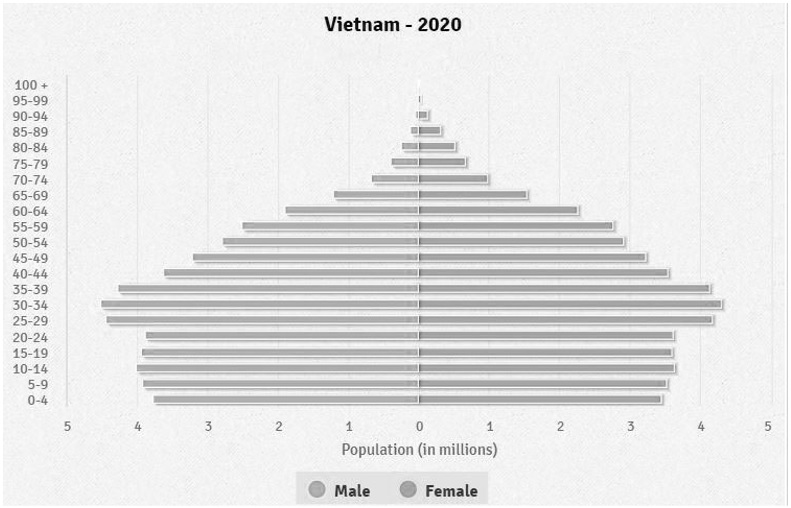
Age structure of the population in Viet Nam, 2020 (Source:
Psychological factors
This study primarily stems from the study of Straughan & Roberts 45, in which psychological factors were examined in a segmentation analysis of green consumption. However, one of those psychological factors, liberalism, will be excluded in this study since Vietnam is a one-political party country, and that would not be relevant in this context. In addition, the factor “Alienation” will be also considered in this study. Those are the following factors:
Alienation means the feeling of being separated from the community, society or culture. Anderson Jr & Cunningham40 found the ethical consumers to be less alienated and more likely to participate in societal activities, whereas Webster, Jr. 21 found a stronger positive relationship between alienation and social consciousness. Anderson et al. 41 suggested the ecologically concerned consumer are more alienated, while Crosby et al. 46 concluded the opposite to be true. The conflicting results in those studies can be caused by using different scales of measurement.
Altruism was defined to be the acting for other individuals’ welfare without expecting to have rewards 47, considered to be the variable leading to natural safeguarding48. Schwartz 47 suggests that pro-environmental mental behavior turns out to be more potential when an individual is aware of negative impacts on other people from a condition of the environment and when that person credits duty regarding changing the offending ecological condition. The past study (i.e., Stern et al. 49) examined the role of that social altruism (concern for well-beings of others) and ecosystem altruism (a concern for the nature) play in influence of green behavior. It was found that both two dimensions positively influence consumers’ green behavior.
In Perceived Consumer Effectiveness (PCE), people believe they have the power to influence how particular issues are resolved 50, 51, which was proven to be the most potent predictor of ECCB, exceeding other demographic and psychographic factors investigated 52. Consumers are more likely to buy ethical items because they believe that their creation, use, and disposal have a positive influence on other people, animals, and the environment 25, 53, 54. The ethical buying movement may be fueled by the individual actions of everyday consumers55. Proposals for the role of PCE in consumer attitudes and reactions to environmental features have been made by a number of researchers 21, 56, 57, 58. The past research indicated those who are aware of the nature and society have greater PCE [17] [45]. Recent research have recognized PCE's critical role in helping people make ethical purchasing choices59, 60. Consumers that have a higher PCE level tend to be more environmentally and socially sensitive than others.
There is a prevalent perception that environmental concern grows from indifference at the lower end of the spectrum to a deep sense of anxiety and worry at its highest point61. In other word, environmental concerns increase the relevance of natural issues, fostering a respect for nature and a desire to act on environmental challenges 62, 63, 64. Individual environmental concerns and support for environmental conservation impact product attribute selection 65. As a result of this, consumers' impressions of the product and their decision-making process are affected66. Concern about the environment may have a significant influence on people's behavior67. In several studies, environmental concern has been found to be a major factor resulting in to organic food consumption (e.g. Grunert 68). Granzin & Olsen69 argued that the greater concern for environmental issues has led people to an intention to participate in environmental activities regardless of all demographic variables. Similarly, The study of Joshi & Rahman 70 concluded that “consumer environmental concerns and product functional characteristics” are key factors of customer’s ethical consumerism.
Hypothesis development
This study adopted quantitative approach, using IBM SPSS 22.0 and AMOS 22.0 software in analyzing. The study's goal is to evaluate ethical consumption from a broad, systemic viewpoint.
In this study, the hypotheses were developed based on the theories and past results in the literature review, the following hypotheses were proposed:
H1: Alienation significantly and positively influences ECOBUY (a), RECYCLE (b), ECOBOYCOTT(c), CSRBOYCOTT (d), PAYMORE (e).
H2: Altruism significantly and positively influences ECOBUY (a), RECYCLE (b), ECOBOYCOTT(c), CSRBOYCOTT (d), PAYMORE (e).
H3: PCE significantly and positively influences ECOBUY (a), RECYCLE (b), ECOBOYCOTT(c), CSRBOYCOTT (d), PAYMORE (e).
H4: Environmental Concern significantly and positively influences ECOBUY (a), RECYCLE (b), ECOBOYCOTT(c), CSRBOYCOTT (d), PAYMORE (e).
Methodology
Measurement tools
The questionnaires sent to people included six separate sections: personal basic information, Ethically Minded Consumer Behaviors, Alienation, Altruism, PCE and Environmental Concern. The Ethical Minded Consumer Behavior (EMCB) of Sudbury-Riley & Kohlbacher 38 will be used to determine the dependent variable. In terms of independent variables, Alienation was adopted from Demes & Geeraert 71, originally aimed to measure psychological adjustment. Altruism’s measurement scale was based on Stern et al. 49. The items in Perceived Consumer Effectiveness was based on Roberts 52 and revised by Antonetti & Maklan72. Lastly, Environmental Concern’s items adapted from Dunlap et al. 73. All independent items were in a Likert-format, anchored by “Strongly disagree” (1) and “Strongly agree” (5). There were categorical questions on Gender, Education Level, and Income Level used to obtain basic personal information.
Participants
The study's focus is on young people's ethical consumption, hence the sample is heavily weighted toward that age range (from 19 to 33 years old). Respondents were chosen at random using a convenient sampling procedure that ensured their identity was protected. There were a total of 442 participants that participated in data gathering in return for $1 voucher presents. After data collection and cleaning, 361 valid and full questionnaires were returned, resulting in an overall response rate of 81.7%. There were 238 women and 123 men that took part in the survey, for a total of 65.9% female and 34.1% male. The data was shown in Table 1.
Samle profile
|
Variable |
Frequency |
Valid percent |
|
Gender | ||
|
Male |
123 |
34.1% |
|
Female |
238 |
65.9% |
|
Age | ||
|
12-18 years old (teenagers) |
60 |
16.6% |
|
19-33 years old (young adults) |
301 |
83.4% |
|
Education level | ||
|
High schools/lower |
56 |
15.5% |
|
Undergraduate degrees |
290 |
80.3% |
|
Postgraduation degrees |
15 |
4.2% |
|
Income level | ||
|
Have not gone to work/ do not go to work |
143 |
39.6% |
|
Below 5 million VND |
76 |
21.2% |
|
5 to 10 million |
72 |
19.9% |
|
Above 10 to 20 million VND |
49 |
13.6% |
|
Above 20 million VND |
21 |
5.8% |
|
Place of residence | ||
|
The South |
326 |
90.3% |
|
The Central |
6 |
1.7% |
|
The North |
19 |
5.3% |
|
Foreign countries |
10 |
2.8% |
|
Type of products often purchased | ||
|
Convenience products |
297 |
82% |
|
Shopping products |
108 |
30% |
|
Specialty products |
33 |
9.14% |
|
Unsought products |
23 |
6.37% |
Statistical procedure
This study used SPSS IBM 22.0 first in order to adopt reliability test for checking the intercorrelation of items in a construct, making sure that all the items in one construct demonstrate not too different meanings, and Exploratory Factor Analysis (EFA) for exploring the underlying dimensions of the scale. This was followed by Structural Equation Modeling (SEM) using Amos IBM 22.0 to confirm and evaluate in the study framework the impacts of psychological factors on ethically consumer minded behaviors and the significance of those effects. Thought the reliability test, two items in the construct Alienation were eliminated to achieve lowest limit of Cronbach Alpha, which is 7.0 74. After all, all the constructs reached the Cronbach’s Alpha over 7.0 and had the statistically acceptable reliability.
Results
Exploratory Factor Analysis
Dependent variable
There were several items of EMCB in Vietnam that were examined using the EFA. Factor analysis was performed using the Extraction technique of Principle Axis Factoring and the Rotation method of Promax with Kaiser Normalization on the 10 EMCB components. The EFA for 10 EMCB items is enough. As of this writing, the KMO measure is 0.794 and the significance level is lower than 0.05. Table 2 shows the loadings in each dimension, in which specific variables belonged to.
Pattern Matrix
|
Factor | |||
|
1 |
2 |
3 | |
|
EMCB1 |
.720 | ||
|
EMCB2 |
.750 | ||
|
EMCB3 |
.883 | ||
|
EMCB4 |
.680 | ||
|
EMCB5 |
.697 | ||
|
EMCB6 |
.629 | ||
|
EMCB7 |
.836 | ||
|
EMCB8 |
.800 | ||
|
EMCB9 |
.821 | ||
|
EMCB10 |
.682 | ||
|
Extraction Method: Principal Axis Factoring. Rotation Method: Promax with Kaiser Normalization. | |||
|
a. Rotation converged in 5 iterations. | |||
In contrast to the theory38, this study's EFA revealed just three constructs, as opposed to the five in the theory. Specifically, EMCB1, EMCB2, EMCB5, EMCB6, EMCB9, EMCB10 belonged to one (from 3 initial factors called “ECOBUY”, “RECYCLE” and “PAYMORE”), the last two constructs (“ECOBOYCOTT” and “CSRBOYCOTT”) have stayed unchanged with the pairs of EMCB3, EMCB4 and EMCB7, EMCB8 respectively. Because of this, an update to the EMCB scale is required. As a result, the name ETHICBUY, derived from the items' content, has been given to the newly extracted construct. In one word, this study eventually includes 3 dependent latent variables instead of 5 as mentioned in proposed hypothesis. The 3 new dependent variables was shown in Table 3.
Revised dependent variables
|
Items |
Dimensions | |
|
EMCB1 |
“When there is a choice, I always choose the product that contributes to the least amount of environmental damage.” |
ETHICBUY |
|
EMCB2 |
“I have switched products for environmental reasons.” | |
|
EMCB5 |
“Whenever possible, I buy products packaged in reusable or recyclable containers.” | |
|
EMCB6 |
“I make every effort to buy paper products (toilet paper, tissues, etc.) made from recycled paper.” | |
|
EMCB9 |
“I have paid more for environmentally friendly products when there is a cheaper alternative.” | |
|
EMCB10 |
“I have paid more for socially responsible products when there is a cheaper alternative.” | |
|
EMCB3 |
“If I understand the potential damage to the environment that some products can cause, I do not purchase those products.” |
ECOBOYCOTT |
|
EMCB4 |
“I do not buy household products that harm the environment.” | |
|
EMCB7 |
“I will not buy a product if I know that the company that sells it is socially irresponsible.” |
CSRBOYCOTT |
|
EMCB8 |
“I do not buy products from companies that I know use sweatshop labor, child labor, or other poor working conditions.” | |
Independent variables
Similarly, the independent variables were also tested with EFA, aiming to identify the underlying structure of independent variables. The KMO is 0.789, indicating that the data is suited for Factor Analysis. Besides, significance level is below 0.05 (=0.000), showing that this test is useful.
A cumulative 66% of the variability is explained by 5 dimensions including certain survey items as above. There was an item in Perceived Consumer Effectiveness excluded due to its low factor loadings. Besides, the allocation of items in dimensions have changed compared to the original scale in the literature. To be more specific, Perceive Consumer Effectiveness is categorized into 2 components. Therefore, a revise of new dimensions is necessary. The titles of new dimensions were based on the common meaning shared by items in those dimensions.
After EFA test, the hypothesis and research model should be revised for further analyses in Table 4.
Revised independent variables
|
PCE2. “My personal actions are too insignificant to affect environmental problems.” ® |
Perceived Ecological Consumer Effectiveness (revised) |
|
PCE3. “Environmental issues are affected by my individual choices.” | |
|
PCE4. “Ecological degradation is partly a consequence of my own consumption choices.” | |
|
PCE5. “My individual consumption choices can contribute to the promotion of fairer working conditions.” |
Perceived Employee Welfare Consumer Effectiveness (revised) |
|
PCE6. “My personal actions can influence companies’ decision to pay all their employees a fair wage.” | |
|
PCE7. “Unfair working conditions are partly a consequence of my own consumption choices.” |
After EFA test, the hypothesis and research model should be revised for further analyses:
H1: Alienation significantly and positively influences ETHICBUY (a), ECOBOYCOTT(b), CSRBOYCOTT (c)
H2: Altruism significantly and positively influences ETHICBUY (a), ECOBOYCOTT(b), CSRBOYCOTT (c)
H3: Perceived Ecological Consumer Effectiveness significantly and positively influences ETHICBUY (a), ECOBOYCOTT(b), CSRBOYCOTT (c)
H4: Perceived Employee Welfare Consumer Effectiveness significantly and positively influences ETHICBUY (a), ECOBOYCOTT(b), CSRBOYCOTT (c)
H5: Environmental Concern significantly and positively influences ETHICBUY (a), ECOBOYCOTT(b), CSRBOYCOTT (c)
Confirmatory Factor Analysis of Measurement Model and Model Fit Analysis
The reliability and validity of the measurement model were evaluated using CFA. A construct's validity is measured by the extent to which it is capable of explaining the data it contains. Those items that have the factor loadings below than 0.5 were dropped before CFA in order to achieve unidimensionality state (i.e., AL1, AL4, PCE8). The Average Variances Extracted (AVE) of all constructs were higher than 0.5 and were acceptable 74. In addition, the latent variables' Composite Reliability (CR) was used to assess the dimensions' consistency. The greater the CR, the more stable a construct's elements were with respect to one another. In this study, the CRs of all latent variables were higher than the threshold of 0.60 suggested by Fornell & Lacrcker75. The criteria to evaluate the model fit in this study is based on Hu & Bentler (1999). The goodness of fit index comparative fit index (CFI=0.920) was above 0.95 and was considered satisfactory. Besides, the CMIN/DF (=2.016) was in between 1 and 3, SRMR (=0.053) was lower than 0.08, RMSEA (=0.053) was lower than 0.06 and PClose (=0.179) was higher than 0.05, all of which met the requirements and were excellent76.
Validation of Causal Relationships: Structural Equation Modelling (SEM), run by AMOS 22.0, was adopted to test the direct relationships between independent and dependent constructs in the proposed model. The results of model testing was shown in Table 5.
Results of model testing
|
Results of model testing |
Estimate |
S.E. |
C.R. |
P |
Label | ||
|
ECOBOYCOTT |
<--- |
EMPLOYEE WELFARE PCE |
.277 |
.110 |
2.513 |
.012 |
par_32 |
|
CSRBOYCOTT |
<--- |
ALTRUISM |
.342 |
.109 |
3.135 |
.002 |
par_33 |
|
ECOBOYCOTT |
<--- |
ALIENATION |
.210 |
.086 |
2.438 |
.015 |
par_34 |
|
ECOBOYCOTT |
<--- |
ECO PCE |
.025 |
.139 |
.181 |
.856 |
par_35 |
|
ECOBOYCOTT |
<--- |
ENVIRONMENTALCONCERN |
.017 |
.087 |
.198 |
.843 |
par_36 |
|
CSRBOYCOTT |
<--- |
EMPLOYEE WELFARE PCE |
.287 |
.111 |
2.591 |
.010 |
par_37 |
|
CSRBOYCOTT |
<--- |
ALIENATION |
.303 |
.092 |
3.288 |
.001 |
par_38 |
|
CSRBOYCOTT |
<--- |
ECO PCE |
-.170 |
.153 |
-1.115 |
.265 |
par_39 |
|
CSRBOYCOTT |
<--- |
ENVIRONMENTALCONCERN |
.226 |
.102 |
2.213 |
.027 |
par_40 |
|
ETHICBUY |
<--- |
EMPLOYEE WELFARE PCE |
.080 |
4.013 |
*** |
par_41 | |
|
ETHICBUY |
<--- |
ALTRUISM |
.387 |
.080 |
4.816 |
*** |
par_42 |
|
ETHICBUY |
<--- |
ALIENATION |
.297 |
.068 |
4.339 |
*** |
par_43 |
|
ETHICBUY |
<--- |
ECO PCE |
-.102 |
.109 |
-.935 |
.350 |
par_44 |
|
ETHICBUY |
<--- |
ENVIRONMENTALCONCERN |
.013 |
.066 |
.191 |
.849 |
par_45 |
|
ECOBOYCOTT |
<--- |
ALTRUISM |
.189 |
.107 |
1.771 |
.077 |
par_46 |
Dependent variable 1: ETHICBUY
The results of relationship testing between independent constructs and ETHICBUY was illustrated in the Table 3. In total 5 relationships proposed with ETHICBUY, there were 3 of them which were supported by the CFA. Specifically, Perceived Employee Welfare Consumer Effectiveness, Altruism, and Alienation were proved to have significant and positive influence on ETHICBUY with standardized regression weights of 0.317, 0.331 and 0.275 respectively (with p-value below 0.001)
Dependent variable 2: ECOBOYCOTT
The Table 3 shows the results of relationships of psychological variables with ECOBOYCOTT. Only 2 out of 5 relationships were supported by CFA. Alienation and Perceived Employee Welfare Consumer Effectiveness were shown to have positive influences on ECOBOYCOTT with standardized regression weights of 0.161 and 0.225 respectively (with p-value below 0.05).
Dependent variable 3: CSRBOYCOTT
Unexpectedly, up to 4 out of 5 hypotheses proposed in the model were supported by CFA. In details, Environmental Concern, Altruism and Perceived Employee Welfare Effectiveness with the p-value < 0.05 were found to have positive impacts on CSRBOYCOTT, corresponding with the standardized regression weights of 0.15; 0.223; and 0.215 respectively. On the other hand, Alienation was indicated to have a significant and positive influence on CSRBOYCOTT with the p-value < 0.001 and standardized regression weight was 0.214.
Discussions
The data was gathered quickly and easily from responders who were able to provide it over the Internet. The total sample size was 361 persons, ranging in age from 12 to 33. Eighty-two percent of them said they bought convenience items on a regular basis, while thirty percent said they shopped for them. The rest of them, 9.14% and 6.3% of the sample, were consumers of specialty products and unsought products, respectively.
All the variables in this study were tested through Cronbach’s Alpha and Exploratory Factor Analysis. There were totally 3 items excluded after those tests so that the reliability and validity could be acceptable. There were new independent variables extracted from initial ones in EFA. Specifically, the initial Perceived Consumer Effectiveness now comprises Perceived Ecological Effectiveness and Perceived Employee Welfare Effectiveness. Regarding dependent variable, initial EMCB, which incorporated 5 dimensions, was suggested by the EFA in this study that it included 3 dimensions (i.e. ETHICBUY, CSRBOYCOTT and ECOBOYCOTT). A summary of hypotheses results is presented in Table 6.
Summary of Hypotheses Results
|
Hypotheses |
Results |
|
H1: Alienation significantly and positively influences ETHICBUY (a), ECOBOYCOTT(b), CSRBOYCOTT (c) |
H1a. H1b and H1c were supported |
|
H2: Altruism significantly and positively influences ETHICBUY (a), ECOBOYCOTT(b), CSRBOYCOTT (c) |
H2a. H2c were supported H2b was not supported |
|
H3: Perceived Ecological Consumer Effectiveness significantly and positively influences ETHICBUY (a), ECOBOYCOTT(b), CSRBOYCOTT (c) |
H3a. H3b, H3c were not supported |
|
H4: Perceived Employee Welfare Consumer Effectiveness significantly and positively influences ETHICBUY (a), ECOBOYCOTT(b), CSRBOYCOTT (c) |
H4a. H4b, H4c were supported |
|
H5: Environmental Concern significantly and positively influences ETHICBUY (a), ECOBOYCOTT(b), CSRBOYCOTT (c) |
H5a, H5b were not supported H3c was supported |
According to the results from Structure Equation Modelling, relationships of certain psychological factors and dimensions in EMCB were revealed. First, ETHICBUY – the dimension that owns the highest number of items in EMCB, were supported in this study to be influenced positively and significantly by Alienation, Altruism and the new extracted factor, Perceived Employee Effectiveness. The significance level was demonstrated by p-value, which is below 0.001. Altruism, concerning others’ well-beings, plays a significantly important role in predicting young people consume ethically, for the sake of both society77, 78 and ecology79. On the other hand, this study supports the hypothesis that alienated people, who prefer to isolate themselves, have more chance to purchase ethically. The finding was opposed to that of Webster21. On the other hand, the perceived effectiveness of people about influencing on employee’s welfare was found to have significant and positive impact on ethical purchase of young people72. Roberts80 also pointed out that PCE is a strong predictor, even stronger than Environmental Concern when it comes to predicting environmentally consumption behaviors.
Only two out of five hypotheses were supported to have influence on ECOBOYCOTT. It is understandable since this dimension has only 2 items in it. Once again, Alienation and Perceived Employee Welfare Effectiveness were indicated to be factors of one dimension of EMCB. First, the more alienated the consumers are, the more likely they punish any enterprises that do not have environmentally friendly behaviors. Besides, the degree people can perceive how they could influence employees’ welfare can also predict the willingness they punish a company due to ecological reasons. This might be confusing since the hypothesis of Perceived Ecological Effectiveness were not supported to have any impact on ECOBOYCOTT. It might result from relatively low concern towards environment of young Vietnamese people, since both items of ECOBOYCOTT in the scale had the lowest means among items in EMCB. Besides, behavior-action gap between attitudes towards the environment and green behavior are relatively considerable, those attitudes are often poor predictor35, 36. In the context of Vietnam – the country is being studied, which is still a developing country, citizens are still influenced by products’ price and quality to make purchase decisions and consumption. For the most part, the most significant elements to consider are price, quality, convenience, and brand awareness 55. However, despite previous predictions that environmental attitudes would have a positive impact on ethical decision-making and purchasing behavior (e.g., Yoon et al 8; Yeonshin Kim et al32; Husted 81), studies on the ethics of consumer behavior have discovered a gap between attitudes and actions. Many experts have tried to understand why customers may have good views about ethical buying yet fail to follow through with their purchase choices6, 8, 31, 32.
Last, CSRBOYCOTT had got up to 4 factors to be supported to have an impact. First, consumers’ worries about the environment also affect the willingness to punish any unethical companies54. Besides, Perceived Employee Welfare Effectiveness was one of the predictors CSRBOYCOTT, according to the results in this study. This is quite reasonable since both constructs have the common topic of working conditions, working benefits, etc. On the other hand, altruism is another construct that has a role in affecting positively CSRBOYCOTT. Altruistic value orientations are more likely to lead consumers to oppose CSR initiatives when their psychological contract has been broken. They could punish the enterprises and improve their self-esteem82. The study of Deng & Long 82 has only indicated the moderative role of altruistic value while the current one has enhanced the role and validated the predictive power of Altruism to CSRBOYCOTT. However, those relationships had significance p-value of lower than 0.05 and higher than 0.001. Last, Alienation is the only factor that significantly has a positive impact on CSRBOYCOTT, with the p-value below 0.001. Alienated people, once again, were found to be more motivated significantly to boycott due to enterprises’ CSR performance. Webster, Jr. 21 also indicated that there was a strong positive correlation between alienation and individuals’ social consciousness. Besides, two items of ECOBOYCOTT have the lowest means among ten items in EMCB scale, indicating low concerns towards the environment. The study of Tantawi 83 undertaken in Egypt – also the developing country, concluded people do not prioritize environmental issues while still being pressured by economic conditions.
Conclusion
This study was carried out primarily with the purpose of answering the questions “What is the relationship between that psychological factors and ethically minded consumption?”. This might become one of the beginners of studies regarding responsible consumption in developing countries, especially Vietnam, whereas most of the previous studies with the similar concerns were undertaken in either developed countries or Western countries.
This study pointed out that there are three different patterns of ethical consumption behaviors in Vietnam instead of five patterns as the original scale development of Sudbury-Riley & Kohlbacher 38 has shown, which are ETHICBUY, ECOBOYCOTT and CSRBOYCOTT. Moreover, this study enhanced the actual consumption behaviors, instead of intentions or opinions, by examining underlying psychological factors of consumers. Considerably, Vietnamese people were found to be more conscious and concerned about human beings’ welfare rather than environmental issues. In one word, Environmental Concern does not seem to be a strong predictor of responsible consumption behaviors in developing countries like Vietnam 84.
Managerial implications
In the near future, an increasing number of firms will transition toward a "societal marketing concept," in which the organizations will strive to service the needs of their target consumers more effectively and efficiently than their rivals, while also enhancing the quality of social life. Using the findings of this research, green or sustainability marketers may make informed decisions. Aiming to encourage consumers to purchase more ethically, marketers could implement certain strategies to make them perceive that their purchase decisions help improve employee welfare in the corporate. Instead of presuming that the whole Vietnamese population is capable of ethical consumption, it would be more effective if marketing techniques were targeted towards ethical young Vietnamese customers. Understanding target client traits is critical to marketing strategy, particularly product creation and communication. Those target consumers could be alienated, altruistic and could perceive that their purchase behaviors have influences on employee welfare of enterprises, according to the findings of this study. Besides, there could be some several studies conducted to learn more about target customers, in order to identify if they have certain psychological characteristics that could make themselves easily boycott.
On the other hand, significant attitude-behavior gap found in this study suggests the need of increasing environmental concerns from companies is less important. For an illustration, according to Yoon et al.9, green attitudes are a weak or non-related predictor of green consumers’ behaviors, indicating that ecologically responsible advertisements may grow green acceptance but not significantly create ultimate green purchases.
Limitations and Further Research Direction
Since this topic is relatively new in Vietnam, the wording in questionnaires are still confusing and respondents had to confirm the meanings with the author several times. Moreover, there were some young people only aged 12, 13 years old involved in this study who were quite young to perceive completely the ethical consumption behavior. For the reason some new constructs have been extracted in this study, there should be further studies examining about those factors for enhancing the theory. Besides, future related studies should include the role of governments as well as organizations in motivating people to go green, as citizens might need help from those 83. Furthermore, researchers can include interviews or focus groups so that explanations of relationships among variables could be answered empirically.
Abbreviation
ETHICBUY or ECOBUY the deliberate selection of environmentally friendly products over their less friendly alternatives
RECYCLE specific recycling issues
ECOBOYCOTT Refusal to purchase a product based on environmental issues
CSRBOYCOTT Refusal to purchase a product based on social issues
PAYMORE A willingness to pay more for an ethical product
EMCB Ethical Minded Consumer Behavior
Conflict of Interest Statement
The author declares that there is no conflict of interest.
Author Contributions
Author Le Dinh Minh Tri is responsible for the contents: Abstract, Introduction, Literature Review, Methodology, Discussion
Author Nguyen Thi Minh Thu is responsible for the contents: Literature Review, Methodology, Results
Author Hoang Thi Que Huong is responsible for the contents: Results, Discussion, Conclusion, Managerial Implications
Author Ha Minh Tri is responsible for the contents: Introduction, Discussion, Conclusion, Limitations and Further Research Direction